

7 Best Used Minivans for Families (Honest Picks)

Try loading two kids, a folded stroller, a week of groceries, and a muddy soccer bag into a compact crossover. You’ll understand within about 90 seconds why the best used minivans for families keep beating SUVs in the real-world practicality fight. Minivans aren’t cool. Nobody brags about one at a dinner party. But they move people and stuff better than almost anything else with four wheels, and a clean used example can be one of the smartest money decisions a growing family makes.
The catch is simple. A great minivan in the wrong model year can quietly turn into a repair fund. So this isn’t about which van was nicest when it rolled off the lot in 2016. It’s about which one still makes sense at 90,000 miles, with a kid kicking the back of the front seat and a checkbook you’d like to keep closed.
Contents
- What makes the best used minivans for families worth buying
- The strongest used minivan picks
- Quick comparison of the best used minivans for families
- What years should you target?
- What to check before buying any used family minivan
- Minivan or three-row SUV for a family?
- The smartest way to shop the best used minivans for families
- Frequently asked questions
What makes the best used minivans for families worth buying
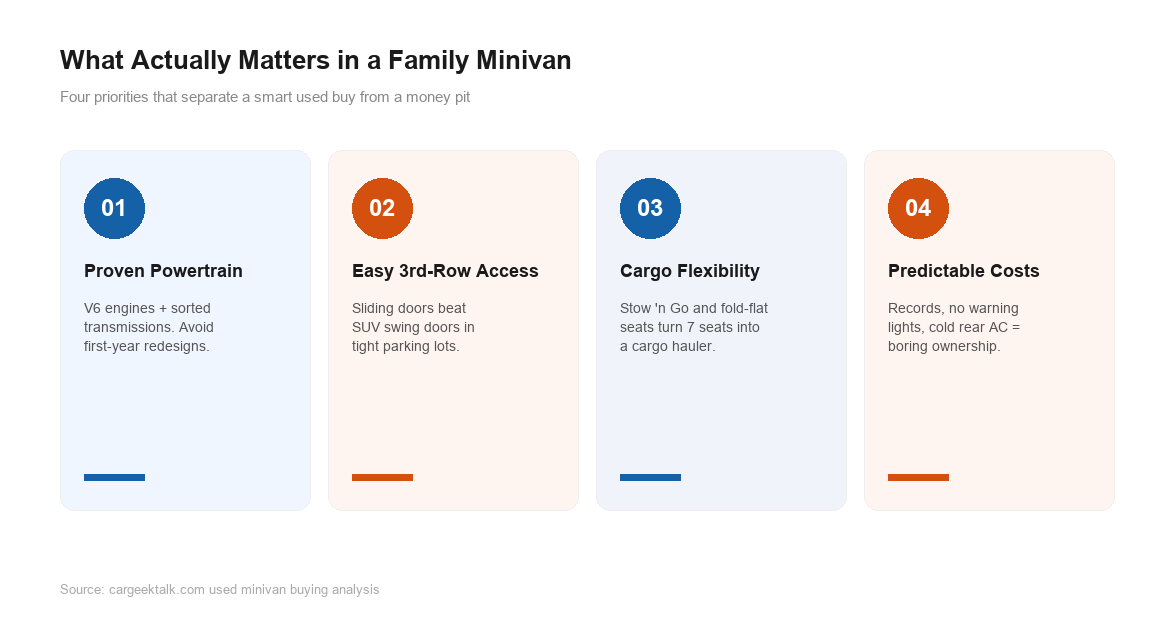
A family hauler doesn’t get days off. It does school runs in the rain, road trips with crayons melting in the cupholders, and parking-lot duty where doors get flung open into the car next to you. Reliability matters more here than in some weekend toy you drive twice a month.
What you actually want comes down to a short list. Wide sliding doors for tight spots. Enough room behind the second row for rear-facing seats. A third row a real human can reach. And ownership costs that stay boring after you sign.
There’s always a trade-off, though. The most dependable van might have laughably dated infotainment. The roomiest one might drink more fuel. A few have terrific engines bolted to transmissions that deserve a hard look before you hand over cash. Which is why model year matters every bit as much as the badge on the hood. According to IIHS crash test ratings, newer minivan generations also pulled meaningfully ahead on small-overlap protection – worth knowing if you’re hauling the people you care about most.
The strongest used minivan picks
1. Toyota Sienna
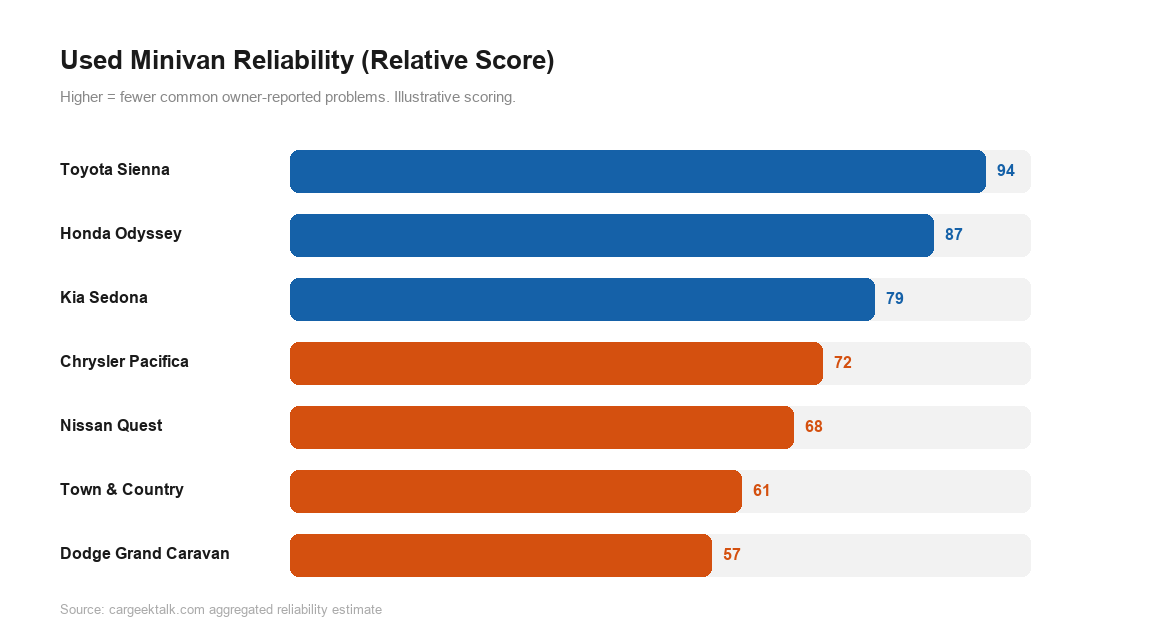
The Sienna is the safe default, and that’s not lazy advice. It built its name on long-term durability, strong resale, and fewer powertrain surprises than most rivals. If your plan is buy-it-once-keep-it-forever, the Sienna usually earns the top spot.
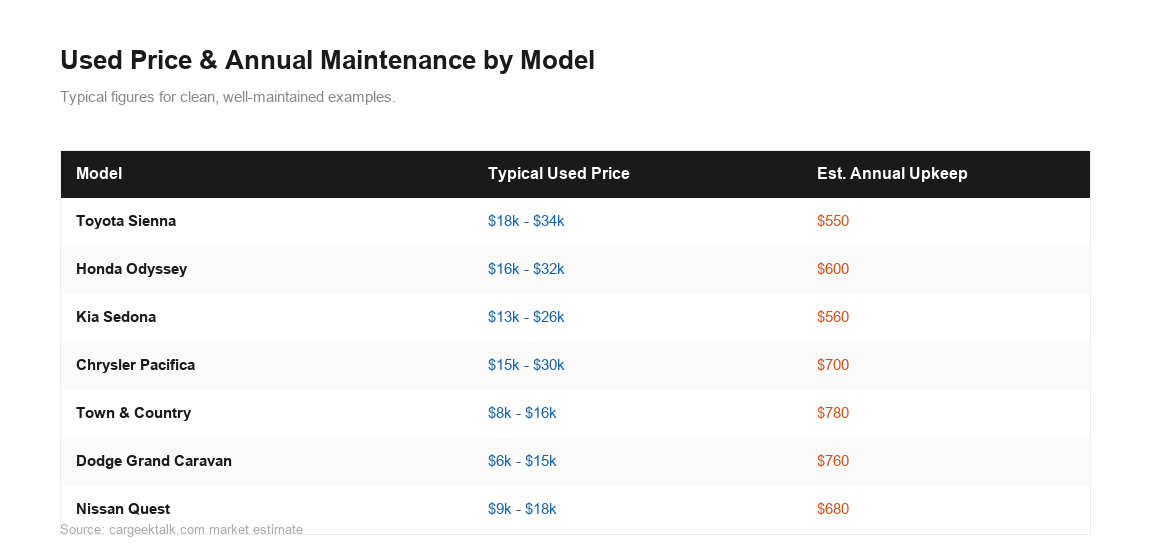
Older V6 Siennas (2011-2020) are tanks when maintenance records exist. The real downside? Price. Used Toyotas carry a tax – you’ll often pay $2,000-$3,000 more for a comparable year and mileage than a Chrysler product. For a lot of families, that premium just buys sleep at night. Worth it, in my experience.
2. Honda Odyssey
The Odyssey is the driver’s minivan, if such a thing exists. It feels more alert through corners than the segment usually allows, and Honda’s interior packaging is genuinely smart. The Magic Slide second-row seats in 2018-and-newer models aren’t brochure fluff – they actually let you slide a captain’s chair sideways to reach a third-row kid mid-drive.
But not every Odyssey year is a slam dunk. Several 2014-2017 V6 models brought transmission complaints, and the cylinder-deactivation V6 can develop issues if oil changes were skipped. A well-kept Odyssey is one of the best buys on this list. A neglected one gets expensive in a hurry – see our breakdown of average car repair costs by brand before you fall for a cheap one.
3. Kia Sedona
The Sedona is the value play, full stop. It never got the Toyota-Honda spotlight, and on the used market that quietly works in your favor. A similar-mileage Sedona often lands $1,500-$2,500 below the Japanese alternatives.
It won’t lead the class in resale or prestige. But the 2015-2021 Sedona packs a lot of equipment for the money – heated seats, a strong 3.3L V6, decent tech. For families who want a modern-feeling van without paying top-tier used prices, it deserves a real look.
4. Chrysler Pacifica
The Pacifica might be the most genuinely pleasant minivan to live with. Stow ‘n Go seating – where the second-row chairs fold flat into the floor – is a feature you don’t appreciate until you’ve used it. One minute it’s a seven-seater. The next it swallows a dresser. Brilliant.
The catch is long-term dependability, and it varies by year. Early 2017 models had electrical and infotainment gremlins. The Pacifica Hybrid is a different conversation entirely – fantastic when healthy, pricey if the battery isn’t. Buy carefully and it’s an excellent family tool. Buy on price alone and you may inherit the last owner’s deferred repairs.
5. Chrysler Town & Country
Shopping on a tighter budget? The Town & Country can make sense. It offers strong comfort, loads of features, and Stow ‘n Go in most trims, all for less than a comparable Sienna or Odyssey.
Don’t buy one blind, though. Electrical issues, transmission concerns, and general aging gripes show up on higher-mileage examples. The value is real. So is the risk. Service history isn’t a nice-to-have here – it’s the whole ballgame.
6. Dodge Grand Caravan
The Grand Caravan is the budget workhorse of the used minivan world. It sold in absurd numbers, so parts are everywhere and inventory is easy to find. Need maximum space for minimum cash? This is usually the first van shoppers land on.
It’s also the easiest van to overbuy emotionally and regret mechanically. Cheap prices hide neglect and hard fleet use – a lot of these spent their lives as rental and shuttle vehicles. A clean Grand Caravan is honest transportation. A rough one is exactly why some people swear off minivans forever.
7. Nissan Quest
The Quest is the wildcard. It’s uncommon, which helps or hurts depending on your local market. Some families like that it breaks the usual minivan mold, and the 2011-2017 interior was surprisingly upscale for the segment.
The worry is long-term support and parts confidence next to the segment leaders. It’s rarely my first recommendation. But find a very clean, well-documented Quest at the right price and it’s worth a conversation.
Quick comparison of the best used minivans for families
| Model | Best For | Main Strength | Main Caution |
|---|---|---|---|
| Toyota Sienna | Long-term ownership | Strong reliability reputation | Higher used prices |
| Honda Odyssey | Balanced family use | Excellent interior packaging | Some years have transmission or V6 issues |
| Kia Sedona | Value shoppers | Good features for the money | Not as strong on resale |
| Chrysler Pacifica | Flexible cargo and seating | Stow ‘n Go practicality | Model-year reliability varies |
| Chrysler Town & Country | Lower-budget families | Comfort and features | Aging electrical and transmission concerns |
| Dodge Grand Caravan | Lowest purchase price | Cheap and easy to find | Many hard-used examples |
| Nissan Quest | Alternative pick | Distinct design and cabin feel | Less common, less proven |
What years should you target?
This is where used minivan shopping gets real. A great model can still be a bad purchase in the wrong year. As a rule, late-cycle versions of a generation are the smart bet – the manufacturer’s had time to fix the early production gremlins.
So a 2019 Sienna usually beats a 2011 Sienna’s first-year quirks, and a 2020 Pacifica is calmer than the launch-year 2017. Family buyers should care less about having the freshest dashboard and more about avoiding pricey transmission work, electrical faults, and a parade of dashboard warning lights. Newer isn’t always wiser. Sorted is.
A proper used-car inspection isn’t optional on a minivan. These things spent years doing school runs, idle-heavy pickup lines, and curb-hopping parking jobs. None of that automatically makes a van bad. It just means hidden wear is common, and you want to find it before the seller’s check clears.
What to check before buying any used family minivan
A few areas reveal a minivan’s true condition faster than the seller ever will. Walk through these before money moves:
- Transmission behavior – delayed shifts, shudder, or a harsh thunk into drive are red flags
- Do every sliding door, power tailgate, and seat-fold mechanism actually work? Test all of them.
- Air conditioning in both front and rear zones – rear AC failure is common and not cheap
- Suspension clunks, uneven tire wear, brake life
- Any sign of coolant or oil leaks, plus a maintenance history that doesn’t have suspicious gaps
Then read the interior. Family vehicles live hard, and a thrashed cabin usually means the mechanical side got the same treatment. Torn seat bolsters, broken trim, missing headrests, dead rear-entertainment screens – those tell you the owner managed problems reactively instead of carefully. Want to fuel your van for less once you’ve bought it? Our guide on making your car more fuel efficient applies to vans more than most people think.
Minivan or three-row SUV for a family?
For most family use, the minivan. That’s the blunt truth. Three-row SUVs win on image and easy all-wheel drive, but minivans win on access, usable third-row space, and cargo flexibility. Sliding doors alone make daily life easier when you’re wedged between two cars in a packed lot. Ever tried opening a swing door wide enough for a car seat next to another SUV? Good luck.
The exception is lifestyle. If you genuinely need ground clearance, regular towing, or real bad-weather traction, a three-row SUV earns its keep. The EPA’s fuel economy figures also show modern minivans holding their own against larger SUVs – another quiet point in their favor. But if the job is moving people and gear efficiently, the van’s the smarter tool. New to all this? Start with our walkthrough on how to buy a reliable used car without regret.
The smartest way to shop the best used minivans for families
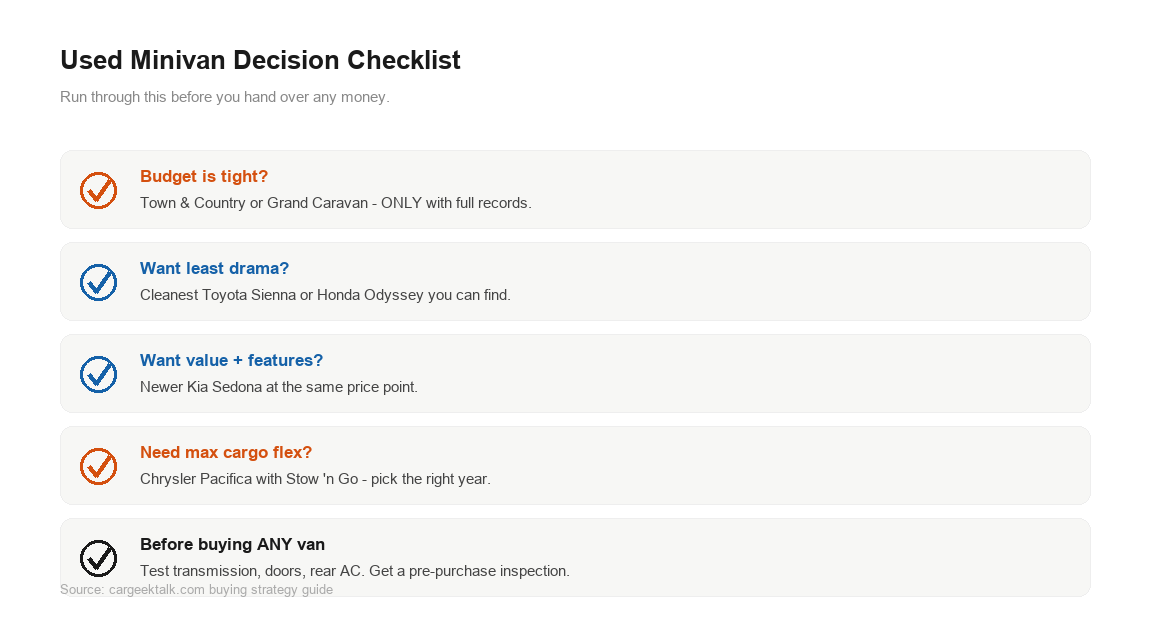
Want the least drama? Start with the cleanest Toyota Sienna or Honda Odyssey your budget allows, then put a newer Kia Sedona next to it at the same money. If budget pressure is higher, look at a Town & Country or Grand Caravan – but only after you’ve verified service records and the overall condition checks out.
Mileage matters. History matters more. A 110,000-mile van with full records, no warning lights, cold rear air, and a smooth transmission is a safer bet than a 78,000-mile example with a vague seller and obvious neglect. That’s the kind of math experienced buyers learn the hard way – usually once, expensively.
My take: the best family vehicle isn’t the one with the prettiest brochure story. It’s the one that starts every cold morning, keeps repair bills predictable, and makes your week easier instead of harder. Shop like that, and the right used minivan stops feeling like a compromise. It starts feeling like a cheat code.
Frequently asked questions
What is the most reliable used minivan for families?
The Toyota Sienna consistently lands at the top for long-term reliability, followed closely by the Honda Odyssey from well-maintained model years. Both have proven V6 powertrains and strong owner satisfaction over high mileage.
What mileage is too high for a used minivan?
There’s no hard cutoff. A documented 120,000-mile Sienna with clean records can outlast a neglected 80,000-mile van. Focus on maintenance history, transmission behavior, and working AC over the odometer alone.
Are minivans cheaper to own than three-row SUVs?
Often, yes. Minivans typically offer better fuel economy than equivalent SUVs and frequently have lower purchase prices on the used market, especially the Kia Sedona, Dodge Grand Caravan, and Chrysler Town & Country.
Which used minivan years should I avoid?
Be cautious with first-year redesigns – the 2017 Chrysler Pacifica launch year had electrical bugs, and some 2014-2017 Honda Odyssey V6 models had transmission complaints. Late-cycle years of any generation are usually the safer choice.
Is the Chrysler Pacifica a good used minivan for families?
Yes, when you pick the right year and verify maintenance. Its Stow ‘n Go seating is the best cargo-flexibility feature in the class. Just avoid neglected examples and budget extra scrutiny for the Hybrid’s battery health.
Should I get a pre-purchase inspection on a used minivan?
Absolutely. A pre-purchase inspection by a trusted mechanic is the single best money you can spend, since family minivans often live hard lives that hide wear in the transmission, suspension, and rear AC system.