
Are German Cars Expensive to Maintain After 100k Miles? Brutal Truth + 7 Real Costs

You’re looking at a 2018 BMW 530i with 108,000 miles on the clock. Clean service history, priced $8,000 below market. And you’re wondering — are German cars expensive to maintain after 100k miles? Because if the answer is yes, that “deal” might be costing you $3,000 a year before you even enjoy the leather seats.
Short answer: yes, German cars are more expensive to maintain after 100k miles than most competitors. But the real question isn’t whether they’re expensive — it’s how expensive, why it happens, and whether you can manage it. After years of owning and wrenching on German cars, I can tell you the brutal truth is more nuanced than “just buy a Toyota.”
Let’s get into the real numbers.
Contents
- Why Are German Cars Expensive to Maintain After 100k Miles?
- Are German Cars Expensive to Maintain After 100k Miles — The Real Numbers by Brand
- 9 Real Costs That Make German Cars Expensive to Maintain After 100k Miles
- BMW vs Mercedes vs Audi — Which Is Cheapest After 100k Miles?
- Real-World Scenario: A Year of Owning a 2017 BMW 340i at 105,000 Miles
- How to Reduce the Cost of Owning a German Car After 100k Miles
- Should You Buy a German Car With Over 100k Miles? Honest Verdict
- Frequently Asked Questions
Why Are German Cars Expensive to Maintain After 100k Miles?
It’s not a myth, and it’s not bad luck. There’s an engineering reason behind it. German manufacturers — BMW, Mercedes-Benz, Audi — build their cars around performance targets first, and serviceability second. That’s a deliberate trade-off, and it works brilliantly at 30,000 miles. At 110,000 miles, it starts to show.
Here’s what’s actually happening under the hood:
1. Turbochargers Running at Extreme Speeds
Modern German turbocharged engines — the BMW B48, B58, Mercedes M274, Audi EA888 — run turbo shaft speeds above 150,000 rpm. The bearings that support those shafts depend entirely on clean, fresh oil. Miss one oil change interval and the bearing wear accelerates. By 100k miles, even well-maintained turbos are approaching the end of their first service life. Replacement cost: $1,500–$3,000 (€1,380–€2,760) depending on the engine.
2. Electric Water Pumps That Don’t Last Forever
BMW switched from mechanical to electric water pumps on most engines starting around 2007. The upside: better cooling control, improved fuel economy. The downside: an electric motor living in a hot engine bay. Most BMW water pumps fail between 80,000–120,000 miles (130,000–193,000 km). When they do, your engine overheats fast. The pump itself costs $150–$300 (€140–€275). Labor on a B48 or N52 to access it properly? Another $400–$600 (€370–€550).
You can read more about this specific pattern in our article on common BMW cooling system problems — it’s one of the most predictable failure points on any high-mileage BMW.
3. Direct Injection Carbon Buildup
Every German car sold in the last 15 years uses direct injection. Fuel sprays directly into the combustion chamber — not past the intake valves. This means detergent additives in the fuel never wash the valves clean. Carbon deposits build up over tens of thousands of miles, eventually restricting airflow enough to cause rough idle, misfires, and power loss. The fix — walnut blasting — runs $400–$700 (€370–€645) and typically needs repeating every 60,000–80,000 miles.
4. Complex Transmissions That Demand Respect
The ZF 8-speed automatic in most BMWs and some Audis is genuinely excellent. Same with Audi’s DSG dual-clutch gearboxes. But both are finicky about fluid condition. ZF officially called its ATF “lifetime fill” — but plenty of transmission shops and independent data suggest a fluid change every 60,000–80,000 miles (96,000–130,000 km) is the difference between a gearbox that lasts 200,000 miles and one that fails at 130,000. DSG service runs $300–$500 (€275–€460).
5. Air Suspension Systems (Mercedes Especially)
If you own a Mercedes E-Class, S-Class, GLE, or anything with AIRMATIC suspension, budget carefully. Air struts typically start failing between 90,000–120,000 miles (145,000–193,000 km). Each strut runs $800–$1,400 (€735–€1,290) installed — and when one goes, the others usually aren’t far behind. A full air suspension rebuild on a W212 E-Class or W166 GLE can run $2,500–$5,000 (€2,300–€4,600).
Are German Cars Expensive to Maintain After 100k Miles — The Real Numbers by Brand
Let’s stop talking in generalities and look at what owners are actually spending. These figures come from aggregated repair data, and real-world reports from independent shops — not dealer estimates, which run 30–40% higher on average.
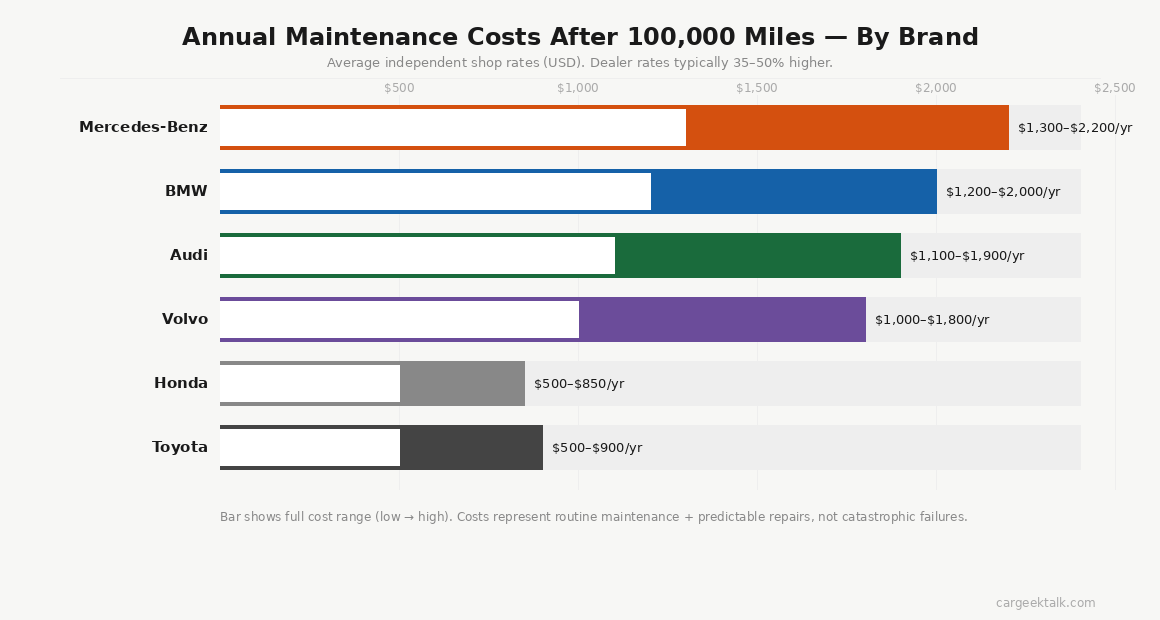
| Brand | Avg. Annual Cost (100k+) | In Euros (approx.) | Most Common Repairs | Reliability After 100k |
|---|---|---|---|---|
| BMW | $1,200–$2,000 | €1,100–€1,850 | Water pump, cooling, oil leaks | Moderate — engine-dependent |
| Mercedes-Benz | $1,300–$2,200 | €1,200–€2,000 | Air suspension, electronics, spark plugs | Moderate — avoid air susp. models |
| Audi | $1,100–$1,900 | €1,015–€1,750 | DSG service, timing chain, carbon | Good — if DSG/timing maintained |
| Toyota | $500–$900 | €460–€830 | Brakes, tires, minor wear items | Very good |
| Honda | $500–$850 | €460–€780 | Brakes, tires, occasional transmission | Very good |
| Volvo | $1,000–$1,800 | €920–€1,660 | Electrical, timing belt, turbo | Below average past 120k |
That $700–$1,300 (€645–€1,200) annual gap between German and Japanese brands looks manageable — until you factor in that German cars often stack repairs. A single shop visit can hit $2,500–$4,000 (€2,300–€3,700) when multiple wear items align.
9 Real Costs That Make German Cars Expensive to Maintain After 100k Miles
Here are the actual line items you’ll encounter — not hypothetical, not dealer-inflated. These are independent shop rates.
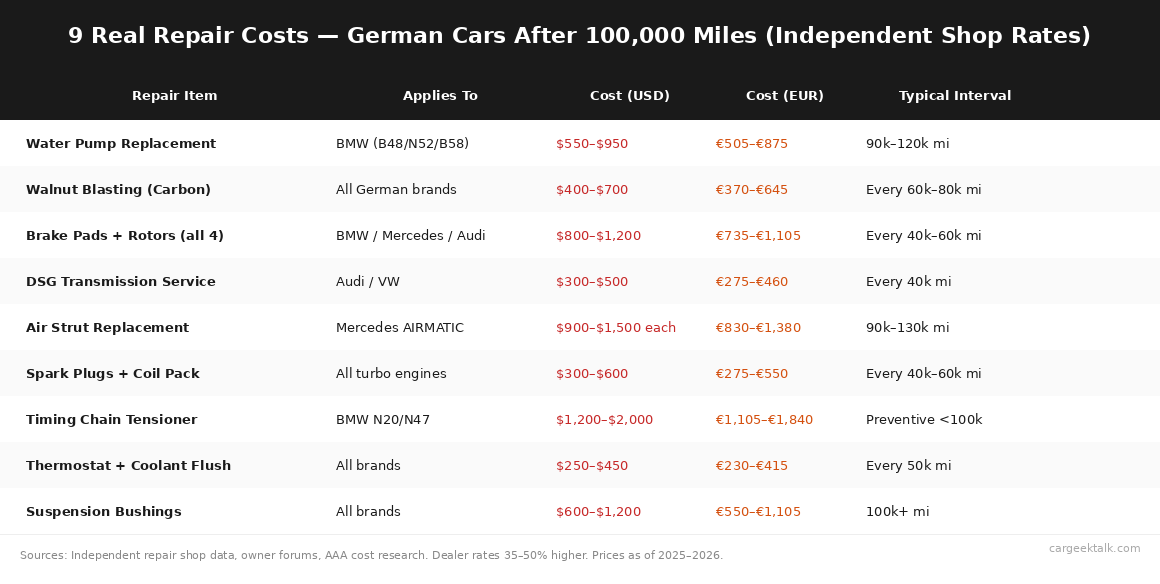
- Water pump replacement (BMW): $550–$950 (€505–€875) — Plan for this between 90k–120k miles on most 4- and 6-cylinder engines.
- Walnut blasting (all brands): $400–$700 (€370–€645) — Direct injection carbon removal; required every 60k–80k miles to maintain performance.
- Brake job (pads + rotors, all around): $800–$1,200 (€735–€1,105) — German cars use large, expensive rotors. Budget 2x what you’d spend on a Civic.
- DSG transmission service (Audi/VW): $300–$500 (€275–€460) — Every 40k miles. Skip it and risk a $4,000–$8,000 rebuild.
- Air strut replacement (Mercedes): $900–$1,500 (€830–€1,380) per corner — AIRMATIC-equipped models. Budget for all four eventually.
- Spark plugs + ignition coils: $300–$600 (€275–€550) — Every 40k–60k miles on turbocharged engines; more cylinders = higher cost.
- Timing chain tensioner (BMW N20/N47): $1,200–$2,000 (€1,105–€1,840) — A notorious weak point; get service history proof this was addressed.
- Thermostat + coolant flush: $250–$450 (€230–€415) — Every 3–4 years or 50k miles. Combined with water pump job saves labor.
- Suspension bushings (all brands): $600–$1,200 (€550–€1,105) — Front and rear at 100k+ miles; German cars ride on short-life polyurethane and rubber.
BMW vs Mercedes vs Audi — Which Is Cheapest After 100k Miles?
This is the question everyone asks. The answer depends heavily on which model and engine you’re comparing — but here’s an honest breakdown based on real ownership patterns:
BMW After 100k Miles
The inline-6 engines (N52, B58) are the sweet spot. They’re robust, and when problems do appear, they’re predictable. Avoid the N20 4-cylinder — the timing chain tensioner is a known liability that can destroy the engine if neglected. The B48 in the 3 Series and 5 Series is solid but does need water pump attention around 100k. In my experience, a well-maintained B58-powered 340i or 540i is genuinely reliable well past 150,000 miles.
Mercedes-Benz After 100k Miles
The best Mercedes to own past 100k is a non-air-suspension model with the M274 or OM651 diesel engine. The air suspension cars (E400, GLE350, S-Class) become genuinely expensive as mileage climbs. What most buyers miss: Mercedes electronics age worse than BMW or Audi. Fault codes can cascade from a single sensor failure into multiple expensive diagnoses. Budget for dealer-level scan tools or find an indy shop that specializes in Mercedes.
Audi After 100k Miles
Audi is often the most underrated of the three in long-term ownership — IF you follow the service schedule. The EA888 Gen 3 engine in the A4/A5/Q5 (2016+) is notably better than earlier versions. Keep the DSG fluid fresh, address timing chain noise immediately, and an Audi A4 or Q5 can cruise past 150k with reasonable costs. Quattro AWD adds another layer of drivetrain complexity — factor in rear diff and Haldex service every 40k–50k miles.
For a broader look at how these brands stack up financially over a full ownership period, this breakdown of average car repair costs by brand puts the long-term picture in perspective.
Real-World Scenario: A Year of Owning a 2017 BMW 340i at 105,000 Miles

Let’s make this concrete. Take a 2017 BMW 340i (B58 engine, 326 hp / 243 kW) purchased at 105,000 miles (169,000 km). Here’s a realistic Year 1 of ownership:
| Repair Item | Cost (USD) | Cost (EUR) | Notes |
|---|---|---|---|
| Water pump + thermostat | $850 | €780 | Do both at once — same labor access |
| Brake pads + rotors (all 4) | $1,050 | €965 | M-Sport brakes cost more |
| Spark plugs + coils | $480 | €440 | 6-cylinder = 6 of each |
| Front suspension bushings | $620 | €570 | Clunking noise at purchase was the tell |
| Oil changes (2x synthetic) | $200 | €185 | BMW LL-01 spec required |
| Total Year 1 | $3,200 | €2,940 | Predictable if you knew what to inspect |
Compare that to a 2017 Toyota Camry at 105,000 miles: brakes, two oil changes, maybe a cabin filter — roughly $700–$900 (€645–€830). The difference is real. But so is the driving experience gap.
Before buying any high-mileage German car, a proper pre-purchase inspection is non-negotiable. Our guide on how to inspect used cars covers exactly what to look for — and several BMW/Audi-specific red flags that most generalist mechanics miss.
How to Reduce the Cost of Owning a German Car After 100k Miles
Here’s what separates owners who spend $1,200/year from those who spend $4,000/year on the same car:
Use an Independent Specialist, Not the Dealer
A BMW or Mercedes specialist indy shop typically charges 40–60% less than the dealership for identical work. Find one with snap-on diagnostic equipment (ISTA for BMW, Xentry for Mercedes, VCDS for Audi/VW) — generic OBD readers miss brand-specific fault codes that cause misdiagnosis.
Do Preventive Maintenance Before Failure
The BMW water pump that costs $850 to replace proactively costs $2,800 to deal with when it fails on the highway and takes the thermostat, coolant hose, and possibly head gasket with it. AAA’s annual vehicle cost research consistently shows that preventive maintenance reduces total ownership costs by 20–30% versus reactive repair.
Follow OEM Fluid Specifications — Exactly
This isn’t brand snobbery. BMW LL-01 oil specification exists because the N- and B-series turbocharged engines run tighter tolerances than most engines. Using the wrong spec oil accelerates timing chain wear, turbo bearing wear, and VANOS solenoid fouling. The extra $30 per oil change is always worth it.
Address Fault Codes Immediately
German cars communicate problems early — often 10,000–20,000 miles before failure. A $120 diagnosis visit that catches a failing cooling system sensor saves a $2,500 overheating repair. Don’t clear codes and ignore them.
Know the Model-Specific Issues Before You Buy
The BMW N20 engine has a timing chain problem. The Mercedes OM642 V6 diesel has a notorious intake manifold swirl flap issue. The Audi 2.0 TFSI (EA888 Gen 1/2) had oil consumption problems. These are documented, predictable issues — not bad luck. Research the specific engine before buying, not after.
Should You Buy a German Car With Over 100k Miles? Honest Verdict
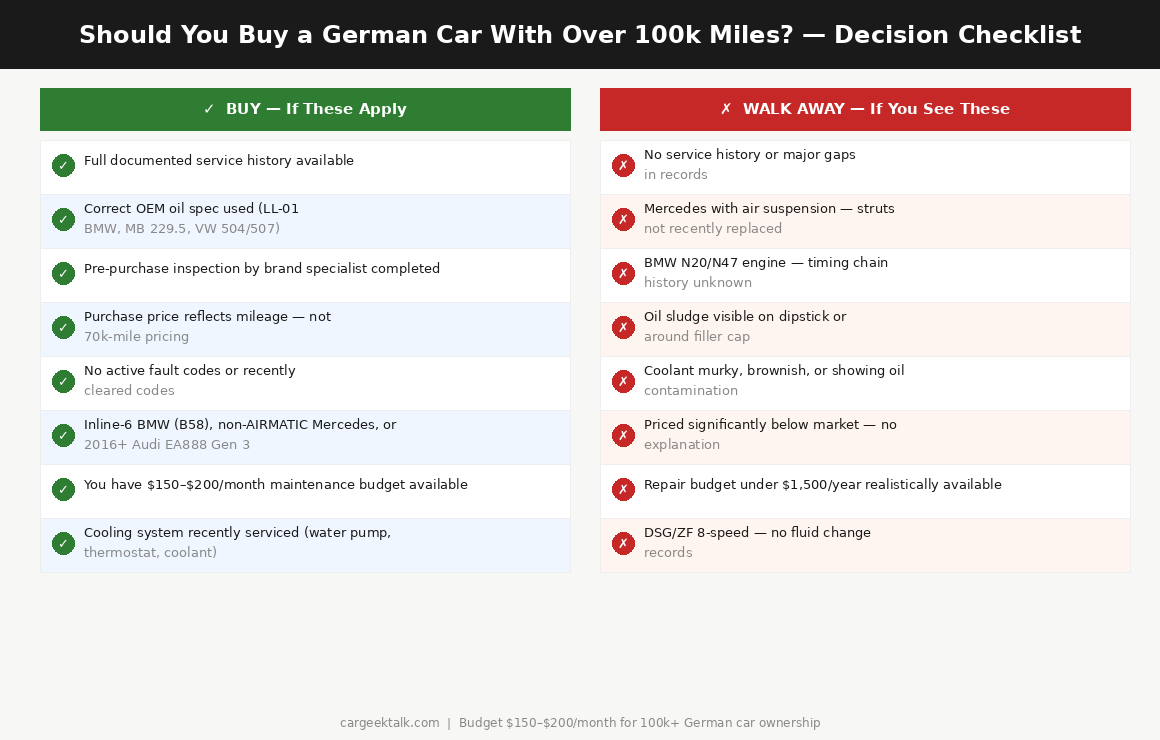
Yes — with conditions. A high-mileage German car can be an outstanding value, but only if you approach it correctly. Here’s the honest framework:
Buy it if:
- It has documented service history from a specialist or dealer
- You budget $150–$200/month for maintenance and unexpected repairs
- You can identify (or hire someone to identify) the model-specific failure points before purchase
- The purchase price reflects the mileage — you’re not paying 70k-mile money for a 110k-mile car
- You’re buying an inline-6 BMW, a non-air-suspension Mercedes, or a 2016+ Audi EA888 Gen 3
Walk away if:
- There’s no service history — or it’s “mostly dealer serviced” with gaps
- You see coolant residue, oil seeping from the valve cover, or deferred maintenance codes
- It’s a Mercedes with air suspension and the seller “just had the front struts done”
- The price feels too good — priced-to-move German cars usually have a reason
- You’re stretching budget to buy it — if $1,500 in unexpected repairs would hurt, don’t do it
For a full framework on evaluating any used car purchase, our guide on how to buy a reliable used car without regret walks through the inspection process and the questions most buyers forget to ask.
German cars after 100k miles demand more than most vehicles. They reward owners who understand the engineering, follow the service requirements, and don’t expect Toyota-level simplicity from machines built around driving dynamics. The IIHS safety data consistently shows these cars performing at the top of their class — that engineering competence runs through every system, including the ones that need attention at high mileage.
Get those things right, and a 120,000-mile BMW 540i or Audi A6 is one of the most satisfying used cars you can buy at any price point.
Frequently Asked Questions
Are German cars more expensive to maintain than Japanese cars?
Yes — significantly. German cars typically cost $1,100–$2,200 (€1,015–€2,000) per year in maintenance after 100k miles, compared to $500–$900 (€460–€830) for Toyota or Honda equivalents. The gap comes from more complex systems, higher parts costs, and labor-intensive repair designs. However, German cars that have been properly maintained often outlast neglected “reliable” alternatives.
Which German brand is cheapest to maintain — BMW, Mercedes, or Audi?
Audi is slightly cheaper on average, particularly models with the EA888 Gen 3 engine (2016+ A4, Q5). BMW’s inline-6 engines (B58) are similarly cost-effective when maintained. Mercedes tends to be the most expensive — especially any model with AIRMATIC air suspension, which adds significant cost from 90k miles onward.
What is the biggest single expense on German cars after 100k miles?
Air suspension on Mercedes models is the most expensive single system failure — a full AIRMATIC rebuild can run $2,500–$5,000. On BMWs, a neglected timing chain replacement (N20 engine) runs $1,500–$2,500. For Audi, DSG transmission rebuild if fluid service was skipped costs $4,000–$8,000.
Is it worth buying a used German car with 100k miles on it?
Yes, if the service history is documented, the purchase price reflects the mileage, and you have a maintenance budget of $150–$200/month. A pre-purchase inspection by a marque specialist is mandatory — not optional. Undocumented high-mileage German cars are high-risk purchases regardless of how they present on the surface.
Can a German car last 200,000 miles?
Absolutely. BMW B58, Mercedes M276 V6, and Audi EA888 Gen 3 engines are all documented to reach 200,000+ miles with proper maintenance. The key variables are oil spec adherence, timing chain service, and cooling system proactive replacement. The transmission and suspension may need component-level rebuilds along the way, but the engines themselves are capable of very high mileage.
How do I reduce German car maintenance costs after 100k miles?
Five things matter most: use an independent specialist (40–60% cheaper than dealer), follow OEM fluid specifications exactly, do preventive replacements before failure (especially water pump, thermostat, and timing components), address fault codes immediately rather than clearing them, and learn your specific engine’s known failure points before they become emergencies.
What should I check when buying a German car with over 100k miles?
Full service history, coolant condition and color, oil consumption between changes, timing chain noise at startup (BMW N20/N47, Audi EA888 Gen 1/2), air suspension leveling behavior (Mercedes AIRMATIC), transmission fluid condition (DSG/ZF 8-speed), and any active or recently cleared fault codes via full OBD scan — not just generic OBDII.