

Exploring the Top 10 Cheapest Car Brands to Fix: A Budget-Friendly Guide to Maintenance

A guy I used to work with test-drove three compact sedans in one Saturday, picked the Volkswagen Jetta because it felt the most solid on the highway, and by year four was staring down a $2,200 quote for dual-clutch transmission service. He’d asked the dealer about fuel economy and warranty length.
Nobody asked about the cheapest car brands to fix, which is the question that actually would have saved him money.
Repair cost studies from firms like RepairPal and YourMechanic consistently point to the same handful of brands for low average annual repair bills — and a few “affordable” brands people assume belong on this list actually don’t. This budget-friendly guide is an honest, top 10 breakdown exploring where the cheapest car brands to fix actually rank, and where the reputation gets ahead of the data.
Contents
Toyota
Toyota tops most long-term repair-cost studies, and it’s not particularly close. Three reasons drive that: parts are everywhere and cheap because Toyota reuses components across the Corolla, Camry, and half a dozen other models; the drivetrains on the mainstream models are about as simple as modern cars get; and the independent-shop network for Toyotas is enormous, which keeps labor rates competitive.
It isn’t a controversial pick. It’s just the boring, reliable answer.
A well-maintained Corolla or Camry routinely runs past 200,000 miles on nothing more than scheduled maintenance. That’s a big part of why resale values stay strong too.
Honda
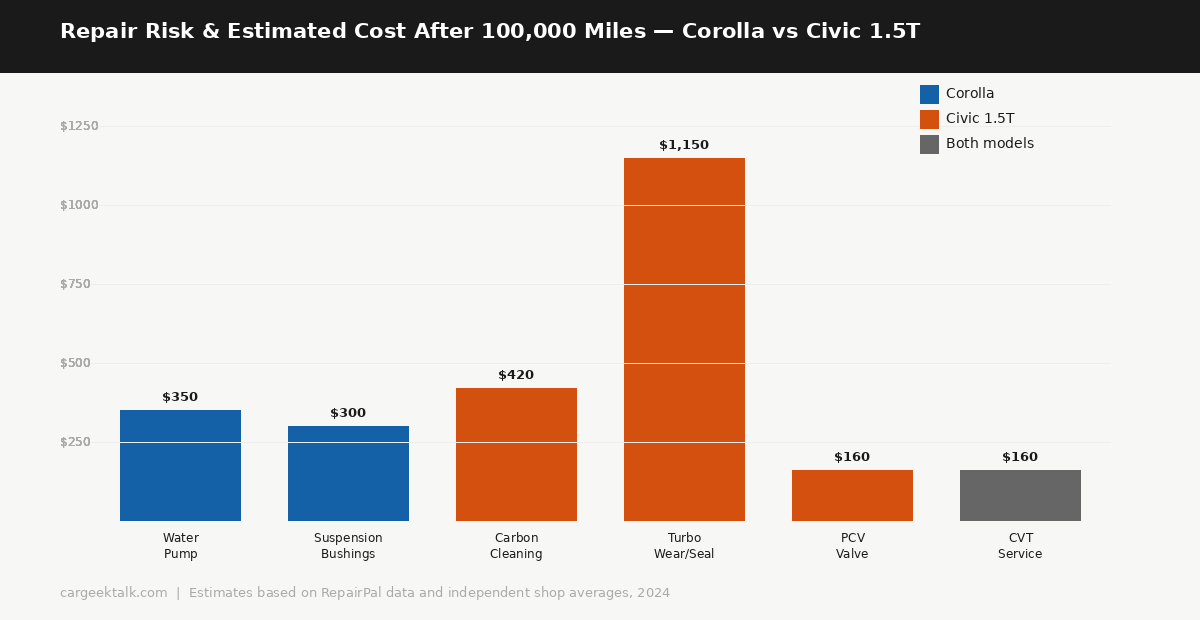
Honda tells almost the same story as Toyota: high production volume, cheap parts, and a Civic/Accord reputation for hitting 200,000 miles on routine maintenance alone.
The one asterisk I’d add is the CVT transmission used in certain older model years, which is a known weak point. Check the specific model year before you buy, not just the badge.
Hyundai and Kia
Hyundai and Kia have closed the reliability gap with Toyota and Honda substantially over the last decade, and routine parts run inexpensive.
One thing I always tell people: don’t buy on brand reputation alone here. Some Theta II 2.0L and 2.4L four-cylinders from the mid-2010s were recalled for engine failure risk, and that’s exactly the kind of issue a brand-level “cheap to fix” ranking won’t catch.
Mazda
The Mazda3 and Mazda6 pair genuinely fun driving dynamics with competitive repair costs. Mazda has kept its engine and platform lineup simple compared to brands juggling five different powertrain variants per model, and that simplicity shows up in the repair bill.
One practical note: Mazda’s dealer and independent-shop network is smaller than Toyota’s or Honda’s in some regions, so it’s worth checking that parts and specialty shops are actually convenient where you live before you buy.
Chevrolet and Ford
The two big domestic brands land closer to the industry average than the cheapest tier. Parts availability is excellent — these are some of the most common vehicles on American roads — but trucks and SUVs with turbocharged EcoBoost engines or more complex 4WD systems can run noticeably higher than their sedan counterparts.
That’s a tradeoff: you’re paying for capability, not just the badge.
A well-optioned F-150 with a turbocharged EcoBoost V6 costs measurably more to maintain over 100,000 miles than a base four-cylinder Escape, even though both wear the same blue oval badge.
Nissan
Routine maintenance on a Nissan is competitively priced, but I wouldn’t recommend an Altima or Sentra from the 2010s without researching the CVT first.
That transmission has a well-documented history of premature failure in certain model years, and a single CVT replacement can wipe out several years of low running costs in one bill.
Subaru
Subaru’s standard all-wheel-drive is a real advantage for capability, but it adds mechanical complexity you don’t get with a front-wheel-drive-only competitor.
That pushes Subaru’s average repair costs to the middle of the pack — reasonable, just not a budget leader.
If you need AWD for winter driving, it’s still a fair tradeoff. If you don’t, a front-wheel-drive Toyota or Honda will almost always be cheaper to keep on the road.
Volkswagen: Not Actually a Budget Pick
This is the brand that gets recommended more than the data supports, and it’s exactly what happened to the guy I mentioned earlier.
Volkswagen has historically ranked among the more expensive mainstream brands to maintain, mostly because of VW-specific parts pricing and dual-clutch transmissions that need specialized service. If low repair costs are the priority, VW isn’t the brand I’d choose.
Check Recalls Before You Buy, Not After
Every brand on this list has specific model years with known issues — the Theta II engines, various CVTs, dual-clutch service costs. Brand-level repair-cost rankings are a good starting filter, but they average across millions of cars and years.
Before you buy anything on this list, run the exact VIN through NHTSA’s recall lookup tool. It takes about thirty seconds and it’s the single best way to catch an open recall a seller may not mention.
I’d rather spend those thirty seconds upfront than find out about a transmission recall after the warranty’s expired.
| Brand | Repair Cost Tier | Watch For |
|---|---|---|
| Toyota | Cheapest | Few weak points; widely-shared parts keep costs low |
| Honda | Cheapest | Older CVT years on some models |
| Hyundai / Kia | Cheap | Theta II engine recalls (mid-2010s) |
| Mazda | Cheap | Simple lineup keeps costs down |
| Chevrolet / Ford | Average | Turbo/4WD trims cost more than sedans |
| Nissan | Average, with a catch | CVT failure risk in 2010s Altima/Sentra |
| Subaru | Middle of the pack | AWD adds mechanical complexity |
| Volkswagen | Not a budget pick | Dual-clutch transmission service costs |
Cheapest Car Brands to Fix: The Bottom Line
If you’re actually optimizing for the cheapest car brands to fix, the answer is boring: Toyota, Honda, Hyundai, Kia, and Mazda lead independent repair-cost studies, in roughly that order.
Brand reputation is a decent starting point, but it’s not the finish line — model-year-specific recalls and known failure points, like CVTs, dual-clutch transmissions, and certain turbo engines, are what actually separate a cheap-to-own car from an expensive surprise. Check the specific year before you check the badge.
Want more ownership cost breakdowns? Check our Ownership Costs and Maintenance section for additional guides.