

Toyota Corolla vs Honda Civic Maintenance Cost – Real 5-Year Ownership Insights
Is the Toyota Corolla cheaper to maintain than the Honda Civic? Yes — over five years and 75,000 miles, the Corolla runs about $800 to $1,000 less, and in the wrong circumstances that gap can grow past $2,000. The reason isn’t really about badges or reputation.
It comes down to one engine that’s naturally aspirated and one that isn’t, and what that difference costs you over the years in oil change receipts, timing chain anxiety, and — for Civic owners in cold climates — a very specific problem most dealerships won’t mention. This breakdown of Toyota Corolla vs Honda Civic maintenance cost covers what the sticker price never will.
I’m comparing the two most commonly cross-shopped US trims: the 2020–2024 Corolla with the 2.0L naturally aspirated engine (169 HP) and the 2020–2024 Civic with the 1.5L turbocharged engine (174 HP). Both land in the $24,000–$28,000 new price range, and both are reliable by any reasonable standard. In my experience, that’s exactly why buyers get tripped up — two cars that look equally safe on paper diverge quietly over time, and the numbers below are where that gap actually comes from.
Contents
- Why Engine Architecture Determines Toyota Corolla vs Honda Civic Maintenance Cost
- Scheduled Maintenance: Where Toyota Corolla vs Honda Civic Maintenance Cost First Diverges
- Repair Risks After 100,000 Miles
- 5-Year Total Ownership Cost: The Real Numbers
- How Competitor Compacts Stack Up
- Who Should Buy the Corolla vs the Civic
- What Experienced Owners Actually Say
- FAQ
- Is the Toyota Corolla cheaper to maintain than the Honda Civic?
- Does the Honda Civic’s turbo engine increase long-term maintenance costs?
- Which car is more reliable after 100,000 miles?
- How significant is the cost difference between the Corolla and Civic?
- Which car is better for long-term ownership?
- Does the Civic or Corolla hold its resale value better?
- Is the Honda Civic oil dilution problem still an issue on newer models?
Why Engine Architecture Determines Toyota Corolla vs Honda Civic Maintenance Cost
Most comparison articles stop at horsepower and cargo space — mine won’t. The real story starts under the hood — not with the numbers, but with what those numbers require to stay healthy.
The Corolla’s 2ZR-FAE 2.0L engine is naturally aspirated. No turbo, no intercooler, no wastegate. Fewer moving parts under heat stress. It runs on regular 87-octane fuel and has proven across multiple generations that it tolerates imperfect maintenance — late oil changes, lower-grade fluids, infrequent air filter swaps — without dramatic consequences. This isn’t laziness. It’s what mechanical simplicity buys you.
The Civic’s L15B7 1.5T is a different animal. It produces 162 lb-ft of torque at low RPM by forcing air through a small displacement, which is thermally demanding work. Turbo bearings, seals, and the intercooler all sit downstream of combustion heat. The oil that lubricates the turbo sees temperatures that can break down conventional fluids faster. Honda specifies 0W-20 full synthetic, and the service intervals are not suggestions.
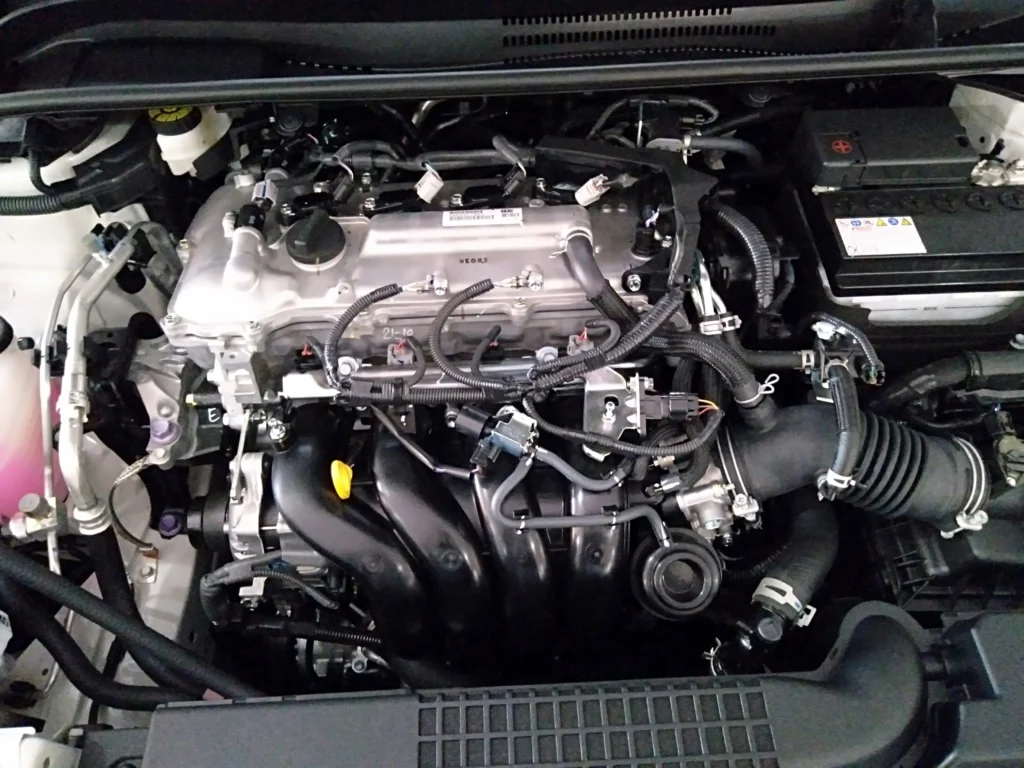
Naturally aspirated vs. turbocharged engine architecture — why complexity matters for long-term ownership costs
My insights from tracking ownership costs across compact sedans: turbocharged engines in this displacement class tend to inflate the 100,000+ mile service bill by 15–30% compared to equivalent NA engines. The Civic is not a lemon — far from it. But the turbo is a variable that the Corolla simply doesn’t carry.
Scheduled Maintenance: Where Toyota Corolla vs Honda Civic Maintenance Cost First Diverges
Routine service is where most owners feel the difference first. The gap per visit seems small. Over five years, it adds up.
| Service Item | Toyota Corolla 2.0L | Honda Civic 1.5T |
|---|---|---|
| Oil Change (full synthetic) | $60–$70 | $70–$85 |
| Spark Plugs (iridium, 60k mi) | $110–$130 | $160–$200 |
| Air Filter | $20–$30 | $25–$35 |
| Brake Pads (front axle) | $220–$280 | $270–$340 |
| Cabin Air Filter | $25–$35 | $25–$35 |
| CVT / Transmission Service | $130–$180 | $120–$160 (CVT) |
| Estimated Annual Average | $350–$450 | $420–$560 |
Both cars use CVT transmissions, and both benefit from fluid changes every 30,000–40,000 miles despite manufacturer “lifetime fluid” claims — a recommendation Consumer Reports has flagged repeatedly for CVT longevity. The Civic’s turbo oil changes cost more because of higher fluid specification requirements and slightly longer drain times at the shop.
Brake wear is also worth highlighting. The Civic’s sportier character invites more aggressive driving, which accelerates pad and rotor wear. If you drive two otherwise identical owners — one in a Corolla, one in a Civic — the Civic driver statistically visits the brake shop 15–20% more often. Driving style is a cost variable that comparison articles rarely account for.
The Oil Dilution Problem in Cold Climates
This is the issue Civic owners in Minnesota, Wisconsin, or Canada bring up the moment you ask about long-term ownership. Honda’s 1.5T has a documented tendency to dilute engine oil with fuel in cold, short-trip driving conditions. When the engine doesn’t reach full operating temperature regularly, unburned fuel mist can pass into the crankcase and thin the oil, reducing lubrication protection for the very turbo bearings that need it most.
Honda acknowledged this in 2017 and issued revised oil change guidance. The fix is more frequent oil changes in cold climates, which directly raises your maintenance cost beyond the baseline figures above. The Corolla’s NA engine has no equivalent vulnerability.
Repair Risks After 100,000 Miles
Scheduled maintenance is the predictable part. What separates the two cars at higher mileage is repair probability — the things you don’t plan for but eventually pay for.
Based on NHTSA complaint data and owner surveys, here’s where each car tends to develop issues after 100,000 miles (160,000 km):
Toyota Corolla 2.0L (common post-100k items):
- Water pump — typically $350–$500 all-in at an independent shop
- CVT fluid degradation if service was skipped — $130–$250 flush
- Suspension bushings (front lower control arm) — $200–$400/side
- Thermostat — $150–$250
Honda Civic 1.5T (common post-100k items):
- Carbon buildup on intake valves (direct injection engines accumulate deposits without port injection washing) — $300–$500 walnut blasting service
- Turbocharger wear/seal replacement — $800–$1,500 depending on severity
- PCV valve failure accelerating oil consumption — $100–$200
- CVT fluid (same as Corolla) — $120–$180
Projected repair risk and cost comparison beyond 100,000 miles — Corolla vs Civic 1.5T
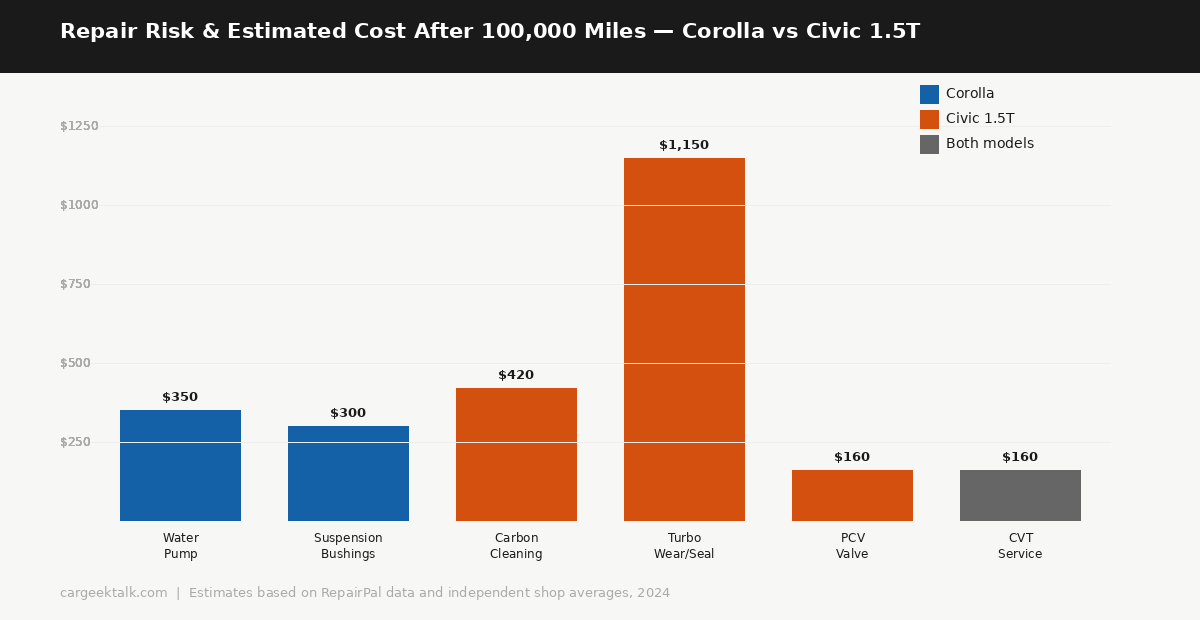
The carbon buildup issue deserves a separate mention. Because the Civic 1.5T uses direct injection only (fuel injected directly into the cylinder, not the intake port), intake valves accumulate carbon deposits over time. Port injection — like what the Corolla uses — washes the valves with every fuel cycle. This is a known limitation of GDI engines, documented by the SAE International in multiple technical papers on deposit formation. Walnut blasting at 80,000–100,000 miles is a legitimate preventive service for high-mileage Civic owners.
None of these Civic issues is catastrophic. A well-maintained 2022 Civic 1.5T with documented service history will comfortably reach 200,000 miles. But the probability of an unplanned $800–$1,500 repair in years 6–10 is meaningfully higher than it is for the Corolla.
5-Year Total Ownership Cost: The Real Numbers
Let’s put hard numbers to it. These figures assume 15,000 miles/year (75,000 miles total over 5 years), dealer pricing for scheduled items, and independent shop pricing for repairs. Data cross-referenced with RepairPal averages and AAA’s annual “Your Driving Costs” study.
| Cost Category | Toyota Corolla | Honda Civic 1.5T |
|---|---|---|
| Scheduled Maintenance (5 yr) | ~$1,900 | ~$2,400 |
| Unplanned Repairs (5 yr avg) | ~$700 | ~$1,200 |
| Tires (2 sets, 40k mi avg) | ~$900 | ~$950 |
| Fuel (avg 32 vs 34 MPG) | ~$9,900 | ~$9,300 |
| 5-Year Total (excl. insurance/depreciation) | ~$13,400 | ~$13,850 |
A few things to note here. First, the Civic’s better fuel economy (EPA-rated 36 MPG highway vs the Corolla’s 34 MPG highway) partially offsets its higher maintenance cost — but doesn’t fully erase it. Second, these are averages. If you drive aggressively, the Civic gap widens. If you do all your own maintenance, both costs drop, but the Corolla’s advantage grows because of the simpler service items.
Third — and this is what most buyers miss — the $450 difference in 5-year totals above doesn’t account for the cold-climate oil dilution scenario or an early turbo repair. In the worst case, the Civic can cost $2,000 more over five years. In the best case, a babied Civic with perfect maintenance nearly matches the Corolla.5-year total ownership cost breakdown: Toyota Corolla vs Honda Civic 1.5T (75,000 miles, US market).
How Competitor Compacts Stack Up
To put Toyota Corolla vs Honda Civic maintenance cost in context, here’s where they land relative to other compacts in the same segment:
| Model | Engine | Est. 5-Yr Maintenance | Reliability Risk |
|---|---|---|---|
| Toyota Corolla | 2.0L NA | ~$2,600 | Low |
| Honda Civic | 1.5T | ~$3,600 | Low-Medium |
| Mazda 3 | 2.5L NA / 2.5T | ~$3,200–$4,100 | Low |
| Hyundai Elantra | 2.0L NA / 1.6T | ~$3,000–$3,800 | Medium |
| Nissan Sentra | 2.0L NA | ~$2,800 | Medium |
The Corolla sits at the low end of this segment for maintenance cost — only the Sentra comes close, but the Sentra’s long-term reliability lags behind. If maintenance cost is your primary metric, the Corolla is the segment leader. If driving dynamics matter too, the Civic still represents good value despite the cost premium.
For buyers considering a used example, my guide on how to inspect a used car covers exactly what to check on a high-mileage Civic 1.5T — including how to spot early turbo wear and oil dilution evidence. And before committing to any compact, it’s worth reviewing average repair costs by brand to understand the broader Honda and Toyota ownership picture.
Who Should Buy the Corolla vs the Civic
This isn’t a verdict — it’s a decision framework. Both are genuinely good cars. The question is which one fits your life.
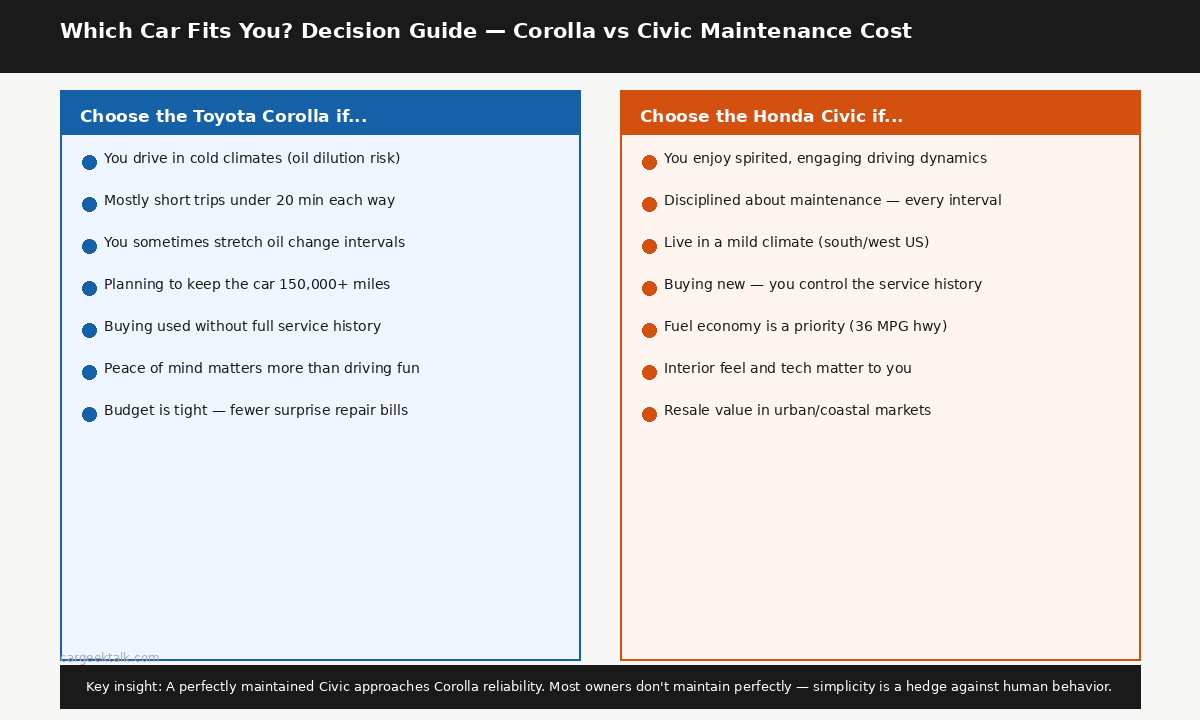
Buy the Toyota Corolla if:
- You drive in a cold climate (below 20°F regularly in winter)
- You do mostly short trips — under 20 minutes each way
- You stretch oil changes longer than the manufacturer recommends
- You want minimal surprises over 150,000+ miles
- You’re buying used and can’t verify the maintenance history
Buy the Honda Civic if:
- You drive enthusiastically and want a car that rewards it
- You’re disciplined about maintenance schedules
- You live in a mild climate
- Resale value matters (Civic holds depreciation well in certain markets)
- You’re buying new and can control the entire service history
The contrarian take is worth stating plainly: a Civic with perfect maintenance records can absolutely match the Corolla’s reliability story. The problem is that most owners don’t keep perfect records. Simplicity is a hedge against human behavior, and the Corolla bets on that hedge more aggressively than almost any other car in its class.
If you’re still deciding which compact best fits your budget and lifestyle, my guide to buying a reliable used car walks through how to evaluate any car’s true ownership cost before signing — including how to use service records and inspection results to predict future costs.
Quick-reference decision guide: Corolla vs Civic based on your driving habits and priorities
What Experienced Owners Actually Say
Data tells part of the story. Owner experience fills in the rest. Across forums and long-term ownership surveys, a few patterns emerge consistently:
Corolla owners beyond 100,000 miles overwhelmingly report no major unplanned repairs — just scheduled items. The most common complaint isn’t mechanical: it’s that the CVT can feel sluggish, and some owners wish they’d bought a Civic for the driving experience.
Civic owners are generally happy — until they’re not. The oil dilution issue creates real anxiety for cold-climate owners, and the first major turbo-related repair (typically between 90,000 and 130,000 miles) is a jarring experience for someone who expected compact-car reliability. NHTSA’s complaint database shows significantly more oil-related complaints for the 2016–2018 Civic 1.5T than any equivalent Corolla generation.
What most Civic owners agree on: the car is more fun to drive, the interior feels more premium, and if you stay on top of maintenance, it’s a genuinely excellent car. What most Corolla owners agree on: they never worry about it. There’s a specific kind of peace of mind that a naturally aspirated Toyota powertrain provides, and it has real financial value that doesn’t appear in any comparison table.
FAQ
Is the Toyota Corolla cheaper to maintain than the Honda Civic?
Yes, the Corolla is cheaper to maintain over 5 years. The Corolla’s naturally aspirated 2.0L engine requires simpler service items, is more tolerant of missed maintenance intervals, and has fewer high-cost failure points than the Civic’s 1.5L turbocharged engine. The estimated 5-year maintenance and repair cost is roughly $2,600 for the Corolla vs $3,600 for the Civic, though real-world figures depend heavily on driving habits and climate.
Does the Honda Civic’s turbo engine increase long-term maintenance costs?
Yes, meaningfully so. Turbocharged engines require higher-specification synthetic oil, more careful oil change intervals, and accumulate carbon deposits on intake valves (a known limitation of direct injection engines) that eventually require a walnut blasting service around 80,000–100,000 miles. Turbo seal wear and the potential for oil dilution in cold climates add further cost variables that the Corolla’s NA engine simply doesn’t have.
Which car is more reliable after 100,000 miles?
The Corolla has a demonstrably stronger track record beyond 100,000 miles, primarily because it has fewer complex components that can fail. The Civic 1.5T is not unreliable — it’s a well-engineered car — but the turbocharger, direct injection carbon buildup, and PCV system represent failure points that don’t exist in the Corolla. For buyers planning to keep a car 150,000+ miles, the Corolla offers a clearer path to high mileage without major unplanned repairs.
How significant is the cost difference between the Corolla and Civic?
Moderate in the base case, potentially significant in edge cases. Under average conditions, the Civic costs $800–$1,000 more over five years. If you drive in a cold climate with frequent short trips (the oil dilution scenario), or if you experience an early turbo repair, that gap can reach $2,000–$2,500. If you’re a meticulous maintainer in a mild climate, a well-kept Civic can come within $300–$400 of the Corolla’s total cost.
Which car is better for long-term ownership?
The Corolla is the better choice if minimizing long-term cost and mechanical risk is your primary goal. The Civic is the better choice if driving engagement, a more premium interior feel, and slightly better fuel economy matter enough to justify the additional cost and maintenance sensitivity. Neither is a bad long-term car — the Corolla is just more forgiving of real-world ownership conditions.
Does the Civic or Corolla hold its resale value better?
Both hold value well in the compact segment, but the Civic typically commands slightly stronger resale in markets where driving dynamics are valued (coastal cities, younger-skewing demographics). The Corolla tends to hold value better in practical-buyer markets and in regions where reliability reputation carries more weight. Over five years, the difference in depreciation is usually under $500 — not a decisive factor in the maintenance cost comparison.
Is the Honda Civic oil dilution problem still an issue on newer models?
Honda issued revised oil change guidance and technical service bulletins addressing the dilution issue in 2017–2018. The 2020+ Civic 1.5T (the generation I’m comparing here) shows significantly fewer oil dilution reports, but the underlying physics of short-trip cold-climate driving still applies to any turbocharged engine. Owners in cold regions should plan for more frequent oil changes — every 5,000 miles rather than waiting for the maintenance minder — as a precaution.
My honest take: if you’re optimizing purely for maintenance cost and you can live without the extra driving engagement, the Corolla is the safer bet — not because the Civic is unreliable, but because it demands more consistency from its owner than most people actually deliver. Buy the Corolla for peace of mind, buy the Civic if you’re willing to earn it.