

Hybrid vs Gas Ownership: 7 Honest Truths
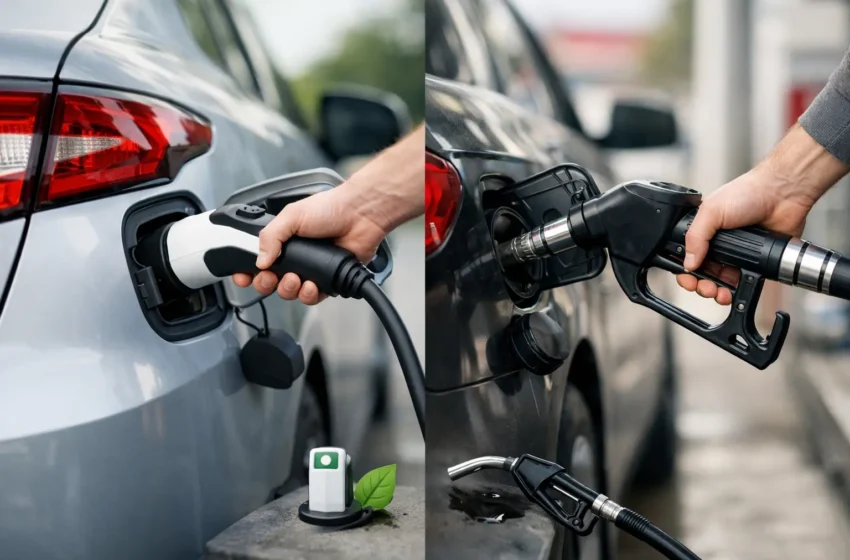
The hybrid vs gas ownership debate sounds simple until you put real numbers against your own commute, your insurance bill, and your patience for repairs. I’ve owned both — a high-mileage Camry Hybrid that quietly sipped fuel through years of city traffic, and a turbo gas sedan that was cheaper to buy but nickel-and-dimed me on maintenance. The honest answer rarely matches the headline MPG figure. It comes down to how you actually drive.
For most US buyers, this isn’t about ideology or even fuel economy alone. It’s about total ownership friction: how much you pay upfront, how often you fill up, what breaks after 100,000 miles, and whether the car suits your driving pattern. Get those four right and the powertrain choice almost makes itself.
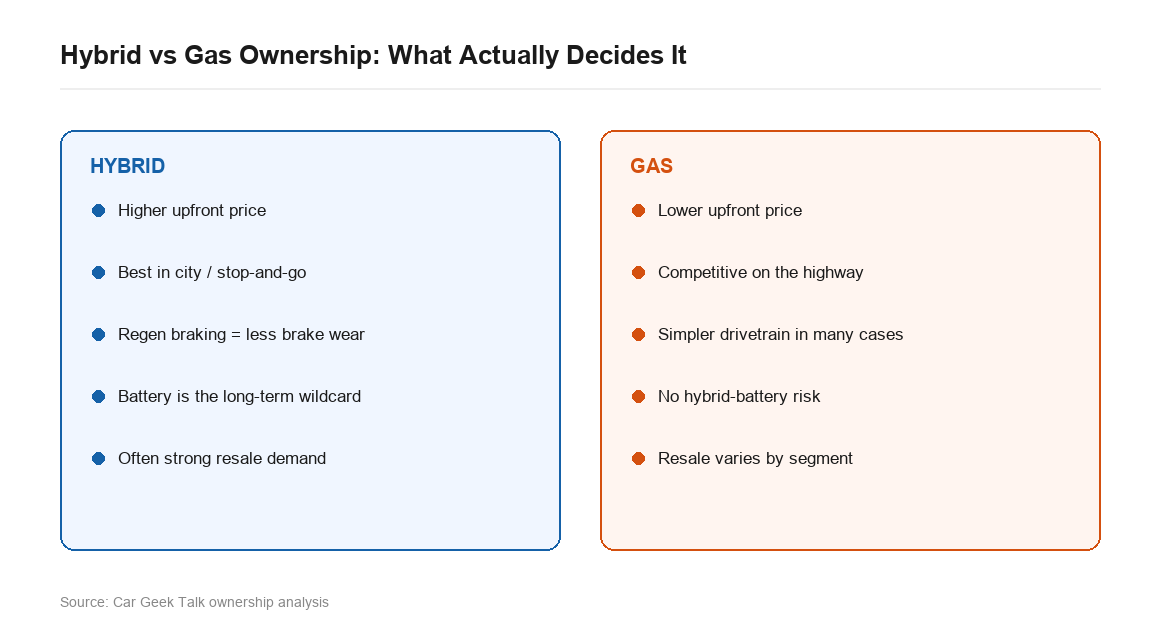
How the hybrid vs gas ownership decision really breaks down by driving pattern.
Contents
- Hybrid vs gas ownership: where the money really goes
- Fuel savings are real — but only if your driving matches the car
- Maintenance and repair in hybrid vs gas ownership
- Upfront cost, insurance, and resale
- Who should choose a hybrid?
- Who should stick with gas?
- The used-car angle changes everything
- Matching the powertrain to how you really drive
- Frequently asked questions
Hybrid vs gas ownership: where the money really goes
The biggest mistake shoppers make is comparing only the sticker price and the EPA ratings. Real ownership cost is a stack of smaller decisions and trade-offs. A hybrid usually costs more to buy, but it can claw that premium back through lower fuel use, less brake wear, and sometimes stronger resale. A gas vehicle starts cheaper and is often easier to understand mechanically — but it will almost always burn more fuel in city driving.
So the answer hinges on miles driven and where those miles happen. If your week is packed with stop-and-go traffic, school runs, and short urban loops, a hybrid system gets to do what it does best. Regenerative braking recovers energy, the gas engine shuts off at lights, and your fuel bill drops in a way you actually feel at the pump.
If most of your driving is steady-speed interstate cruising, the hybrid advantage narrows fast. A modern non-hybrid compact sedan can be efficient enough that the price premium takes years to recover. The EPA’s own side-by-side fuel cost comparisons make this gap obvious once you plug in your real annual mileage.
| Ownership Factor | Hybrid | Gas |
|---|---|---|
| Purchase price | Usually higher upfront | Usually lower upfront |
| City fuel economy | Strong advantage | Usually weaker |
| Highway fuel economy | Smaller advantage | Can be competitive |
| Brake wear | Often lower due to regen | Normal wear rate |
| Mechanical simplicity | A more complex system | Simpler drivetrain in many cases |
| Long-term battery concern | Yes, but not always a disaster | No hybrid battery risk |
| Resale demand | Often strong | Varies widely by segment |
Fuel savings are real — but only if your driving matches the car
A hybrid’s core promise is lower fuel consumption, especially in the city, and that promise is usually legitimate. The catch is that buyers wildly overestimate how quickly those savings erase the higher purchase price.
Say a hybrid version of a compact crossover costs $2,800 more than the gas version. Drive 8,000 miles a year on mostly suburban or highway roads, and the payback period can stretch past six or seven years. Drive 18,000 miles a year in dense metro traffic with constant stops, and that math swings hard toward the hybrid — sometimes paying itself off in three years or less.
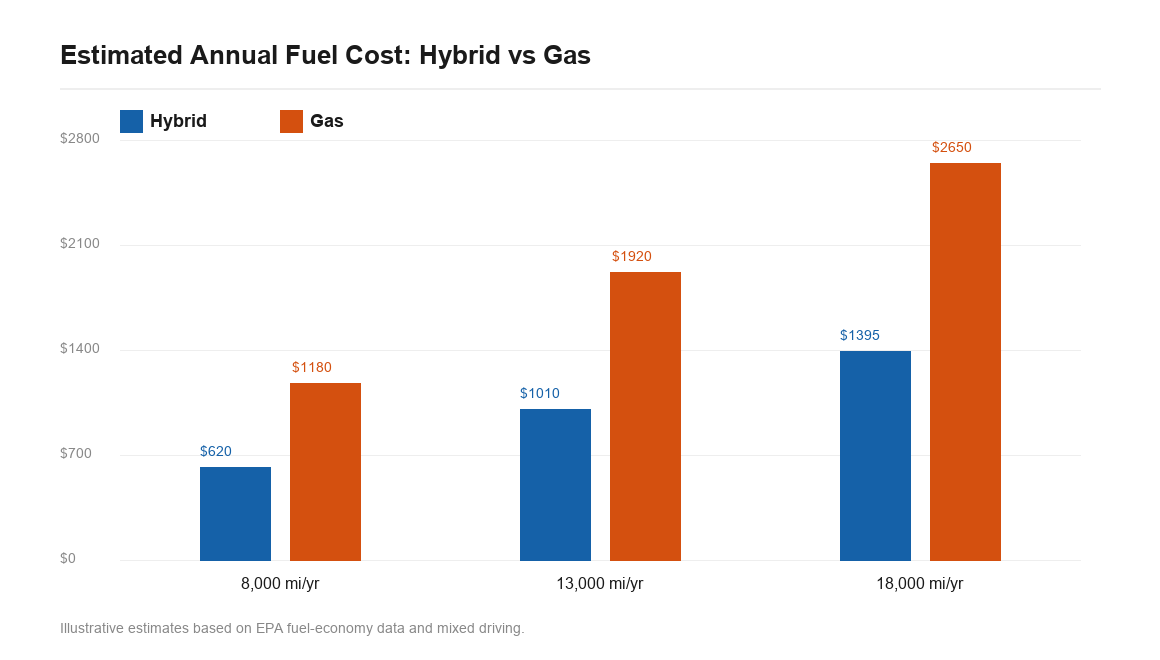
The annual fuel cost gap in hybrid vs gas ownership scales with how many miles you drive.
This is where ownership gets personal. A retiree driving modest annual mileage may never fully cash in on the hybrid premium. A rideshare driver or long-distance metro commuter almost certainly will. If you want to squeeze even more out of either car, our guide on how to make your car more fuel efficient applies to both powertrains.
The practical rule: the more city driving and annual mileage you rack up, the stronger the hybrid case gets.
Maintenance and repair in hybrid vs gas ownership
This is where the conversation gets messy, because both sides of the internet oversimplify it. Gas cars are not automatically cheaper to maintain forever, and hybrids are not automatically financial landmines.
A well-designed hybrid can be genuinely friendly in routine ownership. Regenerative braking reduces friction-brake wear, so pads and rotors often last 60,000–80,000 miles instead of 40,000. The gas engine also sees less stress in stop-and-go situations because the electric motor shares the load.
But yes, hybrids add complexity. You’re dealing with a battery pack, power electronics, electric motors, and software coordination layered onto a conventional gas drivetrain. If something major fails out of warranty, repair costs can be high.
The fear point is always the battery. That fear is understandable but usually exaggerated, especially with proven hybrid models from brands with long track records. The U.S. Department of Energy notes that most modern hybrid batteries are designed to last the life of the vehicle, and many Toyota and Lexus packs cruise past 150,000 miles. Failure isn’t guaranteed at some magic mileage. Still, replacement is expensive enough that used-hybrid shoppers should treat battery health as a real factor, not a footnote.
Gas cars dodge that specific battery risk but stack up their own long-term bills. Turbochargers, direct injection carbon buildup, emissions components, and aging transmissions can erase the simplicity advantage fast. A gas vehicle is only cheaper if that specific model is actually reliable — which is exactly why I always run a proper used-car inspection before buying either type.
| Common Ownership Concern | Hybrid Reality | Gas Car Reality |
|---|---|---|
| Oil changes | Still required | Still required |
| Brake service | Often less frequent | More conventional wear |
| 12-volt battery | Can still fail like any car | Can still fail like any car |
| Hybrid battery pack | Potential big-ticket item | Not applicable |
| Transmission complexity | Varies by system and brand | Varies widely by model |
Upfront cost, insurance, and resale
The brutal truth is that hybrids ask you to pay more before they save you anything. That matters if you’re financing, shopping on a tight budget, or buying used under pressure. A cheaper gas model may simply be the smarter move if stretching for the hybrid leaves you no cushion for maintenance, tires, and emergency repairs.
Insurance can go either way. Some hybrids are cheap to insure because they’re driven conservatively and carry strong safety records — and the IIHS crash-test ratings are worth checking before you assume anything. Other hybrids cost more because replacement parts and repair procedures are pricier. Never guess; pull real quotes on the exact trim.
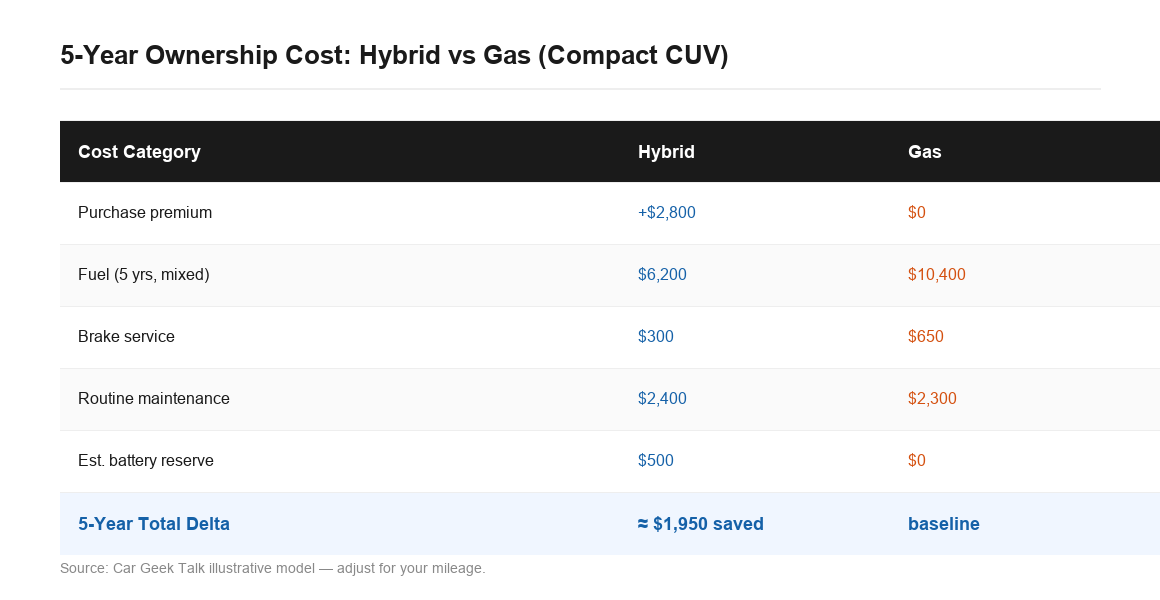
A sample five-year hybrid vs gas ownership cost breakdown for a compact crossover.
Resale is one of the hybrid’s quiet advantages. Across much of the US, efficient vehicles hold strong demand, especially when gas prices spike. That residual strength can offset the higher original purchase price. But it depends on brand reputation and battery confidence. A used hybrid with a clean reliability record is one thing; an obscure hybrid with expensive parts is another.
Who should choose a hybrid?
A hybrid makes the most sense when your ownership pattern matches its strengths:
- You drive a lot of city or mixed-traffic miles
- Fuel costs are a real chunk of your monthly budget
- You plan to keep the car long enough to recover the price premium
- You’re shopping proven hybrid systems, not experimental oddballs
- You value a quieter, smoother low-speed driving experience
For families, commuters, and anyone who spends half their life at red lights, a hybrid often feels like the smarter appliance. Not romantic — but financially sharp.
Who should stick with gas?
A gas car still deserves a hard look if your situation looks like this:
- You do mostly highway driving
- Your annual mileage is low
- You need the lowest possible upfront price
- You want fewer specialized components long-term
- You’re buying older used vehicles where battery replacement risk reshapes the math
There’s also a simple enthusiast angle. Some buyers still prefer the feel, sound, and mechanical honesty of a gas-only car. That’s not irrational. Ownership is partly financial, but it’s also about living with the machine you chose.
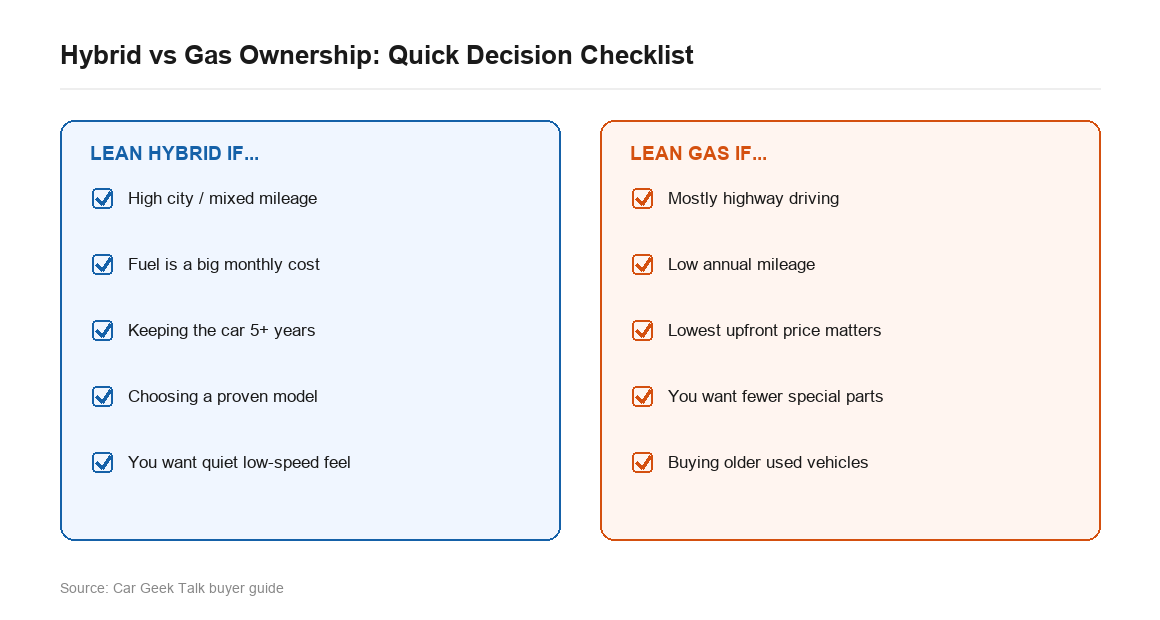
A quick hybrid vs gas ownership checklist to match the powertrain to your driving.
The used-car angle changes everything
New-car hybrid vs gas ownership is one discussion. Used-car ownership is a different beast entirely.
When buying used, the age and condition of the hybrid battery become part of the price equation. A well-maintained five-year-old hybrid from a proven nameplate can be a fantastic buy. A much older hybrid with a fuzzy service history may demand enough future spending to wipe out the fuel savings. Following a disciplined process — like our walkthrough on how to buy a reliable used car without regret — matters more than the powertrain badge.
With used gas cars, the risk shifts elsewhere. You may sidestep hybrid battery worries only to inherit transmission slip, oil consumption, cooling-system leaks, or years of skipped maintenance. The smart play isn’t choosing a powertrain in the abstract. It’s choosing the right model, with the right history, at the right price.
That’s the real Car Geek Talk answer to this whole debate: broad categories matter, but specific vehicles matter more.
Matching the powertrain to how you really drive
Better is not universal here. Hybrid ownership wins for drivers who log meaningful miles in traffic and want to cut fuel spending without leaping to a full EV. Gas ownership wins for buyers who need a lower entry price, drive mostly highway miles, or want to avoid the uncertainty of an aging hybrid battery on the used market.
Cross-shopping two versions of the same vehicle? Calculate the price premium, estimate your annual fuel savings honestly, and ask how long you’ll realistically keep the car. That quick exercise tells you more than any hot take ever will. Buy the hybrid when your driving pattern pays you back. Buy the gas car when a lower upfront cost and simpler ownership fit your life. These seven truths point to the same conclusion: the smart move isn’t chasing the trend — it’s matching the powertrain to the way you actually drive.
Frequently asked questions
Is a hybrid really cheaper to own than a gas car?
It depends almost entirely on your annual mileage and how much city driving you do. High-mileage city drivers usually recover the hybrid premium through fuel savings and lower brake wear. Low-mileage highway drivers often don’t, making a gas car the cheaper overall choice.
How long do hybrid batteries actually last?
Most modern hybrid batteries are engineered to last the life of the vehicle, and many proven models exceed 150,000 miles. Failure isn’t guaranteed at a fixed mileage, but on a used hybrid, you should still verify battery health before buying.
Are hybrids more expensive to repair?
Routine maintenance is comparable, and hybrids often save on brakes. The risk is big-ticket items like the battery pack or power electronics out of warranty. Gas cars avoid those but face their own costs from turbos, injection systems, and transmissions.
Does a hybrid hold its resale value better?
Often, yes — especially from reputable brands and when fuel prices climb. Strong residual value can offset the higher purchase price, but it varies by model and battery confidence in the used market.
Is hybrid vs gas ownership different for used cars?
Significantly. With used hybrids, battery age and condition become part of the price. With used gas cars, you trade that worry for risks like transmission wear or neglected maintenance. The specific vehicle’s history matters more than the powertrain type.