

How to Check Car Frame Damage the Smart Way

You find a clean-looking 2018 Honda Accord on Facebook Marketplace. Low miles, one owner, priced $2,000 below market. The seller says it had a “minor fender bender.” You take it for a spin, it drives fine, and you almost pull the trigger. But knowing how to check car frame damage before handing over cash could be the difference between a smart buy and a five-figure mistake. Structural damage is the one thing that can make a good-looking car genuinely dangerous — and sellers rarely volunteer that information.
This guide walks you through every layer of the inspection process, from what your eyes can catch in a driveway to what a body shop lift will confirm. Whether you’re buying a used car, dealing with insurance after a crash, or just trying to understand a repair estimate, these are the checks that matter.
Contents
- How to Check Car Frame Damage: Start Outside Before You Touch Anything
- How to Check Car Frame Damage Underneath: What a Flashlight Reveals
- What the Test Drive Tells You About Frame Damage
- Using a Vehicle History Report to Check for Frame Damage
- Unibody vs. Body-on-Frame: How to Check Car Frame Damage Differently
- When a Professional Pre-Purchase Inspection Is Non-Negotiable
- Should You Buy a Car With Frame Damage? The Honest Answer
- Protect Your Money and Your Safety
- Frequently Asked Questions: How to Check Car Frame Damage
How to Check Car Frame Damage: Start Outside Before You Touch Anything
Most people open the hood immediately. That’s a mistake. The smartest first move is standing 10–15 feet away and just looking at the car. Your eyes will catch things that a close-up inspection misses.
Look at the car’s stance from each corner. Does one end sit lower than the other? A sagging corner could be worn suspension — or it could be a bent subframe or damaged unibody section that was never properly repaired. Neither is trivial, but only one is structural.
Then walk the perimeter and study the gaps between body panels: hood-to-fender, door-to-door, trunk lid to quarter panel. Factory gaps are consistent and intentional. On a properly assembled car, you can run your finger along the gap and feel even spacing all the way around. On a repaired car, those gaps often tell a different story.
- Gap tight at the top of a door and wide at the bottom? The body opening has shifted.
- Hood sitting 5mm higher on the left than the right? Something moved the front structure.
- Trunk lid not flush with the quarter panels? Check the rear thoroughly.
These mismatches don’t always scream frame damage — cheap cosmetic repairs can create similar symptoms — but they earn the car a much closer inspection. Don’t let a seller minimize them as “just how older cars are.” That’s rarely true on anything assembled after 2005.
While you’re outside, open and close all four doors, the hood, and the trunk. They should latch with light effort and feel solid. A door that needs a proper slam, a hood that doesn’t sit flat, or a trunk opening that looks slightly parallelogram-shaped are all red flags.
How to Check Car Frame Damage Underneath: What a Flashlight Reveals
You don’t need a lift for a useful underside inspection. A good flashlight (or your phone torch) and a willingness to crouch down will get you surprisingly far. You’re looking for four things: asymmetry, fresh coating, abnormal welds, and metal deformation.
Front frame rails and radiator support
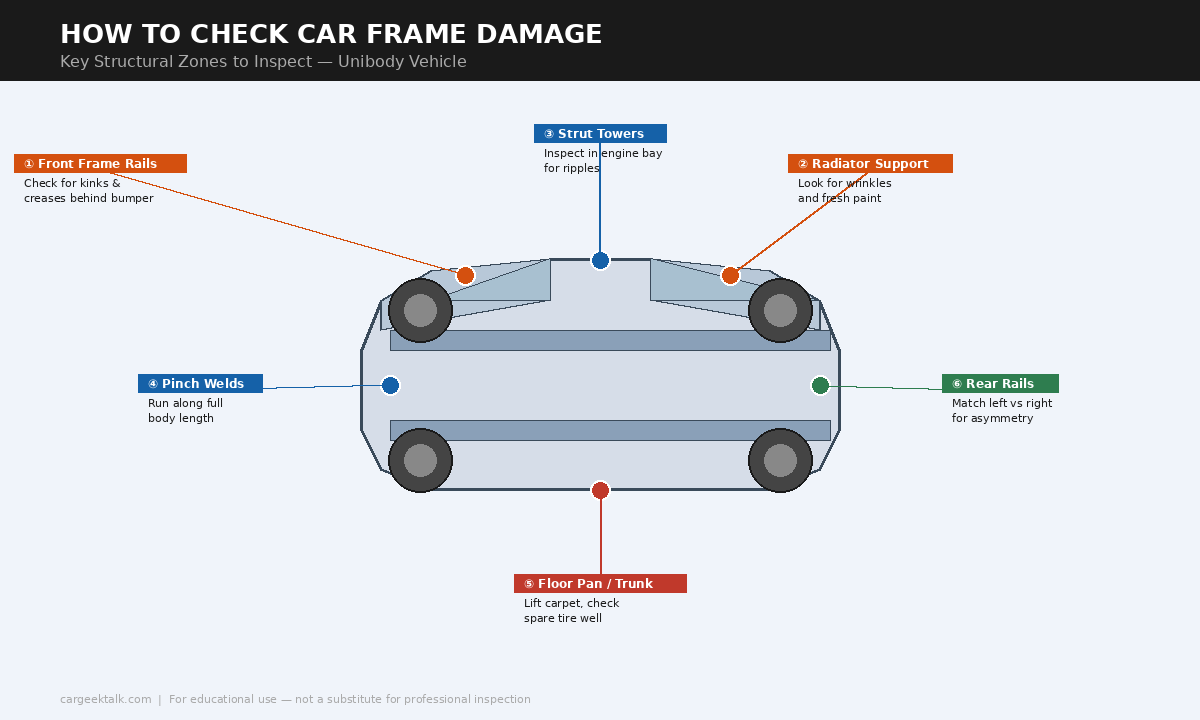
Slide around to the front and look behind where the bumper cover used to sit. The two frame rails running back from the bumper should look identical on both sides — same shape, same surface condition, same color. On a unibody car, these rails are designed to crumple in a controlled way during impact. Once they crumple, they’re not supposed to be straightened and put back into service — they’re supposed to be cut and replaced with factory-spec metal. In my experience, about half the budget collision repairs I’ve seen involve rails that were simply pulled and painted over rather than properly replaced.
Any kink, S-curve, or ripple pattern in those rails is a disqualifying sign unless you already have documentation showing a certified repair with factory replacement sections.
Strut towers and inner fenders
Pop the hood and look at the strut towers — the raised reinforced sections that support the top of your front suspension. These take a direct hit in moderate-speed front-end collisions. Wrinkles, paint cracks, or metal that looks like it was hammered back into shape are serious problems. Suspension geometry calibrates against those mounting points, and if they’ve moved, you may never get a front alignment that holds.
Pinch welds and floor pans
The pinch welds run along the bottom edges of the car where the body panels meet underneath — they’re also what lift pads go under when you jack the car up. Factory pinch welds are smooth and consistent. Accident repairs sometimes leave them distorted, with fresh sealer brushed on to hide the evidence. Tap along them — they should feel solid, not hollow.
On the floor inside, pull back the carpet in the trunk and behind the rear seat if you can. Rear-end impacts often show up in the spare tire well and rear trunk floor long after the bumper cover has been refinished and polished.
What the Test Drive Tells You About Frame Damage
A structurally compromised car doesn’t always feel broken. Sometimes it just feels slightly off in three or four different ways simultaneously — which is actually more useful information than one dramatic symptom.
Take the car on a straight, flat road at highway speed if possible. Let the steering wheel go briefly and see whether the car tracks straight. A bent frame or damaged suspension mounting point often pulls the car to one side in a way that no alignment adjustment will permanently fix. If the seller says “it just needs an alignment,” ask for documentation of the last one. Alignment specs that drift back quickly are a symptom, not a cause.
Listen for wind noise from around the door seals at speed. A body that’s racked (twisted diagonally by impact) will have gaps in seals that weren’t designed to close against a distorted opening. You might also hear structural creaks over bumps — a sound that has no clear source but seems to come from the car’s midsection.
Feel the steering for looseness or vagueness that doesn’t match the car’s mileage. And pay attention to how the car handles uneven pavement. A well-maintained car with a straight structure feels planted. One with hidden structural damage often feels like it’s hunting for grip, even on routine road imperfections.
| Symptom on Test Drive | Possible Cause | Concern Level |
|---|---|---|
| The car pulls left or right at speed | Frame misalignment or bent control arm | Moderate to High |
| Steering wheel crooked on a straight road | Alignment offset after collision repair | Moderate |
| Wind noise from door seals at speed | Body opening is racked or distorted | High |
| Unexplained creaking over bumps | Structural flex from unibody damage | High |
| Uneven tire wear (one side more worn) | Geometry issue from bent frame or subframe | High |
| Vibration above 60 mph | Wheel balance OR bent axle/hub | Low to Moderate (needs diagnosis) |
Using a Vehicle History Report to Check for Frame Damage
A CARFAX vehicle history report or AutoCheck report should be part of every used-car purchase, but you need to understand what it can and cannot tell you. These reports aggregate data from insurance claims, DMV title records, auction records, and reported incidents. What they cannot do is physically inspect the car.
A clean history report doesn’t mean the car has never been damaged. Private-party accidents that don’t involve insurance — more common than you’d think — leave no trace in the database. Cash repairs at unlicensed shops similarly go unrecorded. In my experience evaluating used cars, I’ve seen structurally compromised vehicles carry clean CARFAX reports because the owner handled everything out of pocket to preserve the title.
That said, a flagged report is extremely useful. Look for:
- Airbag deployment records — airbags don’t deploy in fender benders; they deploy when sensors detect significant impact force, usually well above the threshold for structural damage
- Salvage, rebuilt, or flood title branding — these follow the car forever and significantly affect resale value and insurability
- Multiple owners in a short period — a car that cycled through three owners in two years after a collision entry is a yellow flag
- Auction records following a collision entry — dealers often buy collision-damaged cars at auction and flip them retail
Cross-reference the report’s timeline with the physical inspection. If the report shows a collision in 2022, look carefully at those areas of the car for signs of repair. Fresh paint in a specific zone that aligns with the reported damage location is actually confirmatory — at least someone repaired it. What you’re trying to assess is how well they did it.
Unibody vs. Body-on-Frame: How to Check Car Frame Damage Differently
The inspection approach changes depending on what kind of structure you’re dealing with, and most buyers don’t realize there’s a difference.
Unibody vehicles (most modern cars, crossovers, and sedans)
Roughly 95% of passenger cars sold today use unibody construction — the body shell and the frame are one integrated structure. When someone says a Honda Civic or Toyota Camry has “frame damage,” they mean the body shell itself is bent or deformed. There is no separate frame to detach and inspect independently.
Unibody damage is often more expensive to repair correctly because straightening requires a frame machine with precise measuring points. The Insurance Institute for Highway Safety explains how modern unibody structures are engineered to absorb and redirect crash energy through specific crumple zones — once those zones have crumpled, they’ve done their job. Trying to straighten them and reuse them isn’t just structurally questionable; it defeats the vehicle’s crash engineering.
Body-on-frame vehicles (trucks, large SUVs, some vans)
Pickups like the Ford F-150, Ram 1500, Chevy Silverado, and large SUVs like the Suburban or 4Runner use a separate ladder frame beneath the body. This gives you something you can actually inspect independently. Look along the full length of both frame rails from the front bumper mounts to the rear hitch receiver area. You’re looking for:
- Kinks, bends, or fish-scale rust patterns (rust that looks crinkled rather than flat indicates metal stress)
- Welds that don’t match factory spec — misaligned, overlapping, or clearly done by hand rather than robotically
- Holes that shouldn’t be there, or mounting bolt holes that are elongated from being stressed
- Cross-members that look bent or replaced
Surface rust on a body-on-frame truck from a northern state is expected. Structural rust that’s compromised the rail wall thickness is a different problem entirely — the NHTSA’s vehicle integrity guidelines draw a clear line between cosmetic corrosion and structural compromise.
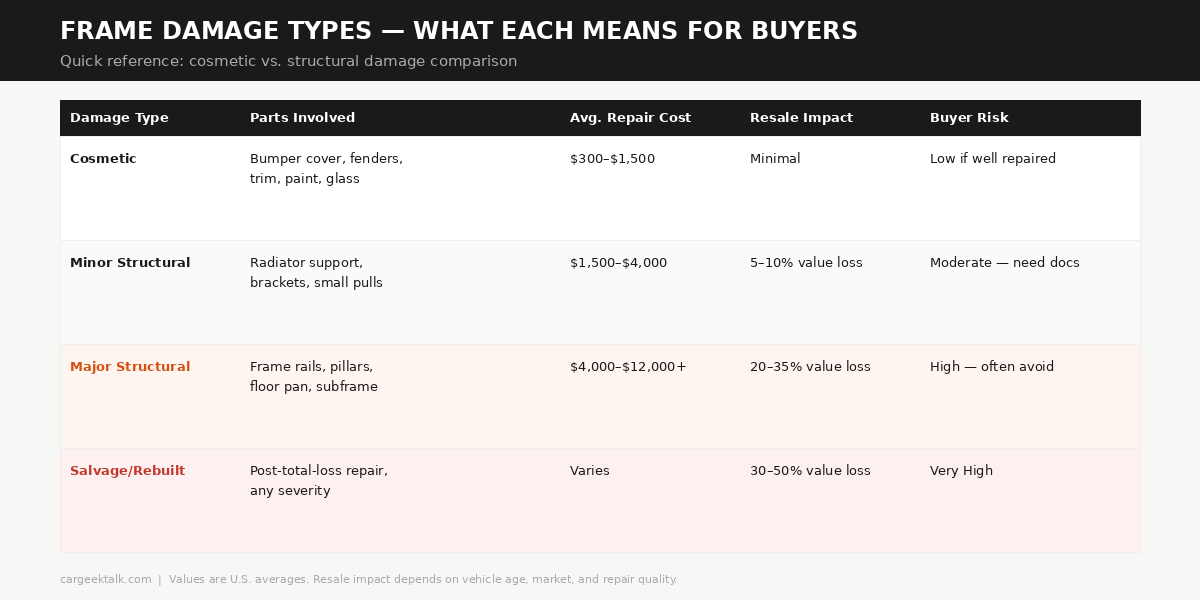
| Damage Type | What It Involves | Typical Repair Cost | Buyer Concern |
|---|---|---|---|
| Cosmetic only | Bumper cover, fender, trim, paint | $300–$1,500 | Low if properly repaired |
| Minor structural | Radiator support, small pull, replaced bracket | $1,500–$4,000 | Moderate — needs documentation |
| Major structural | Bent rails, pillar damage, and floor distortion | $4,000–$12,000+ | High — often a total loss |
| Rebuilt/salvage title | The insurer declared a total loss, then repaired it | Varies widely | Very high — resale and safety concerns |
When a Professional Pre-Purchase Inspection Is Non-Negotiable
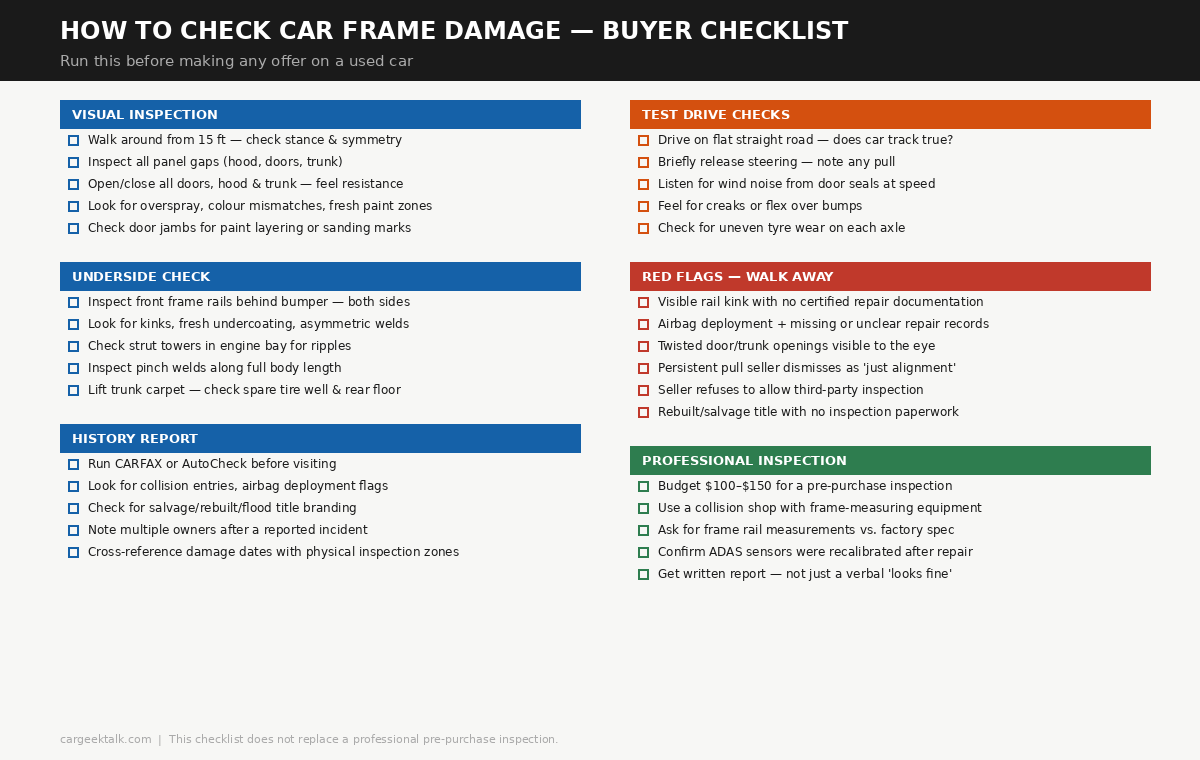
If anything in your visual inspection or test drive raised a flag — even a small one — pay for a professional pre-purchase inspection. This is not optional if you’re spending more than $5,000 on a used car. A reputable collision shop or mechanical shop with frame-measurement equipment will give you a straight answer in about an hour, and it typically costs $100–$150.
What you want them to check specifically:
- Frame rail measurements against factory spec (they use a measuring system with known reference points)
- Whether they see evidence of prior machine pulls — marks on frame rails from pull hooks or chains
- Replaced weld points vs. factory spot welds
- Suspension mounting point integrity — especially subframe mounts and control arm attachment points
- Whether ADAS sensors (cameras, radar) appear to be properly mounted and calibrated after repair
That last point is increasingly important. A 2020 Toyota RAV4 that took a front hit may drive fine, but have a forward collision radar module that’s 2 degrees off its calibration spec. The car will pass a basic drive test but fail on the one occasion you actually need automatic emergency braking. If the car has any driver-assistance features, ask the inspection shop whether those systems were recalibrated after the reported collision.
If you’re serious about doing a thorough used-car inspection, structure is the section where professional verification earns its money back many times over.
Should You Buy a Car With Frame Damage? The Honest Answer
Sometimes yes. Sometimes absolutely not. The answer depends on three factors: severity of the original damage, quality of the repair, and how much the price reflects the risk.
A 2017 Toyota Camry with a properly documented minor front-end repair, factory rail replacement by a certified shop, and a $4,000 discount from market value might be a reasonable buy. The same car with a handshake repair, no documentation, mismatched paint, and a $500 discount is not — you’re paying near-retail for someone else’s problem.
What most buyers miss is the downstream effect on resale. A car with a structural damage history — even a perfectly repaired one — typically sells for 20–30% less than a clean-history equivalent. If you paid $12,000 for a car worth $15,000 clean, and you sell it in four years, you may still take a $3,000–$4,000 haircut compared to someone who bought it clean. That erodes the discount you got upfront.
For guidance on how to negotiate price against a damage history, the used car buying guide on this site walks through the full decision process. And if you want to understand how repair costs compare across makes, the average repair costs by brand page will help you factor in what ongoing ownership might look like on a car that’s already been through structural repair.
The red flags that should stop the deal cold
There are situations where walking away is the right move regardless of price:
- Visible kinks or buckling in frame rails or inner structure, with no documentation of certified repair
- Airbag deployment with unclear or missing repair records — who replaced them, what shop, what parts?
- Doors, hood, or trunk openings that look visibly parallelogram-shaped
- Persistent pull on a straight road that the seller dismisses as “just needs alignment.”
- Seller refuses to allow a third-party inspection — this is the most telling sign of all
- Fresh undercoating or paint underneath with no explanation, especially on a car with a clean reported history
- Rebuilt or salvage title being sold as a “daily driver deal” with no inspection documentation
A defensive seller is a data point. In my experience, sellers who have nothing to hide usually welcome an inspection — they know it will confirm the car and close the deal faster. Sellers who hesitate or add conditions around the inspection often know what a thorough look will find.
Protect Your Money and Your Safety
Knowing how to check car frame damage is one of the most underrated skills in used-car buying. The inspection takes less than 30 minutes if you know what you’re looking for, and it costs nothing beyond a flashlight and a willingness to get your hands slightly dirty. The professional inspection costs $100–$150. The risk of skipping it on the wrong car can cost $5,000 to $15,000 in repairs, in resale loss, or, in the worst case, in an airbag system that doesn’t perform correctly when it’s supposed to.
Slow down on the cars that feel rushed. Walk away from sellers who make the inspection difficult. And treat the structure of any car as the foundation of the entire ownership experience — because that’s exactly what it is.
If you want to understand how common collision-related problems show up long-term by brand, check the repair cost breakdowns by manufacturer — some makes are dramatically more expensive to fix structurally than others, and that’s worth knowing before you buy.
Frequently Asked Questions: How to Check Car Frame Damage
Can you check car frame damage without a lift?
Yes — a significant amount of frame damage can be spotted at ground level with a flashlight. Crouch down and look along the frame rails, pinch welds, and floor pan from each corner of the car. You won’t catch everything a lift reveals, but kinks, fresh undercoating, obvious asymmetry, and weld irregularities are all visible without one. Panel gaps, door operation, and the engine bay inspection require no special equipment at all.
Does frame damage automatically total a car?
Not automatically. Insurers declare a total loss when the estimated repair cost exceeds a threshold — typically 70–80% of the car’s actual cash value, depending on the state and insurer. A 2015 Honda Civic worth $9,000 with $7,500 in structural repair costs will likely be totaled. A 2022 Ford F-150 worth $42,000 with the same repair bill might not be. The severity of the damage matters, but so does the car’s market value at the time of the claim.
How much does it cost to repair frame damage?
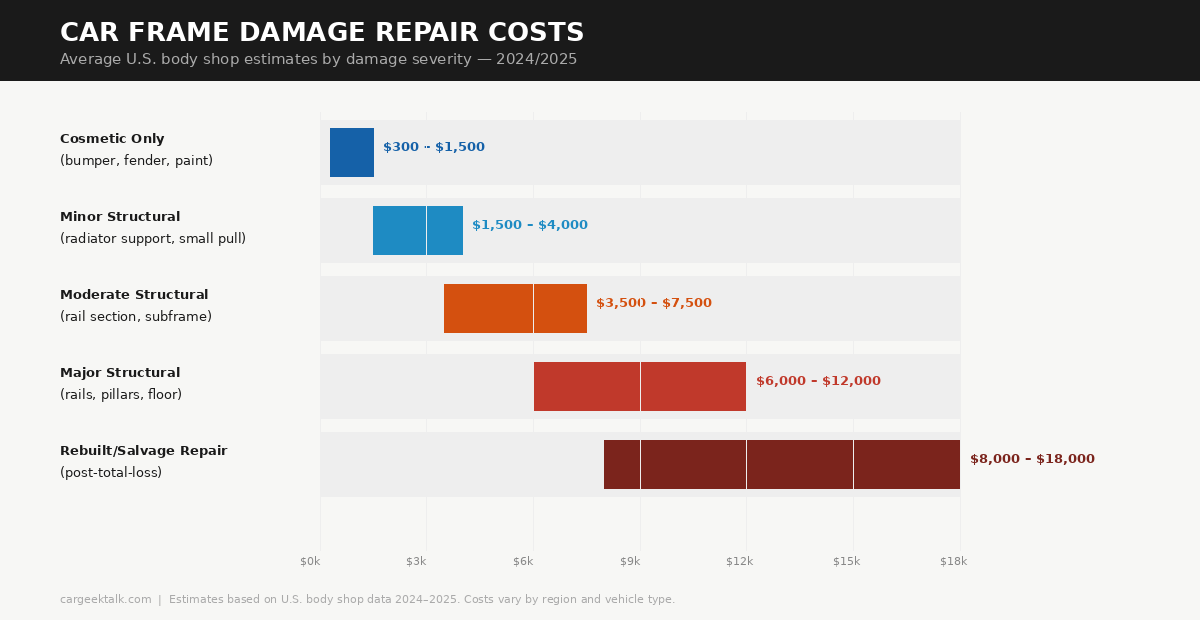
Minor frame straightening at a certified shop runs $600–$2,500. Moderate structural repair involving rail replacement, new panels, and alignment work typically costs $3,000–$7,000. Major repairs involving pillars, floor structure, or extensive rail replacement can exceed $10,000–$15,000 — at which point most insurers will write the car off as a total loss rather than authorize the repair.
Is a car with frame damage safe to drive?
It depends entirely on the severity and quality of the repair. A properly certified structural repair using factory specification parts, performed on a frame machine with measurement verification, can restore a car to roadworthy condition. An uncertified repair that pulled and painted over bent rails is a different situation — the crumple zones have already performed, and the structure won’t behave the same way in a secondary collision. If airbags were deployed and not properly replaced and recalibrated, that’s an additional safety concern.
Will frame damage always show on a CARFAX report?
No. CARFAX and similar services rely on reported data — insurance claims, police reports, title records, and auction disclosures. Private-party accidents handled without insurance involvement leave no trace. Many fleet and rental car incidents go unreported. A clean history report is a positive signal, not a guarantee. It should always be paired with a physical inspection, not used as a substitute for one.
What’s the difference between frame damage and structural damage?
On body-on-frame vehicles (trucks, large SUVs), the frame is a separate ladder structure under the body, so “frame damage” is literal. On modern unibody cars (sedans, crossovers, most SUVs), the body shell and frame are integrated. When people say “frame damage” on a unibody car, they mean the body shell itself is bent or deformed at a structural level — pillars, rails, floor, or firewall. Both types are serious and require professional assessment.
Should I walk away from any car with frame damage?
Not necessarily. A properly documented, professionally repaired structural issue — with paperwork from a certified shop, frame measurement records, and a price that reflects the history — can still be a reasonable buy for the right buyer. The decision should come down to: how severe was the original damage, how competent was the repair, and does the price discount justify the risk and the resale impact? For most first-time buyers, cars with clean histories offer fewer complications and are a safer starting point.
Helpful independent resources: RepairPal · NHTSA · your vehicle's owner's manual