

All Wheel Drive vs Front Wheel Drive: 7 Honest Differences That Actually Matter
You’re standing on a car lot, staring at two nearly identical crossovers. One costs $1,500 more because it has AWD. The salesman says it’s worth every penny. Is it? The awd vs fwd pros and cons debate matters more than most buyers realize — it shapes your purchase price, weekly fuel bill, tire costs, and real-world safety for the next eight to ten years. Get it wrong and you’ll either overpay for hardware you barely use, or spend winters wishing you had more traction.
Here’s what actually matters, with real data behind each point. This breakdown covers all the awd vs fwd pros and cons you need before buying.
Contents
- AWD vs FWD Pros and Cons: What Each System Actually Means
- Why FWD Is Still the Smart Default for Most Drivers
- When the AWD vs FWD Pros and Cons Tip Toward AWD
- The Hidden Costs of All Wheel Drive Most Buyers Don’t Calculate
- 3 AWD Myths That Cost Drivers Real Money
- AWD vs 4WD: They’re Not the Same System
- Tires Matter More Than Drivetrain in Most Situations
- The 7-Point Checklist: FWD or AWD for Your Situation
- Frequently Asked Questions: AWD vs FWD Pros and Cons
AWD vs FWD Pros and Cons: What Each System Actually Means
Front-wheel drive (FWD) sends engine power to the front axle only. The engine and transmission live at the front of the car, driving the same wheels that steer — a compact, lightweight arrangement that became the default for sedans, minivans, and the majority of today’s crossover market. The engine’s weight sits directly over the driven wheels, which is a physics advantage in rain and light snow that people often overlook.
All-wheel drive (AWD) can send power to all four wheels. Most modern systems run primarily as front-wheel drive and only shift torque rearward when sensors detect slip. Others — Subaru’s Symmetrical AWD and Audi quattro, for example — are full-time systems that manage torque at all four corners continuously. That distinction matters because not every AWD badge delivers the same capability. A part-time reactive system is a very different animal from a performance-tuned full-time setup.
| Factor | FWD | AWD |
|---|---|---|
| Purchase price | Lower | +$1,000–$3,000 typically |
| Fuel economy | Better — 1–3 mpg advantage | Slightly worse due to weight & friction |
| Snow traction | Good with proper tires | Better launch grip from a stop |
| Maintenance complexity | Simpler, fewer components | Differential fluid, transfer case service |
| Vehicle weight | Lighter | +50–150 kg heavier |
| Best for | Mild climate, commuters, budget buyers | Snow belt, mountain areas, steep terrain |
Why FWD Is Still the Smart Default for Most Drivers
Front-wheel drive doesn’t get the respect it deserves in online car forums, where every discussion devolves into AWD advocacy. But in fifteen years of writing about car ownership costs, FWD keeps coming out ahead for the majority of American drivers — not because it’s exciting, but because it’s honest.
The engine’s weight sits directly over the driven wheels. On slick roads, that translates to meaningful traction — a FWD car doesn’t understeer on wet asphalt the way some people assume. Pair it with a quality set of all-season or winter tires, and most drivers will never encounter a situation where a second driven axle would have saved them. Add better fuel efficiency and a simpler drivetrain with fewer age-related failure points, and the case for FWD holds up across most real ownership scenarios.
For anyone shopping the used market specifically, this matters even more. A seven-year-old compact crossover with 90,000 miles and FWD carries lower drivetrain risk than the same car with a high-mileage AWD system that’s never been serviced. There’s no rear differential to worry about, no transfer case fluid that should have been changed 40,000 miles ago, and fewer complex components that can fail between now and your next major service.
FWD is the right default if your situation looks like any of these:
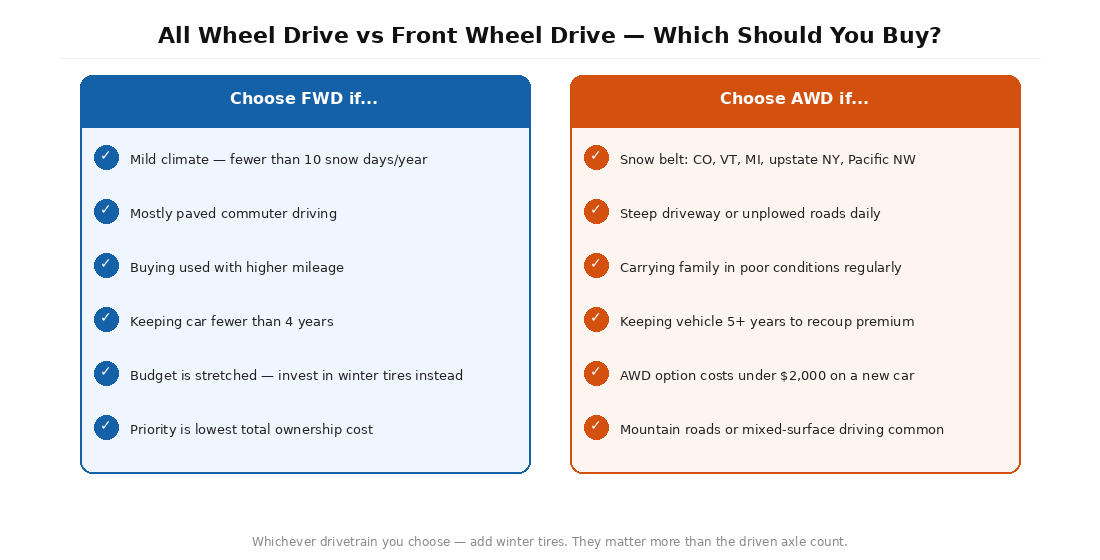
- You commute on paved roads in a region with mild or moderate winters
- You see fewer than 10–15 genuine snow events per year
- You’re buying used and want to limit drivetrain risk on higher-mileage vehicles
- You’d rather spend the $1,500–$2,000 difference on winter tires or a proper emergency fund
- You’re keeping the car for fewer than four years, making the AWD premium harder to recoup
When the AWD vs FWD Pros and Cons Tip Toward AWD
The clearest real-world advantage is launch traction from a stop. At a snow-covered intersection or a wet incline, AWD helps the vehicle put power down with far less wheelspin than FWD. For families, that translates into a calmer, more predictable feeling every morning when conditions are questionable. That confidence factor has real value, even if it doesn’t show up as a line item on a spreadsheet.
Modern AWD systems also improve handling in spirited driving. Torque vectoring setups — found on vehicles like the BMW xDrive and the Volkswagen Golf R — actively push torque to whichever wheel has the most grip, supporting corner exits and high-load stability. For everyday commuters, that advantage is mostly invisible. For mountain driving and mixed-surface roads, it’s genuinely useful.
AWD makes sense when your situation looks like this:
- You live in a consistent snow belt — Colorado, Vermont, Michigan, upstate New York, the Pacific Northwest mountains
- You have a steep driveway or regularly navigate unplowed secondary roads
- You carry passengers often and value the extra margin when conditions turn bad
- You’re buying new, and the AWD option costs less than $2,000
- You plan to keep the vehicle for five or more years, giving the premium time to pay back
One caveat worth putting plainly: all wheel drive helps you accelerate. It does not help you stop. This surprises a lot of drivers. According to AAA’s tire research, winter tires provide 25–50% better traction than all-season tires in heavy snow — an advantage that far outstrips anything AWD provides on its own. An AWD crossover on worn all-season tires can still slide through a winter intersection. A FWD compact on proper winter rubber stops short of it.
The Hidden Costs of All Wheel Drive Most Buyers Don’t Calculate
The sticker price difference between FWD and AWD is visible. The ongoing cost difference is where buyers get caught.
Take fuel. According to CARFAX’s analysis of 2026 models, the AWD version of the Honda CR-V costs $1,500 more and returns 1 mpg less than the FWD model. The Toyota Corolla Cross with AWD costs $1,300 more and gets 2 fewer mpg. That fuel gap may look small, but at 15,000 miles per year and $3.50/gallon, a 2 mpg difference adds up to roughly $525 annually — around $2,600 over five years. You’re effectively paying for the AWD option twice.
Tires add another layer. Many AWD systems — Subaru’s in particular — are sensitive to differences in tire circumference between axles. If one tire is damaged beyond repair, some manufacturers recommend replacing all four to protect the drivetrain from torque imbalance. On a mid-size SUV, that’s $800–$1,400 for a single flat-tire incident versus $200–$350 on an FWD vehicle. It doesn’t happen every time, but it happens often enough that used-car shoppers should factor it in.
| Cost category | FWD | AWD |
|---|---|---|
| Option premium | — | +$1,000–$3,000 |
| Fuel over 5 years | Baseline | +$1,300–$2,600 more |
| Tire replacement | Replace 1–2 as needed | May require full set ($800–$1,400) |
| Drivetrain service | Minimal | Diff fluid + transfer case ($150–$350/service) |
| 5-year true cost gap | Baseline | +$3,000–$7,000 over FWD |
These numbers aren’t meant to discourage AWD buyers — they’re meant to make the calculation honest. If you live somewhere that genuinely needs AWD, that $3,000–$7,000 five-year gap buys real value in safety and reduced stress. If you live in Atlanta and it snows twice a year, you’re paying for something that rarely shows up.
For a broader look at how running costs stack up across manufacturers, our guide to average car repair costs by brand walks through long-term ownership math in detail.
3 AWD Myths That Cost Drivers Real Money
These come up constantly at dealerships and in online forums. Each one leads buyers toward worse decisions.
Myth 1: AWD makes you safer in winter. Partially true — it improves acceleration traction. But safety in winter is primarily determined by braking and cornering grip, both of which come from your tires, not your drivetrain. Tire Rack’s published snow braking test found that winter tires stopped 30 feet shorter than all-season tires from 30 mph on a snow-packed surface. No AWD system closes that gap by itself.
Myth 2: If you have AWD, you don’t need winter tires. This is the most dangerous myth in winter driving. AWD helps you go. Winter tires help you go, stop, and turn. Studies consistently show that AWD with all-season tires has longer braking distances on snow than FWD with dedicated winter rubber. The most effective setup is AWD plus winter tires — not AWD instead of winter tires.
Myth 3: AWD holds its value better. Sometimes, but not reliably enough to justify the premium as an investment. Resale advantage is real in high-snowfall markets like Denver or Minneapolis, but negligible in most of the country. Buying AWD as a resale strategy in a mild climate rarely pencils out.
AWD vs 4WD: They’re Not the Same System
Plenty of buyers treat these terms as synonyms. They aren’t. AWD is designed for on-road, all-weather traction. It works automatically, operates at highway speeds, and requires no driver input. 4WD — the kind found on trucks and body-on-frame SUVs like the Toyota 4Runner and Ford Bronco — is designed for low-speed off-road use, typically requires manual engagement, and includes a low-range gear for extreme terrain situations like rock crawling and deep mud.
If your needs involve ski trips, snowy commutes, and mountain passes, AWD is the right fit. If your needs involve serious trails, deep snow on unpaved roads, or heavy towing, a proper 4WD system is a different — and better — tool for the job. Confusing the two is one reason some buyers end up disappointed by an AWD crossover’s off-road limitations.
Tires Matter More Than Drivetrain in Most Situations
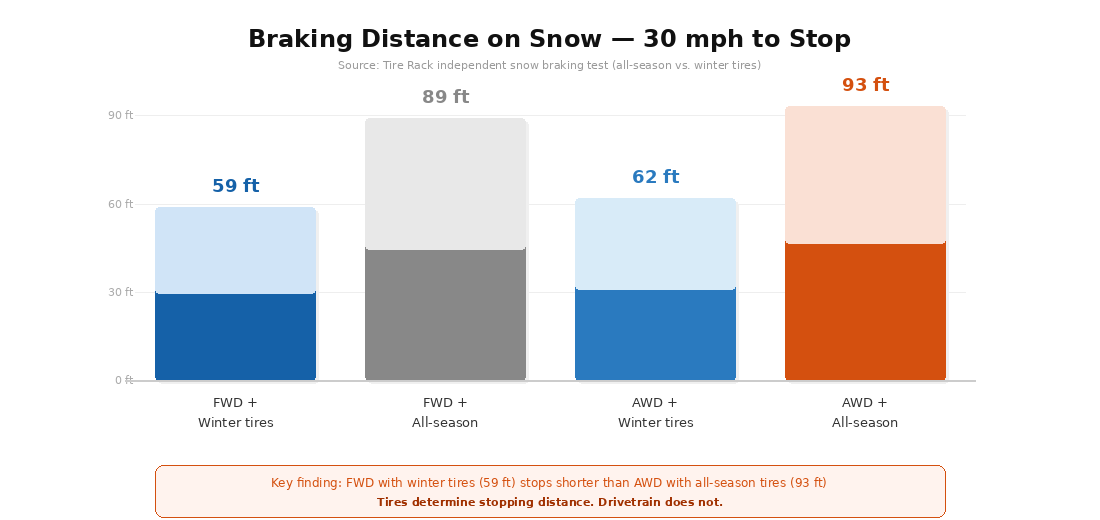
The chart above makes the case clearly, but it’s worth stating in plain English too. Your tires determine braking distance, cornering grip, and aquaplaning resistance. Your drivetrain determines how effectively engine torque reaches the ground when accelerating. In the full picture of winter safety, the tire decision is larger than the drivetrain decision.
The practical ranking for winter capability, from best to least:
- AWD + winter tires — best in every category, highest cost
- FWD + winter tires — braking and cornering nearly identical to #1, lower cost
- AWD + all-season tires — better launch traction, but longer stopping distances than winter-tired FWD
- FWD + all-season tires — fine for mild conditions, limited in genuine winter
A set of quality winter tires typically costs $600–$900 installed. That’s considerably less than the AWD premium on most new vehicles. If your priority is winter safety on a budget, winter tires on FWD frequently outperform AWD on all-seasons at a lower overall cost.
Need help thinking through tire choices for your specific car? Our tire selection guide covers the key decisions without the technical noise.
The 7-Point Checklist: FWD or AWD for Your Situation
the awd vs fwd pros and cons decision comes down to an honest assessment of where you live, how long you’ll keep the vehicle, and what you’re actually trying to solve. In most of the US, FWD paired with the right tires is the more rational choice. In the snow belt, AWD earns its premium — especially when it’s combined with winter tires rather than treated as a substitute for them.
One thing that trips buyers up is confusing what they want with what they need. AWD feels more capable, and that feeling has value. But if you’re paying $2,500 extra for confidence you’ll actually use three weeks a year, it’s worth asking whether a $700 set of winter tires would deliver most of that same confidence at a fraction of the cost.
Before committing to either drivetrain, it’s worth doing a full used car evaluation — drivetrain condition being one of several things to scrutinize closely. Our guide to inspecting used cars like a pro covers what to look for before you sign anything.
Frequently Asked Questions: AWD vs FWD Pros and Cons
Is all wheel drive worth the extra cost?
For drivers in consistent snow belts or mountainous regions, AWD typically returns its premium in safety and reduced daily stress within a few winters. For drivers in mild climates on paved roads, the same money spent on quality winter tires usually delivers more real-world benefit. The calculus changes based on where you live and how long you plan to keep the car.
Is all wheel drive or front wheel drive better in snow?
AWD has a meaningful advantage in launch traction — getting moving from a standstill on ice or snow. But braking and cornering grip, which is where accidents actually happen, are determined by tire compound, not drivetrain. Published testing shows FWD with winter tires stops shorter on snow than AWD with all-season tires. The most capable setup is AWD plus winter tires, but FWD plus winter tires is a close second and considerably cheaper.
How much worse is AWD fuel economy compared to FWD?
Typically 1–3 mpg worse for an equivalent model. Real-world examples include the 2026 Honda CR-V (1 mpg penalty for AWD) and the Toyota Corolla Cross (2 mpg penalty). At 15,000 miles per year and average fuel prices, a 2 mpg difference costs roughly $500–$525 annually — around $2,600 over a five-year ownership period.
Is FWD safe to drive in rain?
Yes. The engine’s weight sits directly over the driven wheels, which naturally improves traction on wet surfaces. Aquaplaning risk is primarily a function of tire tread depth and vehicle speed, not drivetrain type. A FWD car with tires in good condition handles rain confidently in normal conditions.
What is the difference between AWD and 4WD?
AWD is designed for on-road traction — it operates automatically at any speed and improves grip in rain and snow on paved surfaces. 4WD is designed for off-road use, requires manual engagement on most vehicles, and includes a low-range gear for extreme terrain. For the vast majority of awd vs fwd pros and cons buyers, AWD is the relevant system — 4WD is for truck and off-road applications.
Which AWD system is most reliable long-term?
Subaru’s Symmetrical AWD has one of the strongest long-term reliability reputations in the mainstream segment. Toyota’s AWD systems across the RAV4 and Highlander lines have also proven dependable. German systems — Audi quattro, BMW xDrive — are capable but carry higher maintenance costs on older, high-mileage vehicles. When buying used, AWD service history (differential fluid changes in particular) matters more than the brand name of the system.