

Gunther Werks Review: The California Restomod That Takes the Last Air-Cooled 911 to 1,000 HP
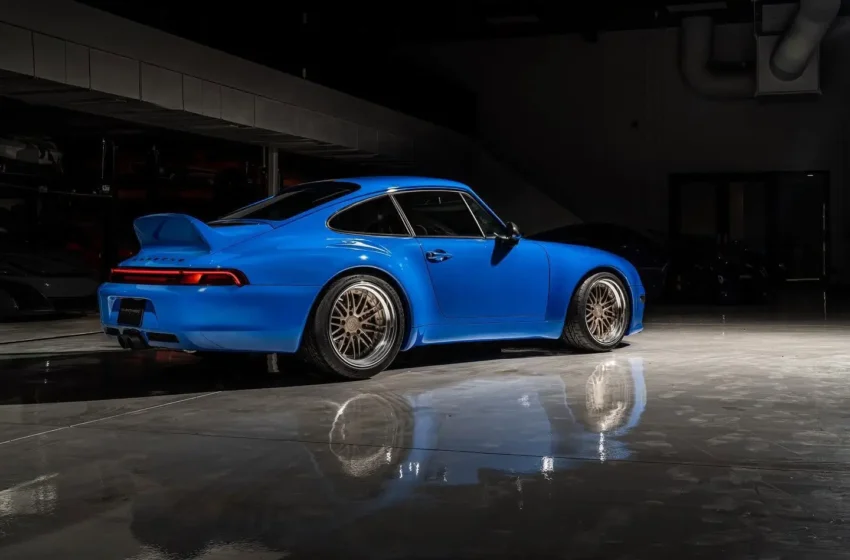
Every time someone asks me which restomod house does the Porsche 993 real justice, I give the same answer: Gunther Werks. Not Singer — they make beautiful cars, but Singer has become something closer to a luxury fashion brand at this point. Not RWB — that’s an entirely different religion. Gunther Werks, every time.
It’s not just the horsepower numbers, though the F-26’s 1,000 hp twin-turbo flat-six is hard to argue with. It’s the story behind the company. A founder who got rejected by every investor he pitched. A company named after a NASA engineer. A vertically integrated workshop in California is quietly building some of the most technically serious restomod cars on earth.
I’ve spent a lot of time with their programs, specifications, and ownership experience. Here’s my full breakdown of what Gunther Werks offers in 2026, why it matters, and whether this is where serious 993 money belongs.
Contents
- The Story Behind Gunther Werks
- What Gunther Werks Actually Builds
- The Six Programs Explained
- Program Specifications at a Glance
- Engineering Details Worth Knowing
- Gunther Werks vs Singer vs Theon Design
- The Ownership Experience
- Why the 993 Specifically
- 2026 Status
- Verdict
- Frequently Asked Questions
- More from Car Builder Spotlight
The Story Behind Gunther Werks
Peter Nam started Gunther Werks the hard way. He had a clear vision — take the Porsche 993, the last air-cooled generation of the 911, and rebuild it using contemporary engineering without destroying what made the original car special. The analog soul, the raw connection between driver and machine, is preserved through modern methods.
Investors weren’t interested. Industry veterans said it couldn’t be done at the level Nam was describing. He got turned down enough times that you’d expect most people to move on. Instead, he kept going. The company’s logo carries a symbolic “X” pattern that represents, in their own words, “every door that closed, and the unwavering vision that opened another path forward.”
The company name is a deliberate tribute. Gunther Werks is named after Gunther Wendt, a NASA aerospace engineer who oversaw pad operations during the Apollo program. Wendt was legendary for his uncompromising standards — nothing went near a rocket on his pad unless it was exactly right. Nam’s reasoning is direct: that kind of precision and discipline is exactly what his builds demand. If you’re going to charge serious money for a car built around a 30-year-old platform, the standards had better be aerospace-grade.
The company operates out of California and functions as a vertically integrated manufacturer. That’s an important distinction. Many restomod shops are more curators than manufacturers — they source components from specialists and assemble them into finished cars. Gunther Werks designs, engineers, and manufactures most of what goes into their cars in-house. That’s a harder way to do it, but it gives them complete quality control and — critically — it means they can push innovation forward for existing owners without locking them into the spec their car shipped with.
What Gunther Werks Actually Builds
Every Gunther Werks car starts with a Porsche 993 donor. The 993 was produced from 1994 to 1998 and represents the final evolution of the air-cooled 911 before Porsche switched to water cooling with the 996 in 1998. More on why that matters in a moment.
The process is comprehensive from the start. The donor car is fully disassembled. Every body panel, chassis component, and mechanical system is assessed before anything is rebuilt. Carbon fiber bodywork is fabricated in-house. The chassis undergoes structural reinforcement. The powertrain is rebuilt — or in some programs, entirely replaced — with components engineered specifically for the commission.
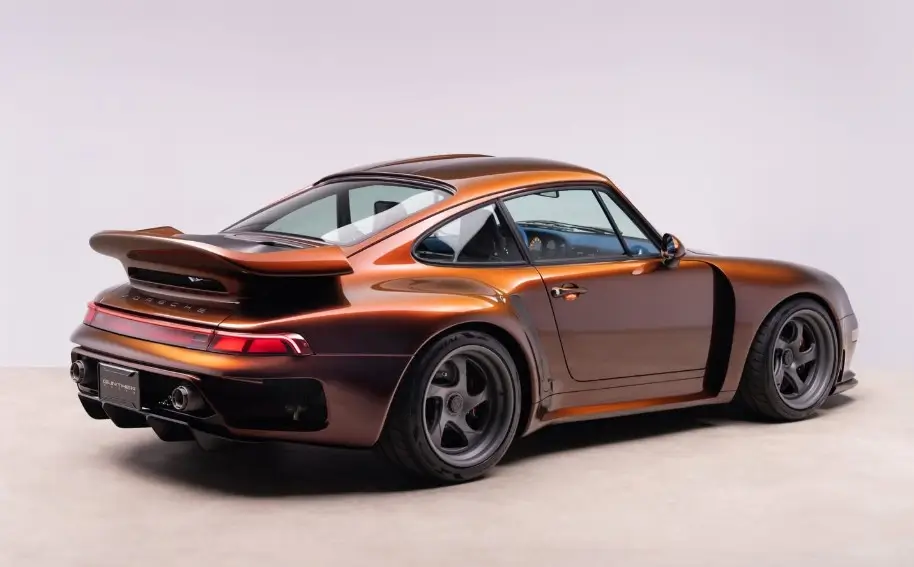
Six distinct programs exist in 2026, ranging from a naturally aspirated purist’s build to a 1,000-horsepower twin-turbo monster. Each is a commission — you don’t buy a Gunther Werks off a lot. You come to them with your preferences, and the car is built around you.
The Six Programs Explained
Gunther Werks doesn’t use the word “model” in the traditional sense. They call these programs because each one represents a different philosophy about what the 993 should be. Pricing is available on direct inquiry — none of these are impulse purchases, and Gunther Werks doesn’t publish price lists the way a mainstream manufacturer would.
GWR — “The Definitive 993”
The GWR is Gunther Werks’ naturally aspirated program and the one I’d describe as the emotional core of what the company is trying to do. No turbos, no forced induction, no theatrical horsepower figures — just a properly sorted 993 that rewards clean driving. The tagline is “the definitive 993,” which is a confident claim, but the engineering behind it backs it up.
If you care about what a 993 is supposed to feel like — that direct, analog steering, the flat-six singing behind your ears, the rear-engine balance that you have to earn — the GWR is the program to start with. It’s the one Peter Nam would probably build for himself.
Coupe — “Pure Form”
The Coupe program strips the brief down to design. Pure form, as they describe it. This isn’t about chasing a lap time or a dyno number — it’s about building the most visually and functionally resolved version of the 993 body. Carbon fiber work is central here, and the attention to panel gaps, shut lines, and proportions reflects the aerospace-grade quality standards the company was founded on.
The Coupe appeals to buyers who want the Gunther Werks treatment but define perfection through aesthetics and craftsmanship rather than performance metrics.
Speedster — “Open-Air Emotion”
The Speedster is the open-air program — a roofless interpretation of the 993 that prioritizes the sensory experience of driving without a roof between you and the air. It’s an emotional proposition. The mechanical underpinnings still benefit from the full Gunther Werks treatment, but the Speedster’s reason for existing is the feeling rather than the specification sheet.
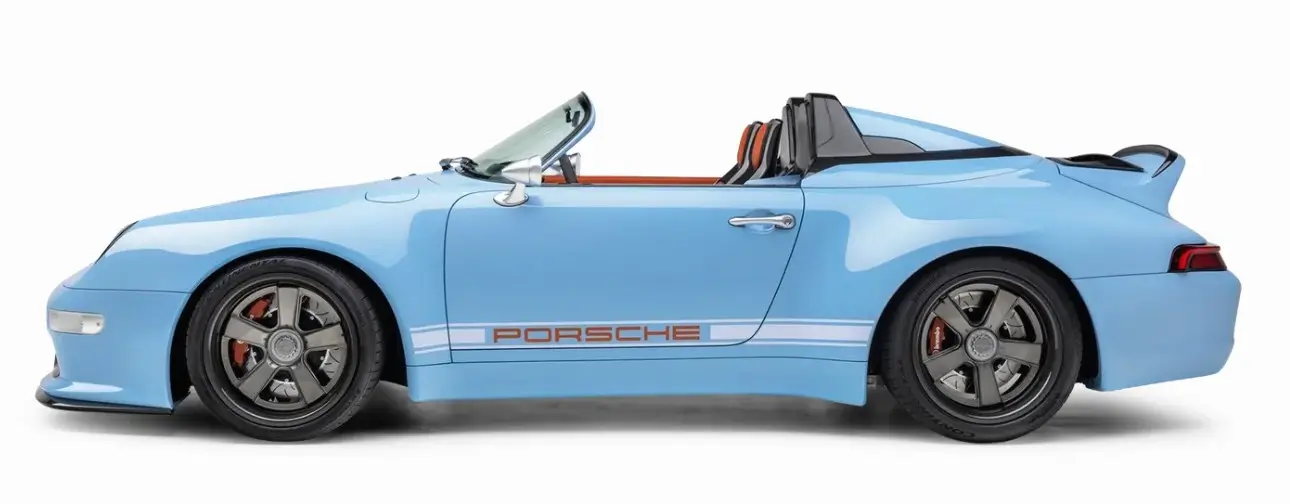
Convertibles and open cars are polarizing in this segment. If you’ve ever driven a classic open-air 911 on a mountain road on a warm evening, you understand why this program exists. If you haven’t, it’s hard to explain on paper.
Turbo — 850 HP
This is where the numbers start getting serious. The Turbo program produces 850 horsepower and 600 lb-ft of torque from a 4.0-liter twin-turbo flat-six. The engine spins to 7,500 rpm, managed by a Motec ECU, and drives through a Getrag 6-speed gearbox with a carbon clutch differential offering 40% locking capability. Production is limited to 75 examples.
The chassis work that makes these numbers usable is thorough. Suspension geometry has been revised with bespoke computer-controlled active coilover suspension — DGR specification. The braking system uses Brembo GTR hardware: 6-piston calipers and 355mm x 32mm discs up front, 4-piston and 345mm x 28mm at the rear, with optional CCMR carbon brake upgrade. Wheels are 18×11″ front and 18×13″ rear in forged magnesium/carbon fiber, or T-6061 forged aluminum, running on titanium studs.
The Turbo is the program for buyers who want a road car that can also embarrass supercars at track days without requiring a trailer-queen ownership experience.
F-26 — 1,000 HP
The F-26 is the headline program. It produces 1,000 hp at 7,600 rpm and 750 lb-ft of torque at 5,600 rpm from a 4.0-liter twin-turbo flat-six developed in collaboration with Rothsport Racing — one of the most respected Porsche engine specialists in the country. Fueling is mapped for high-octane with ethanol capability and adaptive fueling.
The cooling system deserves special mention: Gunther Werks’ race-derived flat fan delivers more than double the airflow of a standard vertical fan — critical when you’re pushing a 993’s air-cooled architecture to these outputs. Exhaust exits through a 935-style system with external wastegates, which is both technically correct and visually dramatic.
The chassis changes are substantial. The 993 steel frame receives a 200% rigidity increase. The wheelbase is extended 30mm rearward — a significant chassis modification that improves weight balance and high-speed stability. Front suspension uses a double wishbone layout with JRZ electronic adjustment. Rear is multilink, also JRZ electronic. Steering remains hydraulically-assisted rack-and-pinion, which is the right choice at this performance level — you want feel, not isolation.
Brakes are massive: 381mm CCMR rotors with 6-piston GT-R calipers up front, 355mm with 4-piston GT-R calipers at the rear. Wheels are the same 18×11″ and 18×13″ Turbo Twist magnesium format as the Turbo program, wearing Continental ExtremeContact Force tires — 295/30R18 front, 335/30R18 rear. Curb weight: 2,750 lbs.
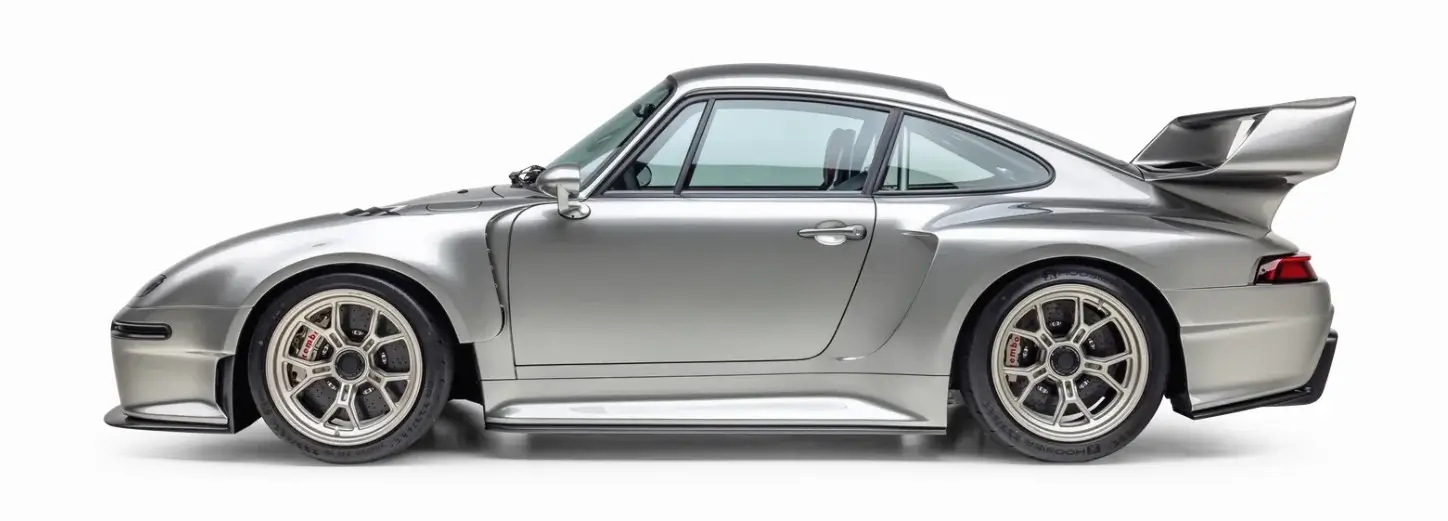
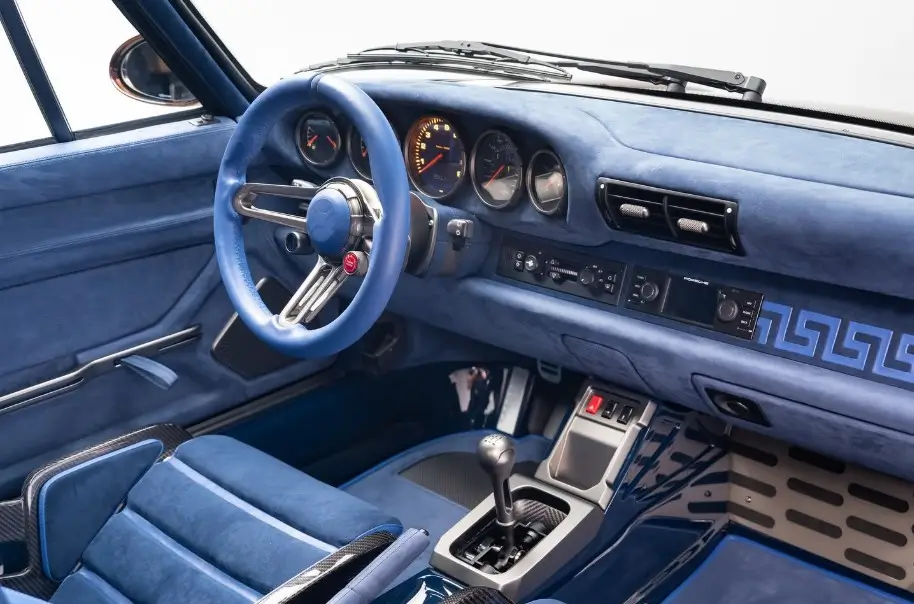
Inside, a carbon-fiber steering wheel with a fighter-jet profile, leather and Alcantara seating, satin stealth gauge rings, and a Porsche Classic radio unit with Apple CarPlay. The roll cage is finished in Carmine Red. Externally, exposed carbon fiber appears on the engine shroud, rear spoiler, and diffuser, and the taillights are tinted LED Sabre units.
The F-26’s 1,000 hp flat-six, developed with Rothsport Racing — source: guntherwerks.com
GWX — Invitation Only
The GWX is Gunther Werks’ experimental division — described as “a true one-of-one masterpiece.” Access is by invitation only. Specifications are not published because there are no standard specifications; each GWX is created in direct collaboration with a single client.
This is the program that exists to answer the question: what if no constraint is applied? The GWX is where Gunther Werks pushes the platform into territory that has no name yet. I don’t know exactly what’s been built under this designation — that’s intentional on their part — but the existence of an invitation-only experimental program at a house this serious suggests the results are extraordinary.
Program Specifications at a Glance
| Program | Power | Engine | Production | Tagline |
|---|---|---|---|---|
| GWR | N/A | Naturally aspirated 3.8L flat-six | Limited commission | The definitive 993 |
| Coupe | TBD on commission | Commission-spec | Limited commission | Pure form |
| Speedster | TBD on commission | Commission-spec | Limited commission | Open-air emotion |
| Turbo | 850 hp / 600 lb-ft | 4.0L twin-turbo, 7,500 rpm, Motec ECU | Limited to 75 examples | Forced induction mastery |
| F-26 | 1,000 hp / 750 lb-ft | 4.0L twin-turbo, 7,600 rpm, Rothsport | Limited commission | The future of analog power |
| GWX | Undisclosed | Undisclosed | One-of-one, invitation only | A true masterpiece |
Engineering Details Worth Knowing
The numbers are one thing. How Gunther Werks actually achieves them is more interesting.
Vertical Integration
Most restomod builders are integrators — they orchestrate suppliers and assemble. Gunther Werks does much of the fabrication in-house: carbon fiber body panels, structural chassis work, interior trim, and suspension components. This matters for quality consistency, and it matters for the owner who wants the car updated as the company’s technology advances.
Backward Compatibility
This is one of the most unusual policies in the segment. Gunther Werks develops products with backward compatibility, meaning existing owners can benefit from engineering innovations that come after their car was delivered. That’s closer to a software company’s philosophy than a coachbuilder’s — and it reflects genuine respect for the people commissioning these cars.
The Chassis Engineering
The F-26’s 200% chassis rigidity increase and 30mm wheelbase extension aren’t marketing metrics — they’re structural decisions that change how the car behaves at speed. The 993’s original chassis was designed around a 270-horsepower engine. Asking it to contain 1,000 horsepower without modification isn’t engineering; it’s optimism. Gunther Werks solves this properly.
JRZ Electronic Suspension
Both the Turbo and F-26 programs use computer-controlled active suspension from JRZ, a Dutch suspension specialist respected in motorsport. This gives the car the ability to adapt damping in real time — compliant enough for road use, firm enough when the driver is pushing. On a car with 850–1,000 hp, this isn’t a luxury option; it’s a safety requirement.
The Warranty That Shouldn’t Exist
Gunther Werks offers a 5-year / 100,000-mile comprehensive warranty. On a heavily modified, limited-production sports car built on a 30-year-old platform, this is extraordinary. Most restomod operations offer limited support; Gunther Werks backs its work with a warranty that rivals mainstream manufacturers. The coverage is also retroactive across owners — if you buy a second-hand Gunther Werks, the warranty transfers with it, and you’re not program locked.
Gunther Werks vs Singer vs Theon Design
The obvious comparison is Singer Vehicle Design. Both companies work in California, both produce limited-edition Porsche 911 restomods, and both charge serious money for the privilege. Theon Design in Oxfordshire works in the same platform segment but focuses on the 964 rather than the 993.
| Gunther Werks | Singer Vehicle Design | Theon Design | |
|---|---|---|---|
| Platform | Porsche 993 (1994–1998) | Porsche 964 (1989–1994) | Porsche 964 (1989–1994) |
| Location | California, USA | California, USA | Oxfordshire, UK |
| Max power | 1,000 hp (F-26) | ~500 hp (DLS) | ~500 hp (Theon R) |
| Programs | 6 (GWR, Coupe, Speedster, Turbo, F-26, GWX) | Multiple (Classic, DLS, Turbo Study) | 4 (3.8 Coupe, 4.0 Coupe, Theon R, Targa) |
| Warranty | 5-year / 100,000-mile, transferable | Limited, program-specific | Standard builder warranty |
| Backward compatibility | Yes — engineering upgrades apply to existing cars | No formal policy | No formal policy |
| Vertical integration | High — most components in-house | Mixed — specialist partnerships | Mixed — specialist partnerships |
| Starting price (approx.) | On application | $500K–$1.8M+ | From £410K (~$520K) |
My honest take: Singer makes the most recognizable Porsche restomod. Walk into any car show with a Singer, and people will crowd around it. But Singer’s pricing has climbed to the point where the DLS — their flagship — costs more than most Ferraris, and the brand now carries a fashion premium that’s separate from the engineering.
Theon Design is the most technically focused of the three in the 964 space. Founder Adam Hawley’s background at BMW, Lotus, and Jaguar shows in the engineering decisions, and the Theon R is a genuinely impressive piece of work.
Gunther Werks occupies a different position. The 993 platform gives them a technical head start — it’s a more refined, more capable base car than the 964. The warranty and backward compatibility policy is unmatched in this segment. And the F-26, at 1,000 horsepower, is playing in a performance category that Singer and Theon simply don’t reach.
The Ownership Experience
Gunther Werks is explicit that owning one of their cars is meant to be more than a transaction. The ownership experience includes access to an exclusive community of fellow owners, invitations to private events, and track experiences at world-class circuits. For context: if you’ve spent half a million dollars or more on a car, the idea that you’d want to use it alongside other people who made the same decision makes sense.
The 5-year / 100,000-mile warranty is transferable and retroactive across owners — meaning if the original commissioner sells the car, the buyer inherits the warranty. In a market where most rare cars are bought and sold multiple times, this matters. Gunther Werks also explicitly states there is no “program locking” — you aren’t frozen at the specification your car shipped with. As the company develops new solutions, existing owners can access them.
For commissioning, you contact the team directly via the Gunther Werks contact page. There’s no walk-in showroom experience. You’re having a conversation with the company about what you want, and the car gets built around that conversation.
Why the 993 Specifically
This question is worth answering properly, because the 993’s status as “the last air-cooled Porsche 911” is sometimes treated as pure nostalgia. It’s not.
The air-cooled 911 ended with the 993, not because Porsche wanted to preserve some automotive heritage, but because emissions and thermal management requirements were pushing into territory the air-cooled architecture couldn’t meet without severe compromises. The 993 was Porsche’s engineers solving every problem they could within that constraint — multi-link rear suspension replacing the old semi-trailing arm setup, a revised 3.6-liter flat-six, improved aerodynamics, a more refined interior. It’s the most complete version of a design philosophy that traces back to the 1960s.
The 996 that followed was a genuinely good car — better in most measurable ways. But it was a different car. Water-cooled, new architecture, new philosophy. The 993 is the end of a continuous line, and that’s not a story that car manufacturers can replicate. Gunther Werks knows exactly what they’re working with and builds accordingly.
Donor cars typically require sourcing from the market before a commission begins. A good 993 base now trades well into six figures — the platform’s reputation is established, and prices reflect that. As with any restomod of this nature, the total investment includes the donor cost plus the build cost.
2026 Status
Gunther Werks is in full operation with all six programs active. The Turbo program is the most production-limited at 75 examples, and with its build rate, allocations in that program close relatively quickly. The GWX remains invitation-only and, by its nature, has no announced availability.
Demand for 993-based restomods has grown internationally as the platform’s significance becomes more widely understood. California remains the operational base, but commissions come from buyers across the United States, Europe, and the Middle East.
Verdict
Gunther Werks is the answer to a specific question: what does a serious engineer do with the best version of the air-cooled 911? Not the most famous version, not the most emotionally resonant version, but the technically best one — and then applies contemporary manufacturing discipline to bring it to a standard the original couldn’t reach.
The F-26 at 1,000 horsepower is the headline. But I’d argue the GWR is the soul of the company. A naturally aspirated 993 sorted to modern standards, driven the way a 911 is supposed to be driven — that’s the thing Peter Nam was rejected for believing in, and that’s the thing he built anyway.
The 5-year warranty, the backward compatibility, the vertical integration — these aren’t marketing points. They’re evidence of a company that takes its commitments seriously. In a segment full of beautiful objects that exist primarily to photograph well, Gunther Werks is building something that functions at the highest level and stands behind it.
If the 993 is the car, Gunther Werks is the house to go to.
Frequently Asked Questions
What is Gunther Werks?
Gunther Werks is a California-based restomod company that builds comprehensively reengineered versions of the Porsche 993 — the last air-cooled generation of the 911, produced 1994–1998. Founded by Peter Nam and named after NASA engineer Gunther Wendt, the company operates six programs ranging from naturally aspirated builds to a 1,000-horsepower twin-turbo flagship.
How much does a Gunther Werks car cost?
Gunther Werks does not publish pricing publicly. All builds are commissioned directly with the company. Given the complexity of the builds, the engineering involved, and comparable programs in the segment, entry-level commissions are expected to start well into six figures. Contact the team via the Gunther Werks enquiry page for current pricing and availability.
What is the most powerful Gunther Werks program?
The F-26 is the most powerful, producing 1,000 horsepower and 750 lb-ft of torque from a 4.0-liter twin-turbo flat-six co-developed with Rothsport Racing. The chassis is substantially reinforced, and the wheelbase is extended by 30 mm to handle the power output.
Does Gunther Werks offer a warranty?
Yes. Gunther Werks offers a comprehensive 5-year / 100,000-mile warranty — one of the most generous coverage packages in the restomod segment. The warranty is transferable to subsequent owners, and the company operates a “never program locked” policy, meaning existing owners can benefit from future engineering advances.
What is the GWX program?
The GWX is Gunther Werks’ experimental division, producing true one-of-one builds by invitation only. Specifications are not published — each GWX is designed in direct collaboration with a single client with no template constraints applied.
How does Gunther Werks compare to Singer Vehicle Design?
Both companies are California-based Porsche restomod specialists. Singer focuses on the 964 platform; Gunther Werks works with the 993. Gunther Werks’ flagship programs exceed Singer’s power outputs significantly (1,000 hp vs roughly 500 hp for Singer’s DLS), and Gunther Werks’ warranty and backward compatibility policies are more comprehensive. Singer has stronger brand recognition and a longer track record in the market.
Why does Gunther Werks use the Porsche 993 as a donor car?
The 993 is the final air-cooled Porsche 911, produced 1994–1998, and represents the most refined version of the original 911 architecture. It introduced multi-link rear suspension, improved aerodynamics, and a more sophisticated chassis compared to earlier generations. As the last of its kind, it holds significant historical and emotional value — and as a technical platform, it provides a superior starting point for high-performance restomod work compared to earlier generations.
More from Car Builder Spotlight
Gunther Werks isn’t the only boutique builder worth knowing about. Our Car Builder Spotlight series digs into the niche manufacturers, restomod specialists, and independent builders that mainstream media ignores.
- Theon Design Review — The British restomod that builds a better 911 than Porsche. A husband-and-wife team in Oxfordshire is rebuilding the Porsche 964 from bare metal, 6,000 hours at a time.
- Kimera Automobili Review — The Italian restomod brand reimagining legendary rally cars. Modern engineering meets the soul of Group B homologation specials.