
Start a Car With a Bad Fuel Pump: 7 Proven Tricks

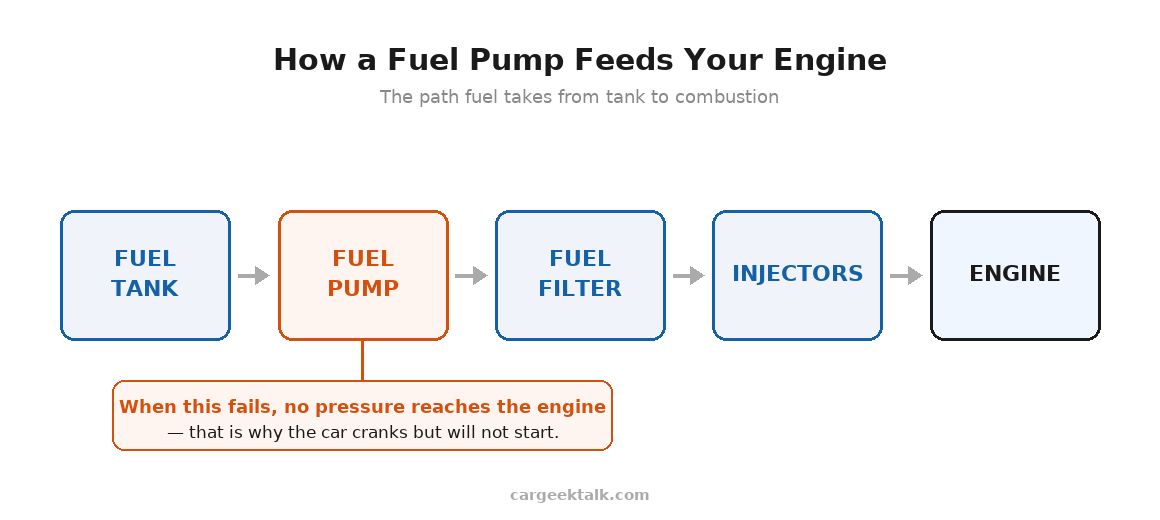
It always happens at the worst possible moment. You turn the key, the starter spins, the engine cranks over and over — and nothing catches. If you have ever had to start a car with a bad fuel pump, you know that sinking feeling: you are late, you are stranded, and the nearest tow truck is an hour out. Here is the good news from someone who spent years on the lot and under the hood — a fuel pump rarely dies all at once. It usually fades. And while it is fading, there are real tricks that can coax one more start out of it long enough to get you home or to a shop.
Below are the seven methods I actually trust, why each one works, and the honest line where you need to stop turning the key and call for help instead.
Contents
- First, Confirm It Is Actually the Fuel Pump
- 7 Ways to Start a Car With a Bad Fuel Pump
- Why a Fuel Pump Fails in the First Place
- What It Costs to Fix a Bad Fuel Pump
- When You Should Stop Trying to Start a Car With a Bad Fuel Pump
- My Honest Take After Years on the Lot
- FAQ: Starting a Car With a Bad Fuel Pump
First, Confirm It Is Actually the Fuel Pump
Before you do anything else, make sure you are chasing the right problem. Plenty of cars get towed in for a “dead fuel pump” that turns out to be a flat battery, a corroded relay, or a clogged filter. The symptoms overlap, and guessing wrong wastes time and money.
A genuinely failing pump usually shows a pattern: the engine cranks normally but will not fire, it sputters and dies under acceleration, or it starts fine cold and quits once everything heats up. A high-pitched whine from the rear of the car is another classic tell. If the engine does not crank at all, or the dash goes dark when you turn the key, you are likely looking at a battery or starter issue instead — not the same beast as other fuel-system problems that mimic pump failure.
7 Ways to Start a Car With a Bad Fuel Pump
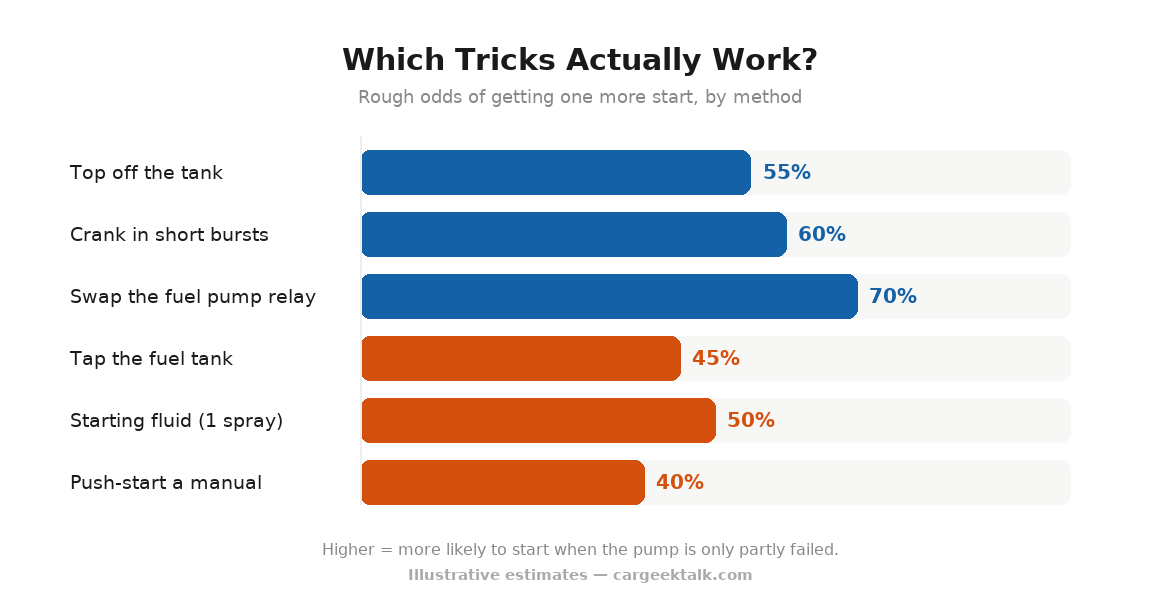
Work through these in order. The early ones are quick and safe; the later ones carry more risk and should only be used when you are genuinely stuck. None of them are permanent fixes — they buy you a drive, not a cure.
1. Top Off the Tank and Rule Out Bad Fuel
A weak pump struggles far more when the tank is low, because the fuel itself helps cool and lubricate the pump motor. Running on fumes makes a marginal pump give up entirely. Add a few gallons of fresh fuel and try again. While you are at it, think about the last fill-up — if you bought gas from a sketchy station or the car has sat for months, contaminated or stale fuel can choke an already-tired pump.

2. Listen for the Fuel Pump Prime
Turn the key to the “on” position — but do not crank — and listen closely near the rear seats or filler neck. A healthy pump gives a faint two-second whirr as it pressurizes the system. Silence is a strong sign that the pump (or its relay or fuse) is not getting power. If you do hear the prime but the car still will not start, the pump may be building partial pressure, which is exactly the situation where the next few tricks can work.
3. Crank in Short Bursts
A dying pump can sometimes build just enough pressure if you give it a moment. Turn the key to “on,” wait three to five seconds for the prime, then crank. If it does not catch, stop, cycle the key off and on a couple of times to re-prime, then try again. Cranking in short bursts — rather than one long, battery-draining grind — is one of the most proven and reliable ways to start a car with a bad fuel pump when it is right on the edge.
A gentle tap of the accelerator while cranking can help on older throttle-body cars, but go easy. Endless cranking will flatten your battery and cook the starter, so cap it at five or six attempts.

4. Tap the Bottom of the Fuel Tank
This sounds like a backyard myth, but it has saved me more than once. The pump motor sits inside the tank, and worn brushes can stick on a dead spot. A few firm taps on the underside of the tank with a rubber mallet or a closed fist — while a helper holds the key in “on” — can jar the brushes off that spot just long enough to spin the motor. It is crude, it is temporary, and it absolutely means the pump is on its way out. But in a parking lot at night, it can be the difference between driving home and waiting for a flatbed.
5. Test or Swap the Fuel Pump Relay
Often, the pump is fine, but the relay supplying it has failed. The relay is a cheap plug-in switch in the fuse box, and the fix can cost a few dollars instead of several hundred. Find your fuse-box diagram (it is usually printed on the lid or in the owner’s manual), locate the fuel pump relay, and pull it. Many cars use the same relay for the horn, A/C, or headlights — swap one of those identical relays into the pump slot and try to start. If the engine fires, you just found your culprit.

6. Use Starting Fluid — Carefully
Starting fluid (ether) sprayed into the intake gives the engine something to burn for a second or two, which can be enough to get it running if the pump is producing a trickle of pressure. I list this one near the bottom for a reason: ether is harsh, and overusing it can wash down cylinder walls or, on diesels and some direct-injection engines, cause real damage. One short spray, one start attempt — that is the limit. If it does not fire on the first try, this is not your fix.
7. Push-Start a Manual
If you drive a stick, you can bump-start it. Get the car rolling (on a slight downhill or with a couple of strong pushers), turn the key to “on,” put it in second gear, and pop the clutch once you have a little speed. The turning engine can sometimes pull fuel past a weak pump long enough to catch. This does nothing for an automatic, and it will not help if the pump is producing zero pressure — but for a manual with a borderline pump, it works surprisingly often.
Why a Fuel Pump Fails in the First Place
Understanding the cause helps you avoid a repeat. Most pumps die for a handful of reasons: chronic low fuel levels that let the motor run hot, contaminated or water-laced fuel that wears the internals, simple high-mileage age, electrical faults in the relay or wiring, and heat soak in summer. There is also one cause owners forget entirely — recalls. Fuel pumps from major suppliers have been recalled in enormous numbers over the years, so it is always worth checking your VIN against the official database at NHTSA’s recall lookup before you pay for a new part.
Keeping the tank above a quarter and sticking to reputable fuel are the two cheapest habits that extend pump life. The EPA’s own vehicle maintenance guidance backs up what every good mechanic will tell you: small, consistent care beats expensive repairs later.
What It Costs to Fix a Bad Fuel Pump
Once you have limped the car home, you need to know what the real repair costs. Here is a realistic range. Doing it yourself saves a lot, but in-tank pumps often require dropping the tank, which is a genuinely awkward job — budget accordingly. For a full walkthrough of tackling jobs like this, see our step-by-step car repair guide.
| Repair | DIY Parts Cost | Shop Total (Parts + Labor) |
|---|---|---|
| Fuel pump relay | $5 – $30 | $60 – $120 |
| Fuel filter | $15 – $50 | $70 – $160 |
| In-tank pump module | $80 – $300 | $400 – $900+ |
| External (inline) pump | $50 – $200 | $250 – $600 |
If you are weighing whether the car is worth the repair at all, our breakdown of long-term hybrid vs gas maintenance costs can help you put a single big bill in context.
When You Should Stop Trying to Start a Car With a Bad Fuel Pump
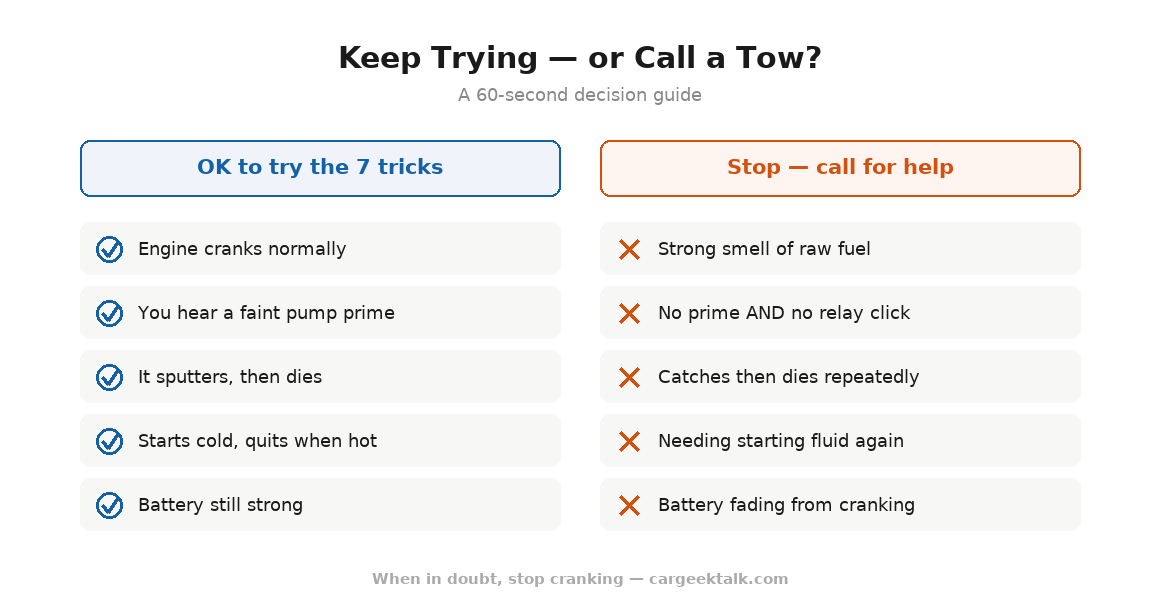
This is the part most guides skip, and it matters most. There is a point where trying again does more harm than good. Stop and call a tow if you notice any of the following: a strong smell of raw gasoline (possible leak), repeated need for starting fluid, the engine catching and dying instantly over and over, no pump prime and no click from a known-good relay, or a battery that is clearly fading from too much cranking. Pushing past these signs risks a fire, a flooded engine, or a flat battery that strands you twice.
Use the quick decision guide below to decide in under a minute whether to keep trying or make the call.
My Honest Take After Years on the Lot
I have watched plenty of buyers limp a car in on tricks like these, and almost every time the pump had been warning them for weeks — the hot-day stalls, the morning hesitation, the faint whine they tuned out. These methods are genuinely useful in a pinch, and I would not hesitate to use them to get myself off a dark roadside. But treat the first successful start as borrowed time, not a repair. Get the pump diagnosed the next day properly, and you turn a roadside emergency into a planned, far cheaper fix.
FAQ: Starting a Car With a Bad Fuel Pump
Can you still start a car with a bad fuel pump?
Often, yes, temporarily. If the pump is failing but still building partial pressure, tricks like topping off the tank, cranking in short bursts, tapping the tank, or swapping the relay can get one more start. A pump producing zero pressure will not start at all.
How long can I drive on a failing fuel pump?
There is no safe distance. A weak pump can quit at any moment — often on a highway or in traffic, which is dangerous. Drive only as far as needed to reach a safe spot or a shop, then have it replaced.
Does tapping the fuel tank really work?
Sometimes. Firm taps can jar stuck motor brushes off a dead spot long enough to spin the pump. It is strictly a temporary trick and a clear sign the pump needs replacing soon.
Is starting fluid safe to use?
In tiny amounts on gasoline engines, occasionally. Overuse can damage cylinder walls and is risky on diesel and direct-injection engines. One short spray and one attempt is the limit — never make it a habit.
How do I know if it is the fuel pump or the relay?
Swap the fuel pump relay with an identical one from the fuse box (horn, A/C, etc.). If the car starts, the relay was the problem — a cheap fix. If nothing changes, the pump itself is the likely cause.
How much does it cost to replace a bad fuel pump?
A relay runs $5–$30 in parts. A full in-tank pump module typically costs $400–$900+ at a shop, or $80–$300 in parts if you do it yourself.
Helpful independent resources: RepairPal · NHTSA · your vehicle's owner's manual