
Car Warning Lights: 8 You Should Never Ignore
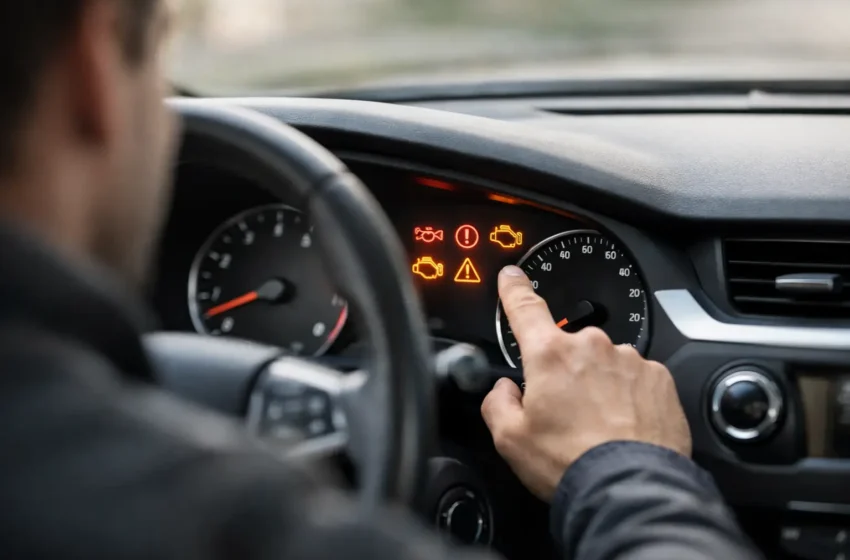
You’re three hours into a road trip, doing 75 in the left lane, when a little amber icon blinks to life on the dash. Heart skips. Foot eases off the gas. And then the question every driver has asked at least once: do I pull over right now, or is this a “deal with it Monday” situation? That’s the whole problem with car warning lights — they don’t all carry the same weight, and the dashboard rarely tells you how scared to be.
Some are gentle nudges. Your washer fluid is low. Cool, noted. Others are your engine quietly screaming that it’s about to grenade itself if you keep driving. Treating those two the same way is exactly how people end up paying for a new long block when a $30 quart of oil would’ve saved it.
I’ve owned enough high-mileage cars to have seen most of these icons up close — some on my own dash, some on a friend’s car right before it stranded them. So let’s sort the harmless from the catastrophic.
Contents
- Car warning lights: what the colors actually tell you
- The 8 car warning lights that matter most
- Quick reference for the most common dash lights
- The car warning lights people quietly underestimate
- What to do when a warning light comes on
- Why one warning light can mean wildly different repair bills
- When you can drive and when you should stop
- Frequently asked questions about car warning lights
Car warning lights: what the colors actually tell you
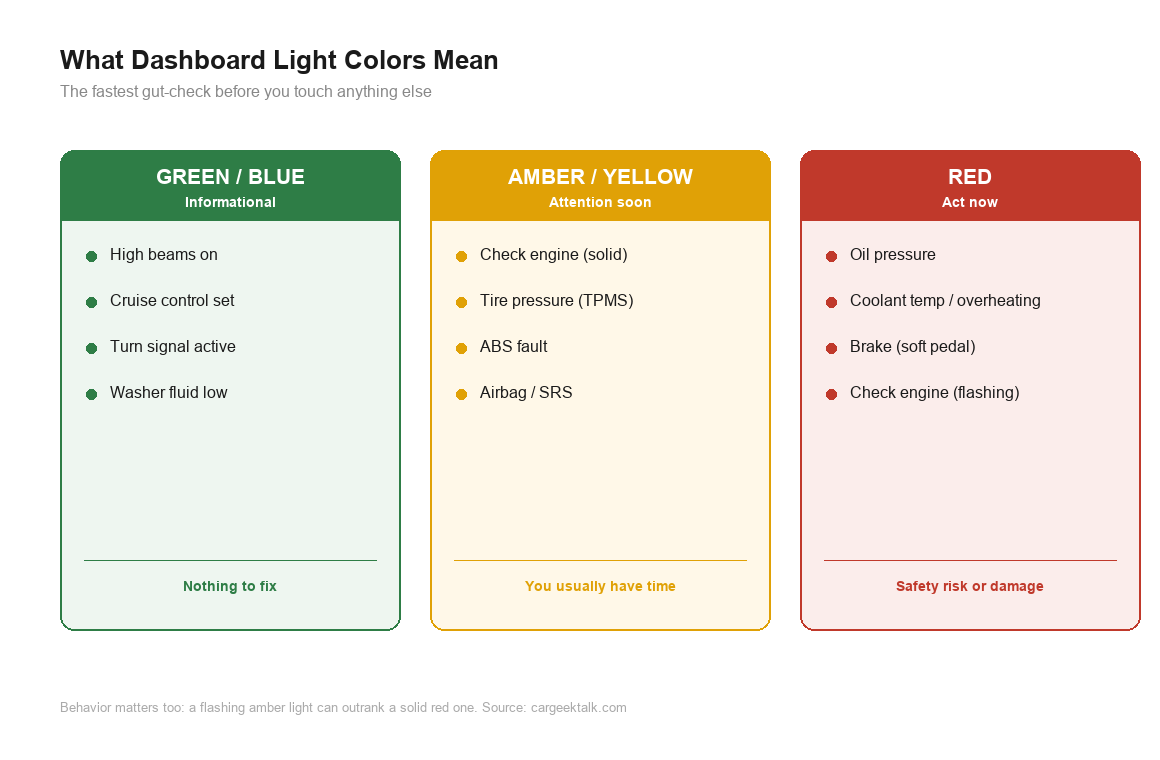
Before you memorize a single icon, learn the color code. It’s the fastest gut-check you’ve got.
Green or blue lights are informational. High beams are on. The cruise is set. Nothing to fix. Amber or yellow means caution — something needs attention soon, but you’ve usually got time to plan. Red is the one who earns your full respect. Red typically means a safety risk or active mechanical damage, and it’s not asking politely.
Here’s the catch most people miss: the color rule isn’t bulletproof. A flashing amber check engine light can be more urgent than a solid red seat-belt reminder, because a flashing CEL often means the engine is misfiring right now. Color tells you a lot. Behavior tells you the rest.
So watch both. Is the light steady or flashing? Does the car feel normal, or is it shaking, smoking, or losing power? That combination is what really sets the urgency.
The 8 car warning lights that matter most
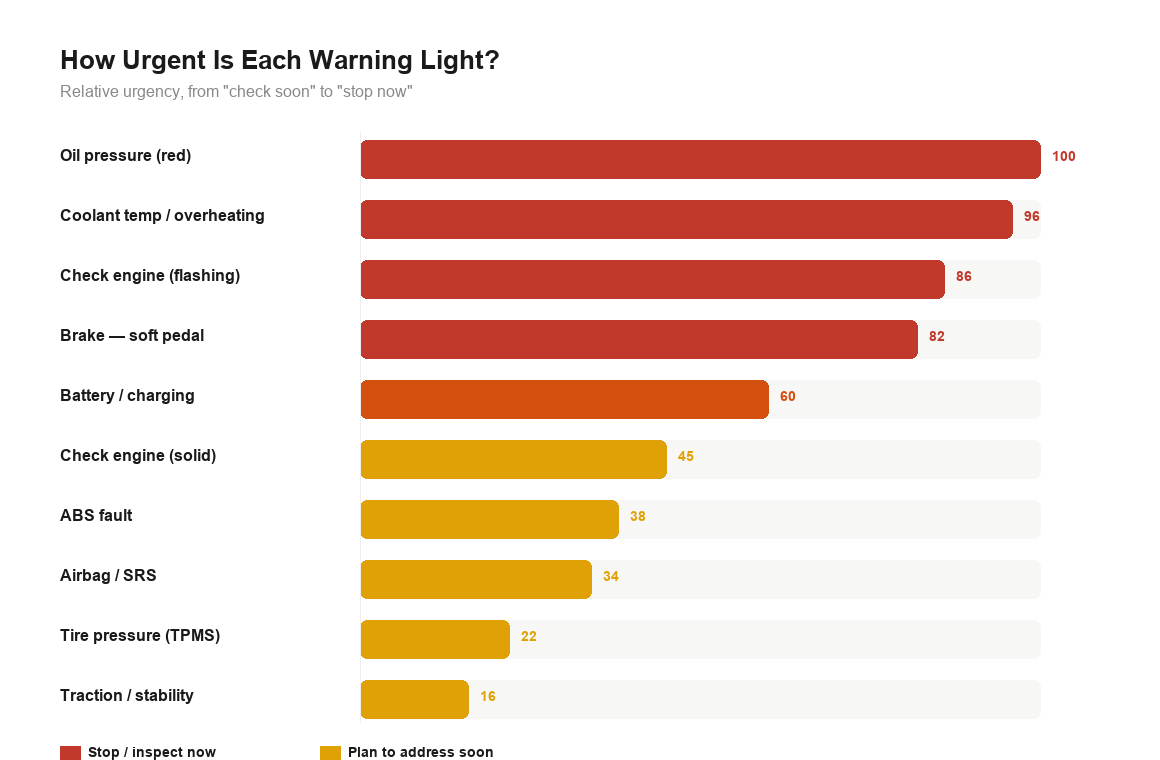
Plenty of dash icons exist. Most you’ll never see. These eight show up the most often and carry the biggest range of consequences — from “ignore it” to “call a tow truck.”
1. Check engine light
The king of vague. A check engine light can mean a loose gas cap, a tired oxygen sensor, a dying ignition coil, an EVAP leak, or catalytic converter trouble. Dozens of faults, one icon.
If it’s solid and the car drives normally, you’ve usually got time. Drive it short-term, get it scanned, sort it out. But if it’s flashing, change your plans. A flashing CEL almost always means an active misfire, and a misfire dumps raw fuel into the exhaust, which cooks your catalytic converter in a hurry. That’s a four-figure repair on a lot of modern cars. Don’t gamble it away to save a 20-minute stop.
My take: every driver should own a basic OBD-II scanner. They’re $25 on a slow day. You plug it in, read the code, and suddenly you’re walking into the shop knowing whether you’re looking at a sensor or a disaster.
2. Oil pressure warning light
This is the scary one. People see it and think, “Oh, I’m a little low on oil.” Wrong mindset entirely. The red oil can light means the engine may not be building proper oil pressure — and without pressure, the metal bits inside grind themselves to powder.
A low oil level can trigger it. So can a failing oil pump, sludge, internal wear, or a bad sensor. Doesn’t matter which yet. If this light comes on while you’re driving, pull over the second it’s safe and shut the engine off.
I mean it. An engine starved of oil pressure can self-destruct in minutes, not weeks. A tow is cheap. A rebuilt engine is not.
3. Battery/charging system light
Everyone assumes this means “buy a battery.” Sometimes, sure. More often, it’s pointing at the whole charging system — the alternator, the serpentine belt, the wiring, corroded terminals, or the battery itself.
A car with this light glowing can keep running for a while on stored battery power. But once voltage sags too low, it’ll stall and refuse to restart. If it pops on at night, you might notice the headlights dimming or the power windows crawling. That’s your warning that the clock is ticking.
Where are you headed? If you’re 40 miles from home in the dark, that changes the math.
4. Coolant temperature warning light
Overheating goes from manageable to catastrophic faster than almost anything else on a car. The light usually shows as a thermometer in waves, or your temp gauge climbing into the red. Causes? Low coolant, a stuck thermostat, a dead water pump, a fan that quit, or a leak somewhere.
If the engine is genuinely overheating, stop driving. A warped cylinder head or a blown head gasket costs a fortune compared to a tow and a $15 jug of coolant. I’ve watched someone “just make it home” with the needle pegged. They didn’t make it home. They made it to a new head gasket.
5. Brake warning light
This one needs context. A red brake light might just mean the parking brake is still engaged — embarrassing, harmless. But it can also flag low brake fluid or a real hydraulic problem. If the pedal feels soft, the car pulls under braking, or stopping power drops, don’t drive casually. That’s not a “tomorrow” issue.
The ABS light is its own thing. With ABS disabled, normal braking still works — the car will stop. What you lose is anti-lock function, which means emergency stops and braking on wet or icy roads get sketchier. The IIHS has solid data on why anti-lock braking matters for crash avoidance, and it’s worth a read if you ever drive in bad weather.
6. Tire pressure monitoring (TPMS) light
Common, rarely dramatic, still worth handling. Underinflated tires wear out faster, drag down your fuel economy, and can overheat at highway speed — which is how blowouts happen. Sometimes the light means a tire’s genuinely low. Sometimes it’s a dead wheel sensor, especially if it blinks for a bit and then stays solid.
Keeping your pressures right is one of the easiest wins for both safety and economy. If you want the deeper version, our guide on making your car more fuel efficient goes into how much proper inflation actually saves. The EPA’s own maintenance and fuel economy data pegs the loss from soft tires at meaningful numbers over a year.
7. Airbag / SRS light
Easy to ignore, because the car drives perfectly. That’s the trap. If the SRS light is on, your airbags or seatbelt pretensioners may not deploy correctly in a crash. You’ll never know until the worst possible moment — and that’s exactly when you need them working.
Get it diagnosed. It’s often a connector under a seat that’s worked loose, which is cheap. But assuming that without a scan is a bet on your own safety.
8. Traction/stability control light
Sometimes this light flickering just means the system is doing its job on a slick surface — totally normal. The problem is when it stays on. A solid stability control light usually means the system has faulted and switched off, so you’ve lost part of your electronic safety net. On a rainy on-ramp, that net matters.
Quick reference for the most common dash lights
| Warning Light | Typical Color | What It Usually Means | Keep Driving? |
|---|---|---|---|
| Check Engine | Amber | Emissions, ignition, fuel, or sensor fault | Yes, if solid, no if flashing |
| Oil Pressure | Red | Low oil pressure or lubrication failure | No — stop the engine immediately |
| Battery / Charging | Red | Alternator, battery, belt, or charging fault | Briefly, but failure can come fast |
| Coolant Temp | Red | Engine overheating | No — stop when safe |
| Brake | Red | Parking brake, low fluid, or brake fault | Depends on feel — inspect now |
| ABS | Amber | Anti-lock brake system fault | Usually, with reduced emergency braking |
| TPMS | Amber | Low tire pressure or sensor issue | Usually, after checking the tires |
| Airbag / SRS | Amber | Airbag or pretensioner fault | Yes, but safety systems may not fire |
The car warning lights people quietly underestimate
A handful of lights get ignored simply because the car still drives fine. That’s what makes them dangerous — there’s no immediate pain to force your hand.
The airbag light leads that list. No change in how the car drives, so people leave it for months. Then there’s the stability control light, dismissed as “it’s just the icy-road thing.” Sometimes it is. Sometimes the system’s offline, and you’re driving without it.
And the most expensive one to ignore: the transmission temperature or transmission fault light, especially on trucks and SUVs that tow. Heat is the number one killer of automatic transmissions. Tow a heavy trailer up a grade with that light on, ignore it long enough, and you’re shopping for a rebuild that can run $3,000 to $5,000. Sound expensive? It is.
What to do when a warning light comes on
Don’t panic. Don’t ignore it either. There’s a middle path, and it’s mostly about gathering information before you react.
Run through this:
- Color and behavior first — is it red or amber, solid or flashing?
- How does the car actually feel? Rough idle, overheating, weak brakes, and charging hiccups all crank up the urgency.
- Check the easy stuff if it’s safe — gas cap snug? Tires look low? Any visible fluid puddles?
- Got an OBD-II scanner? Plug it in for any check engine fault and read the code.
- Red oil pressure or overheating? Pull over and kill the engine. No exceptions.
Context is everything. A check engine light on a car that drives perfectly is one situation. That same light paired with shaking, smoke, or a sudden loss of power is a completely different — and more urgent — story.
Why one warning light can mean wildly different repair bills
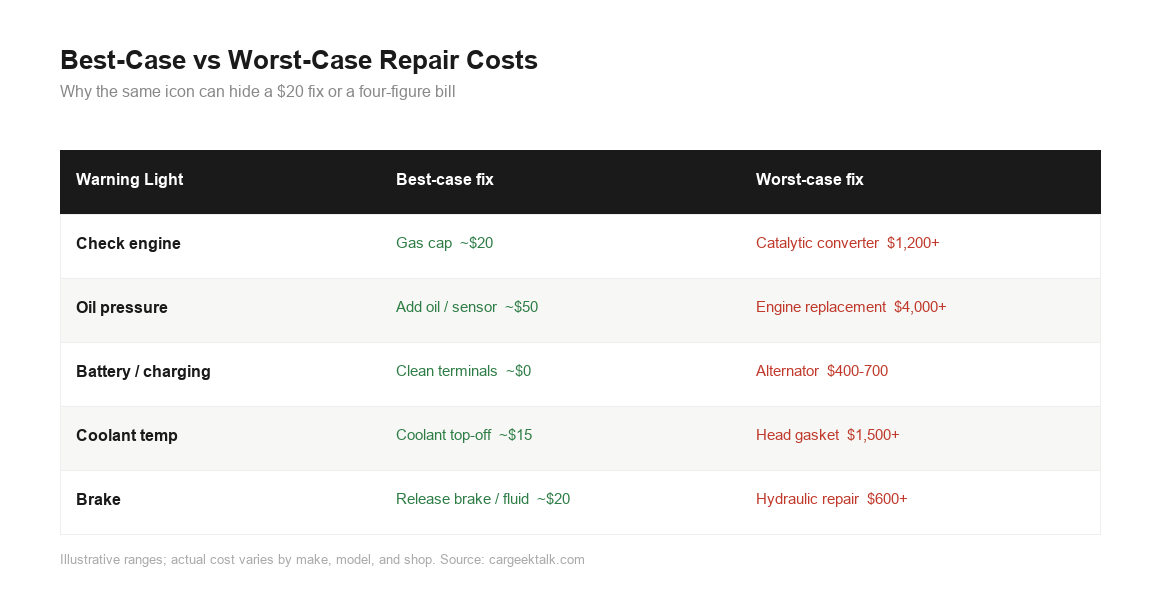
Here’s where ownership reality bites. The same icon can hide a $20 fix or a $2,000 nightmare, and there’s no way to know which from the dash alone.
A check engine light might be a loose gas cap. Or a failed catalytic converter pushing well past $1,200. A battery light could be due to corroded terminals that you clean with a wire brush, or a full alternator replacement. That spread is exactly why guessing is the most expensive strategy there is — people throw parts at a symptom, “parts cannon” style, and burn money doing it.
Scan the codes. Check the symptoms. Understand which system is actually involved. That’s the difference between a smart fix and a slow drain on your wallet. If you want a brand-by-brand sense of what these repairs run, our breakdown of average car repair costs by brand is a useful gut-check before you walk into a shop.
| Warning Light | Best-Case Fix | Worst-Case Fix | Cost Range |
|---|---|---|---|
| Check Engine | Replace gas cap (~$20) | Catalytic converter / internal engine | Low to very high |
| Oil Pressure | Add oil or replace the sensor | Engine replacement | Low to extreme |
| Battery / Charging | Clean battery terminals | Alternator or wiring repair | Low to moderate |
| Coolant Temp | Coolant top-off or thermostat | Head gasket or engine damage | Low to very high |
| Brake | Release the parking brake / add fluid | Hydraulic system failure | Low to high |
When you can drive and when you should stop
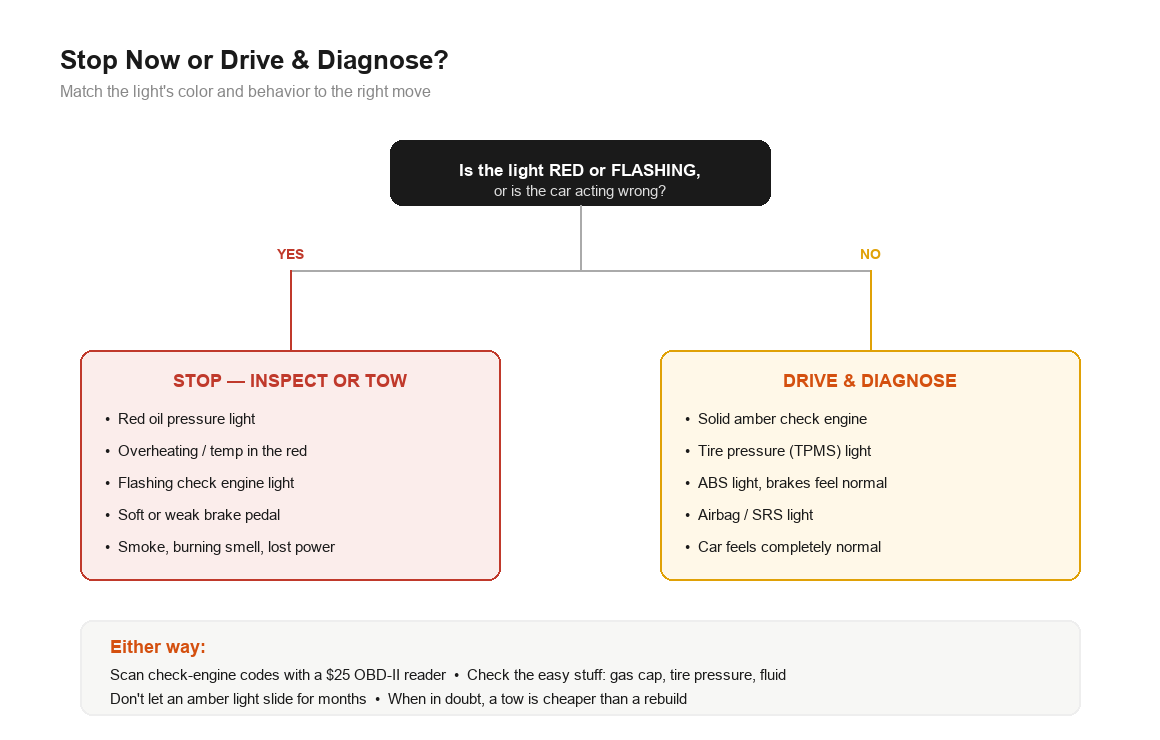
A simple rule cuts through the noise. If the light is red, if it’s flashing, or if the car is showing obvious symptoms — smoke, overheating, lost oil pressure, weak brakes, a violent misfire — stop driving as soon as it’s safe and get it inspected or towed.
If the light is amber and the car feels completely normal, you’ve generally got breathing room to diagnose without drama. Generally. That word’s doing heavy lifting. A solid amber light is not a license to ignore it for six months until inspection day humiliates you.
For used-car owners, this matters doubly. Older vehicles throw lights from small age-related stuff all the time — a worn sensor here, a tired connector there. But that same familiar icon can also hide a genuine mechanical problem, and the trick is telling them apart. If you’re shopping, our guide on how to inspect a used car walks through exactly which lights to verify before you hand over a dime.
The smartest habit you can build is dead simple: learn the difference between a warning and a catastrophe. Your dashboard isn’t out to ruin your day. It’s handing you a chance to avoid a much worse one — usually with a little time to spare, if you actually pay attention.
Frequently asked questions about car warning lights
Is it safe to drive with the check engine light on?
If it’s solid and the car drives normally, usually yes — short term, while you get it scanned. If it’s flashing, no. A flashing light means an active misfire that can wreck your catalytic converter quickly.
What car warning lights mean I should stop immediately?
Red oil pressure and engine overheating top the list. Both can destroy your engine in minutes. A flashing check engine light and a brake warning with a soft pedal also mean stop and inspect right away.
Why is my battery light on if the car still runs?
The car’s running on stored battery power, but the charging system likely isn’t replacing it. Once the voltage drops too low, the car will stall and may not restart. Get the alternator and belt checked soon.
Can I keep driving with the TPMS light on?
Usually, after you check and correct your tire pressures. Underinflated tires wear faster, hurt fuel economy, and can overheat at highway speed, so don’t leave it indefinitely — especially before a long trip.
Do I need a scan tool to figure out warning lights?
For check engine faults, a basic OBD-II scanner (around $25) reads the trouble code so you know what you’re dealing with. For red safety lights like oil pressure or overheating, skip the scanner and stop driving first.
The light went off by itself — am I fine now?
Not necessarily. A check engine light can clear if the fault was intermittent, like a slightly loose gas cap. But the stored code often remains, and the problem can return. Get it scanned to be sure.
Helpful independent resources: RepairPal · NHTSA · your vehicle's owner's manual