
Particulate Filter Below Threshold: 5 Proven Fixes
You’re driving home, the dash lights up, and there it is: particulate filter efficiency below threshold. No explanation. No warning sound. Just a message that sounds expensive. If you own a modern diesel, this one shows up more often than most dealers will admit — and the panic it causes usually leads to repairs you didn’t actually need. I’ve seen owners drop $1,800 on a new DPF when a $40 sensor was the real culprit. So before you reach for your wallet, let’s break down what this fault really means and what your honest options are.
Here’s the part that gets lost in most forum threads: this warning rarely points to a single broken part. It’s the engine control unit telling you the exhaust isn’t being cleaned the way emissions rules demand. Why that happens is where it gets interesting. And expensive, if you ignore it.
Contents
- What Particulate Filter Efficiency Below Threshold Actually Means
- How a Diesel Particulate Filter Is Supposed to Work
- Common Causes of Particulate Filter Efficiency Below Threshold
- Symptoms You May Notice
- Top 5 Proven Solutions for Particulate Filter Efficiency Below Threshold
- What Each Fix Actually Costs
- Maintenance Habits That Reduce DPF Efficiency Problems
- Cost and Long-Term Ownership Considerations
- The Bottom Line Before You Replace Anything
- Frequently Asked Questions
What Particulate Filter Efficiency Below Threshold Actually Means
The message gets triggered when your ECU decides the diesel particulate filter (DPF) is no longer trapping soot the way it’s supposed to. Modern diesels watch the exhaust constantly. Differential pressure sensors sit before and after the filter, temperature sensors track how hot things get, and the ECU does the math.
When that math says too many particulates are slipping through, it logs a fault code. Often, the check engine light comes on too.
This isn’t a cosmetic nag. A confirmed particulate filter efficiency below the threshold condition will fail emissions testing in most regions — full stop. The EPA treats the DPF as a legally required emissions component, and tampering with or removing one carries real penalties. You can read the official stance on aftermarket defeat devices straight from the EPA’s enforcement page. Worth knowing before someone offers you a cheap “delete.”
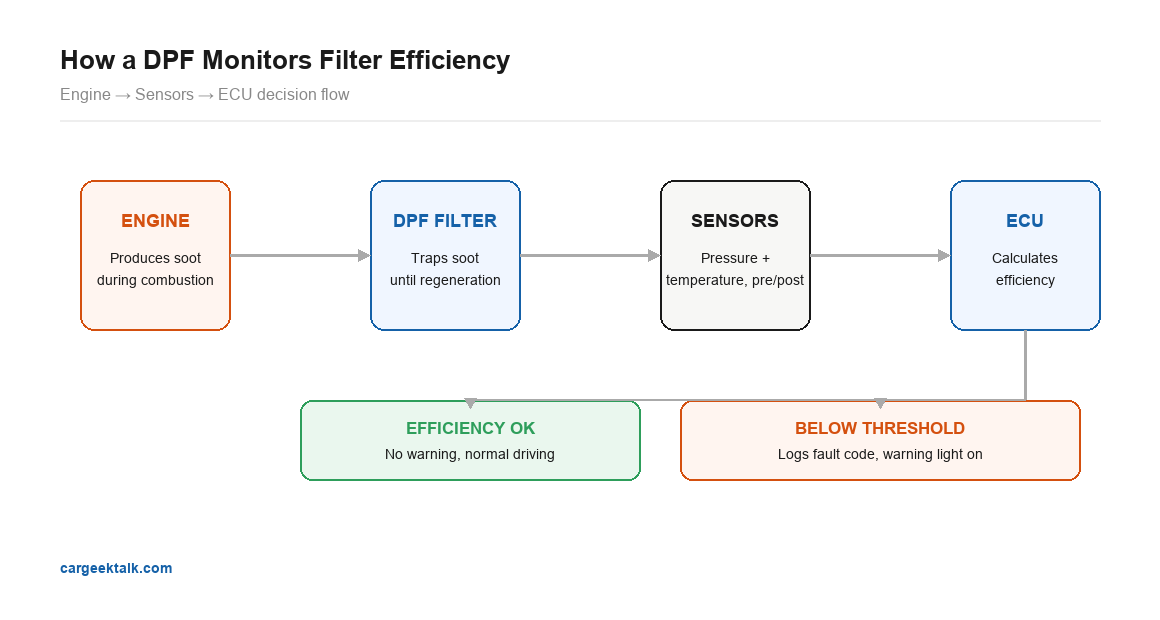
How the DPF, sensors, and ECU work together to monitor filter efficiency.
How a Diesel Particulate Filter Is Supposed to Work
The DPF’s job is simple on paper: catch the soot your engine produces and hold it until it can be burned off. That burning-off process is called regeneration, and there are two flavors of it.
Passive Regeneration
This happens on its own. Sustained highway driving pushes exhaust temperatures high enough to oxidize the trapped soot — no driver input needed. Think of a 30-minute motorway run at 65 mph. That’s the ideal scenario your engineers designed for.
Active Regeneration
When soot builds up past a set point, the ECU steps in. It injects extra fuel to raise exhaust temps and torch the soot deliberately. You might notice a faint burning smell or a slight bump in idle. Totally normal.
But here’s where it falls apart. Interrupt active regen too many times — short trips, cold starts, school runs — and the cycle never finishes. Soot stacks up. The filter chokes. And eventually, the system can’t hit its efficiency target, which is exactly what fires off the particulate filter efficiency below threshold warning.
Sound familiar? If your diesel mostly does five-minute drives to the shops, this is practically inevitable.
Common Causes of Particulate Filter Efficiency Below Threshold
There’s no single villain here. In my experience working through these faults, the cause is usually one of these — and often two at once:
- Too much short-distance driving. The regen cycle never completes. Most common cause by a mile.
- High soot or ash accumulation that’s pushed past the service limit
- A failed or drifting differential pressure sensor — cheap part, big false alarm
- Exhaust leaks upstream or downstream that throw off the pressure reading
- Is your EGR valve stuck open? That dumps extra soot into the system
- Turbocharger inefficiency is hurting combustion quality and raising soot output
Notice how many of these have nothing to do with the filter itself. That’s the whole point. The DPF is frequently the messenger, not the problem. Which is why a proper diagnosis saves you the most money.
If you’re shopping for a used diesel and want to spot these issues before you buy, our guide on how to inspect a used car covers the exhaust and warning-light checks I run on every test drive.
Symptoms You May Notice
Sometimes the car drives perfectly fine, and the only clue is the dashboard. Other times it’s obvious. Owners typically report some mix of these:
- Check engine light or an emissions warning
- Reduced power, or the car drops into limp mode
- Fuel economy that’s quietly gotten worse
- Regen cycles that run constantly or never seem to finish
- A sharp, hot exhaust smell during attempted regens
My honest take: the fuel economy hit is the one people miss. If your diesel was returning 45 mpg and you’re suddenly seeing 38, that’s not just bad luck. At 1,500 miles a month, that drop alone can cost you an extra $30–$40 in fuel before any repair bill lands.
And keep driving with these symptoms? You risk turning a sensor issue into a melted filter. That’s the difference between $150 and $1,500.
Top 5 Proven Solutions for Particulate Filter Efficiency Below Threshold
Here’s how I’d work through it — cheapest and least invasive first. Don’t skip straight to replacement just because a shop suggested it.
1. Extended Highway Drive (Forced Passive Regeneration)
If the filter’s only lightly loaded, a long steady run can finish the regen the ECU couldn’t complete in town. Aim for 30–40 minutes at a constant 60–70 mph in a lower-than-usual gear to keep revs up. Free fix. Works surprisingly often — but only if the DPF substrate is still physically intact.
2. Diagnostic Scan and Sensor Verification
This is the step most people skip and shouldn’t. A faulty pressure or temperature sensor will lie to the ECU and report low efficiency that doesn’t exist. A proper scan tool reads live data and tells you whether the filter is actually clogged or just being misread. Verify before you spend a cent on the filter.
3. Professional DPF Cleaning
Off-car thermal or aqueous cleaning can bring a soot- or ash-clogged filter back to life. The filter gets removed, baked, or flushed, then refitted. Far cheaper than replacement and genuinely effective — provided the substrate isn’t cracked or melted.
4. Software Updates or ECU Relearn
Manufacturers sometimes release calibration updates that tweak regen logic. These are applied at the dealer. If your vehicle’s a known model for finicky regen behavior, ask whether there’s a service bulletin. Costs little, occasionally fixes everything.
5. DPF Replacement
The last resort. If the substrate is cracked, melted, or chemically poisoned by the wrong oil, no amount of cleaning will save it. Replacement resets the system properly. It’s the priciest path — but on a poisoned filter, it’s the only honest one.
What Each Fix Actually Costs
Prices swing a lot by region and brand, but here’s a realistic ballpark from quotes I’ve gathered across independent shops and dealers. Use it to sanity-check whatever estimate you’re handed.
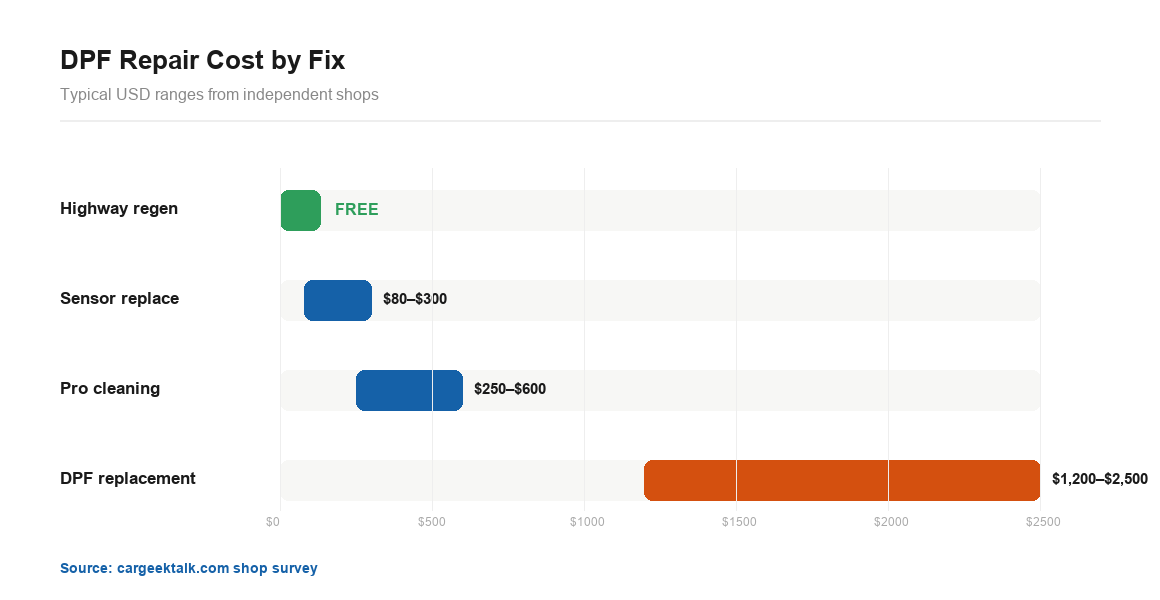
Typical cost range for each DPF repair path (independent shop estimates).
| Solution | Relative Cost | Reliability Outcome | Long-Term Ownership Impact |
|---|---|---|---|
| Highway regeneration | Free | Temporary if driving habits don’t change | Minimal — buys you time |
| Sensor replacement | $80–$300 | High if it’s the root cause | Restores correct monitoring |
| Professional DPF cleaning | $250–$600 | Good if the filter is intact | Extends DPF lifespan |
| DPF replacement | $1,200–$2,500+ | Excellent | Resets the emissions system fully |
For a wider sense of where diesel repair bills tend to land by manufacturer, our breakdown of average car repair costs by brand is a useful reality check before you commit to a brand long-term.
Maintenance Habits That Reduce DPF Efficiency Problems
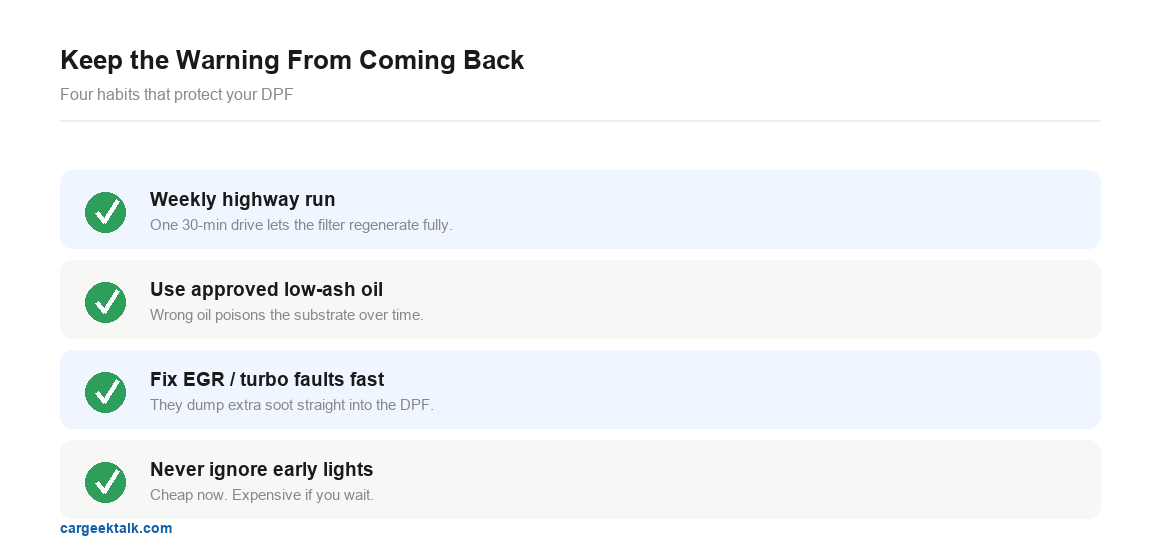
Stopping the particulate filter efficiency below threshold warning from coming back is mostly about how you drive and how you service the car. Not glamorous. But it works.
- Build a regular highway run into your week — even one 30-minute trip helps the filter regenerate
- Stick to manufacturer-approved low-ash engine oil; the wrong oil poisons the substrate over time
- Fix EGR or turbo faults the moment they appear, not “next service.”
- Never ignore an early warning light — it only gets pricier from there
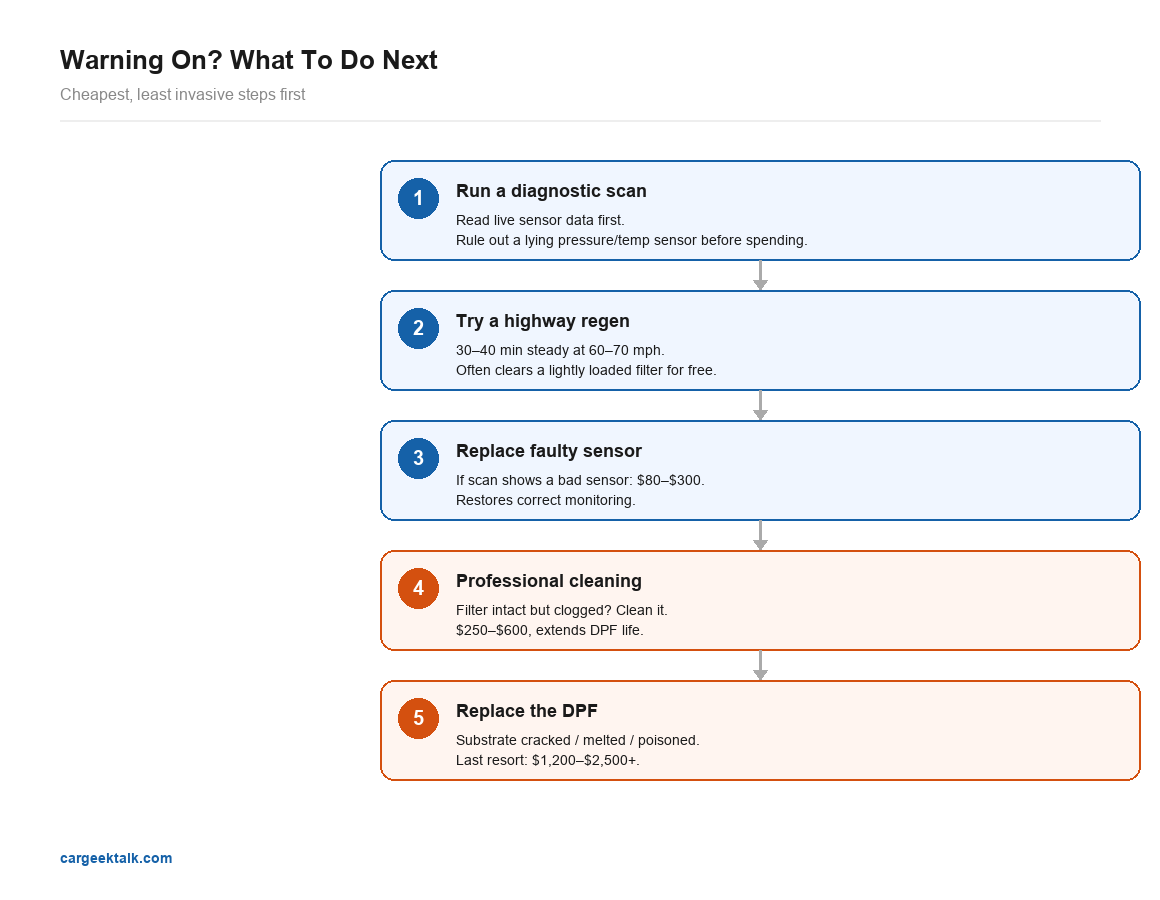
A simple decision flow for what to do when the warning appears.
Driving style and fuel quality matter more than people think. The U.S. Department of Energy’s vehicle maintenance research on fueleconomy.gov backs up the link between proper upkeep and emissions-system longevity. If you want to squeeze more efficiency out of your diesel in general, our tips on making your car more fuel efficient tie in nicely with healthier regen cycles.
Cost and Long-Term Ownership Considerations
The financial sting of a particulate filter efficiency below threshold issue depends almost entirely on timing. Catch it early, and you’re looking at a diagnostic fee or a clean. Sit on it, and you’re funding a full replacement plus the collateral damage to sensors or the turbo it took out on the way down.
There’s a buyer’s lesson buried here too. Diesels used mainly for short urban trips are statistically far more prone to recurring DPF trouble. So if you’re a city-only driver eyeing a used diesel, ask yourself honestly whether a petrol or hybrid would suit your routine better.
That trade-off is exactly the kind of thing I weigh in our guide on buying a reliable used car without regret — worth a read before you sign anything.
The Bottom Line Before You Replace Anything
A warning that the emissions system is out of spec sounds scary. It usually isn’t a death sentence for the filter. Diagnose properly, fix the actual root cause, and adjust how you drive — that combination clears most of these faults without a five-figure surprise.
Get the scan done first. Drive it on the highway. Check the sensors. Only then, if the substrate’s genuinely cooked, reach for a replacement. Do it in that order and you’ll protect your engine, stay emissions-compliant, and keep that diesel running for years longer than the panic on the dash suggests.
Frequently Asked Questions
Can I keep driving with a particulate filter efficiency below the threshold warning?
Short term, often yes — but it’s risky. If the car hasn’t dropped into limp mode, you can usually drive to a shop or attempt a highway regen. Keep ignoring it, though, and you risk turning a cheap sensor fix into a melted filter replacement.
Will this warning cause an emissions test failure?
Yes. A confirmed particulate filter efficiency below the threshold condition means the DPF isn’t meeting its required efficiency, and that fails emissions inspection in most regions until it’s resolved.
How much does it cost to fix?
Anywhere from free (a successful highway regen) to $80–$300 for a sensor, $250–$600 for professional cleaning, or $1,200–$2,500+ for a full DPF replacement. Diagnose before you assume the worst.
Can a clogged DPF clean itself?
If it’s only soot-loaded and not physically damaged, yes — a sustained highway drive can complete passive regeneration and clear it. Ash buildup and cracked substrates can’t be cleaned by driving and need professional cleaning or replacement.
Does deleting the DPF fix the problem?
It removes the warning, but it’s illegal on road vehicles in the U.S. and most of Europe, voids emissions compliance, and can carry steep fines. Not a real fix — just a different problem waiting to happen.
Why does my diesel keep getting this fault if I mostly drive short trips?
Short trips never let the exhaust reach regeneration temperature, so soot accumulates faster than it burns off. City-only diesels are the most prone to recurring DPF issues — a longer regular drive is the simplest preventive habit.
Helpful independent resources: RepairPal · NHTSA · your vehicle's owner's manual