

Do Hybrid Cars Have More Problems? 7 Honest Facts

Picture this: you’re standing in a Toyota dealership, eyeing a RAV4 Hybrid, and the salesman is mid-pitch when your brain hits the brakes. Do hybrid cars have more problems than a regular gas car? That single question stops more buyers than the sticker price ever does. I’ve heard it from friends, family, and just about every reader who emails me about going hybrid. So let’s settle it with real data and real ownership experience — not marketing fluff.
Short version? No. And the long version is more interesting than you’d expect.
Hybrids have been on American roads since the Prius landed in 2000. That’s over two decades of data, millions of vehicles, and enough high-mileage examples to tell us exactly how these things hold up. The myth that they’re fragile, battery-eating money pits? It dies pretty fast once you look at the numbers.
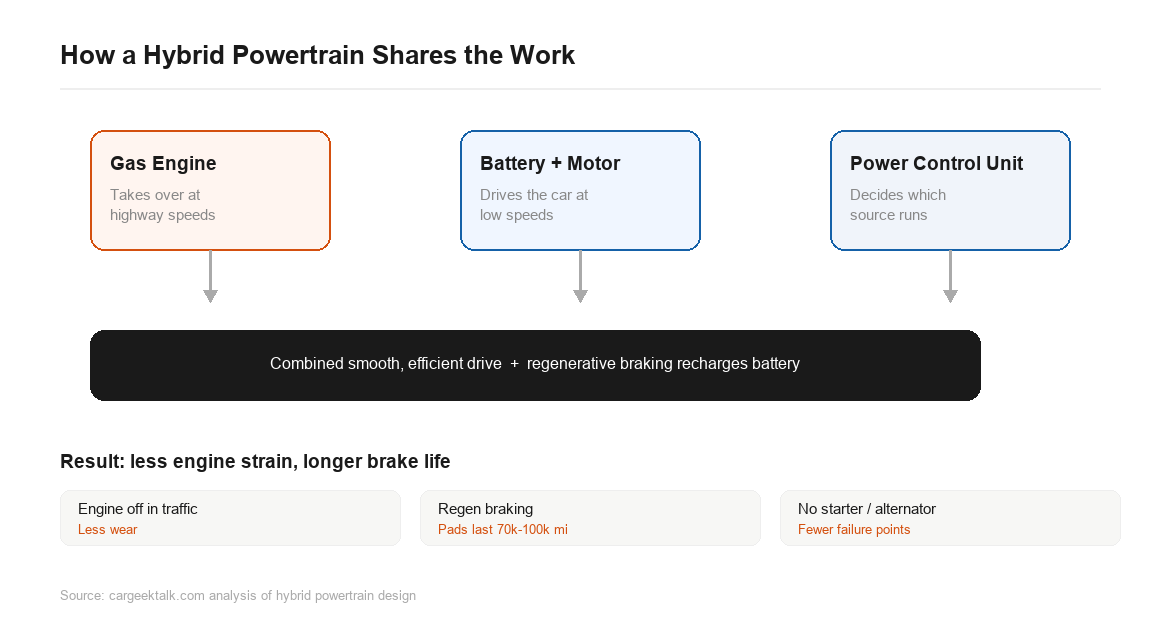
How a hybrid powertrain splits work between the gas engine and electric motor.
Contents
- Do Hybrid Cars Have More Problems? What the Data Actually Says
- Battery Longevity: The Concern That Won’t Die
- Maintenance and Repair Costs — The Honest Numbers
- Fuel Savings: Where Hybrids Quietly Pay You Back
- The Real Weak Spots — Because Nothing’s Perfect
- Which Hybrids Hold Up — And Which to Approach Carefully
- So Should You Actually Buy One?
- Frequently Asked Questions
Do Hybrid Cars Have More Problems? What the Data Actually Says
Here’s the thing that surprises people. Hybrids often score better on reliability surveys than their pure-gas siblings. Consumer Reports has repeatedly placed Toyota and Lexus hybrids near the top of its rankings, and the Prius is one of the most reliable cars they’ve ever tracked.
Why? It comes down to how a hybrid actually works.
The electric motor handles low-speed crawling and helps with acceleration. That means the gas engine works less hard, runs cooler, and gets switched off completely in stop-and-go traffic. Less strain, less wear. The regenerative braking system also takes load off the friction brakes — many hybrid owners get 80,000+ miles out of a single set of brake pads. Try that in a gas-only car.
But I won’t pretend hybrids are flawless. They’ve got more moving parts than a gas car and fewer than a fully electric one. So the question isn’t really “do hybrid cars have more problems” — it’s “what kind of problems, and do they cost you more?” That’s where it gets practical.
The Components That Actually Differ
A hybrid adds a few systems that a normal car doesn’t have:
- High-voltage battery pack (the part everyone panics about)
- One or two electric motor-generators
- Power control unit and inverter
- Regenerative braking system
- An electric or electric-assist water pump on some models
And here’s what they often delete compared to a gas car: the alternator, the starter motor, and frequently a conventional belt-driven setup. Fewer of those failure points. The Toyota Hybrid Synergy Drive, for example, uses a planetary gearset instead of a traditional transmission with clutches and torque converters. That’s one of the least-failure-prone designs in the business.
Battery Longevity: The Concern That Won’t Die

The high-voltage battery pack — the part buyers worry about most, and the part that lasts longest.
This is the big one. The fear that a hybrid battery will die at 100,000 miles and hand you a $6,000 bill. Sound familiar?
Reality check. Most hybrid batteries last 150,000 to 200,000 miles, and plenty go well beyond that. I’ve personally seen first-gen Prius taxis in major cities clock 300,000+ miles on the original pack. The federal government mandates a minimum 8-year/100,000-mile warranty on hybrid battery components, and in California (plus the states that follow CARB rules) that jumps to 10 years/150,000 miles. Toyota now backs its newer hybrid batteries for 10 years/150,000 miles nationwide.
So what happens if it does fail out of warranty? You’ve got options the doom-mongers never mention:
- A reconditioned pack from a specialist runs $1,500–$2,500 installed for most Toyotas.
- Replacing individual failed cells is cheaper still, often under $1,000.
- A brand-new dealer pack is the expensive route — $2,500 to $4,500 depending on the model.
- Aftermarket warranties from companies like Greentec now cover refurbished packs.
Compare that to a blown automatic transmission in a gas SUV, which can hit $4,000–$7,000. Suddenly, the battery doesn’t look so scary. The EPA’s own data on hybrid durability backs this up — modern nickel-metal-hydride and lithium packs are engineered to outlast the rest of the car in most cases. You can read more on how these systems are rated over at the EPA’s hybrid technology breakdown.
My take: battery anxiety is mostly a holdover from 2005. The tech has moved on. Buyers haven’t.
Maintenance and Repair Costs — The Honest Numbers
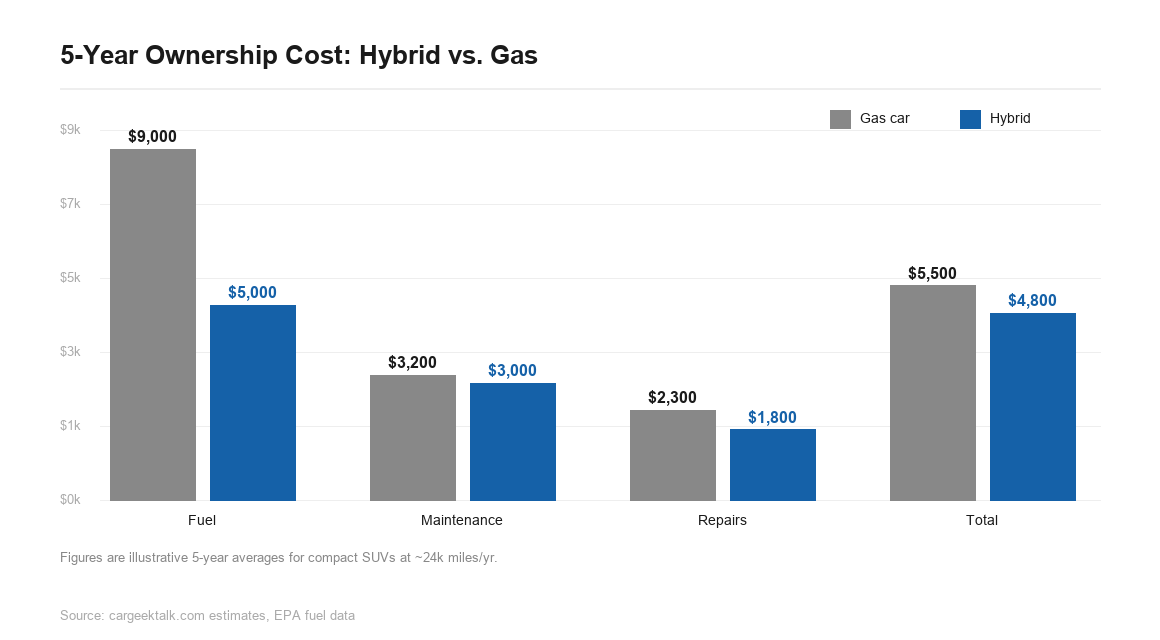
Average annual maintenance and repair costs: hybrid vs. gas-only over five years.
People assume hybrid maintenance costs a fortune because the system is complicated. It doesn’t.
Your oil changes, cabin filters, tire rotations, and coolant flushes are basically identical to a gas car. The brake pads last longer thanks to regen braking. The 12-volt battery still needs replacing every 4–6 years like any car. And because the gas engine spends so much time off, it accumulates wear far more slowly.
Where hybrids cost more: specialized diagnostic work and the rare high-voltage repair. But here’s the catch — those jobs are increasingly rare and increasingly common knowledge. Twenty years ago, only the dealer could touch a Prius. Now independent shops everywhere handle them.
| Maintenance Item | Gas Car | Hybrid |
|---|---|---|
| Oil changes/year | $120–$200 | $120–$200 |
| Brake pads (lifespan) | 30k–50k mi | 70k–100k mi |
| Transmission service | $150–$400 | Minimal (eCVT) |
| Battery replacement (if needed) | N/A | $1,500–$4,500 |
| Avg. 5-yr total | ~$5,500 | ~$4,800 |
Notice the bottom line — and these are the facts: over five years, a well-maintained hybrid often costs less to keep running, not more. If you want to dig deeper into what different brands cost to fix, our guide to average car repair costs by brand is worth a read before you commit.
Fuel Savings: Where Hybrids Quietly Pay You Back
This is the part the reliability debate always forgets. Even if a hybrid had slightly higher repair odds — which it doesn’t — the fuel savings dwarf the difference.
Take a Honda CR-V Hybrid against the gas version. The hybrid gets roughly 40 mpg combined versus about 30 for the gas model. Drive 2,000 miles a month, and that gap puts something like $80 back in your pocket every single month. Over a year, that’s nearly $1,000. Hold the car for five years, and you’re looking at almost $5,000 in fuel alone — more than enough to cover a battery replacement that probably won’t happen anyway.
City drivers benefit most. Stop-and-go is exactly where the electric motor does its best work, and the gas engine barely sips. If your commute is short and congested, a hybrid is almost a no-brainer. Want to squeeze even more out of it? Our tips on making your car more fuel efficient apply to hybrids too.
The Real Weak Spots — Because Nothing’s Perfect
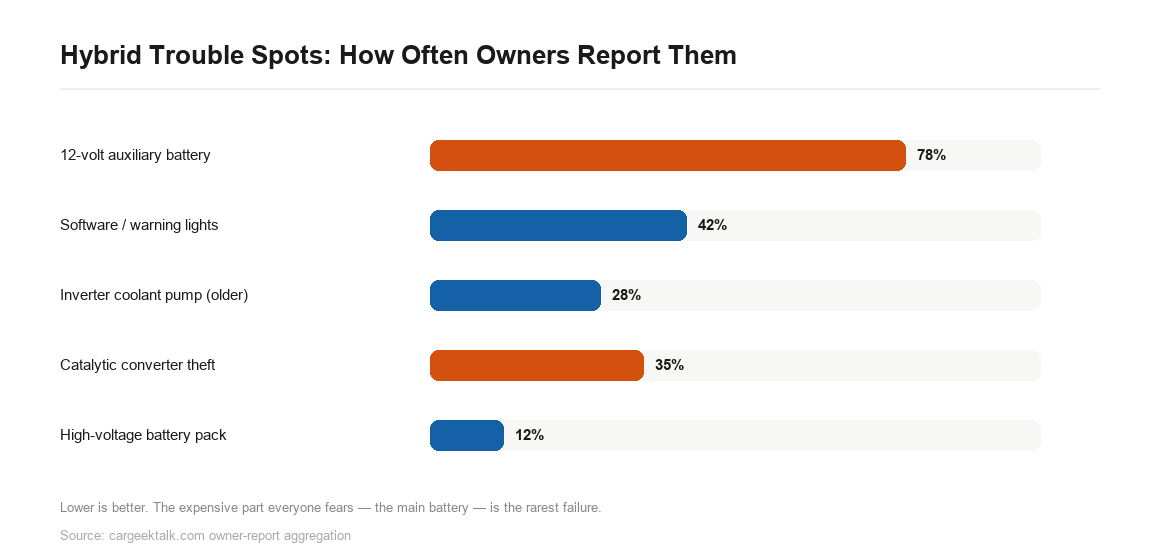
Common hybrid trouble spots ranked by how often owners actually report them.
I’d be lying if I said hybrids never break. Here’s where they genuinely can give trouble, ranked by how often I actually hear about it:
1. The 12-Volt Auxiliary Battery
This trips up more hybrid owners than the main pack ever will. The little 12V battery boots the computers and won’t crank a huge engine, so it’s small — and it dies quietly. One morning, the car just won’t power on. It’s a $150–$250 fix and totally routine, but people panic and assume the expensive pack is dead.
2. Inverter Coolant Pump (older Toyotas)
Some 2004–2009 Prius models had an inverter water pump that liked to fail. Toyota issued fixes, and the newer pumps are solid. If you’re buying used, ask whether it’s been replaced.
3. Software Gremlins
Hybrids are rolling computers. Occasionally, a software glitch throws a warning light that a dealer update clears in minutes. Annoying, not catastrophic. Speaking of which — if your dash lights up and you’re not sure what’s serious, our breakdown of how to inspect a used car covers what to check before you buy.
4. Catalytic Converter Theft
Not a reliability issue exactly, but worth knowing. Older Priuses are a top target for catalytic converter thieves because their cats contain more precious metal and are barely used. A shield helps.
That’s basically the list. Compare it to the turbocharger failures, timing chain stretch, and carbon buildup plaguing a lot of modern turbo gas engines, and the hybrid suddenly looks downright boring. Boring is good when it comes to reliability.
Which Hybrids Hold Up — And Which to Approach Carefully
Not every hybrid is built equal. Toyota and Lexus essentially wrote the playbook, and their hybrid systems are about as bulletproof as it gets. The Prius, Camry Hybrid, RAV4 Hybrid, and Lexus ES/RX Hybrids consistently top long-term reliability data.
Honda’s newer two-motor system in the Accord and CR-V Hybrid has earned a strong reputation too. Ford’s hybrids are decent but historically a notch below Toyota.
Where I’d do extra homework: some early European plug-in hybrids and a handful of first-generation systems from brands still finding their footing. The IIHS also notes that hybrids and EVs now match or beat gas cars on crash safety, which you can verify through the IIHS hybrid and electric vehicle research. Reliability and safety both point in the same direction.
If you’re shopping used, treat a hybrid like any other car — get the history, get it inspected, and walk if something feels off. Our complete walkthrough on buying a reliable used car without regret applies double when there’s a battery involved.
So Should You Actually Buy One?
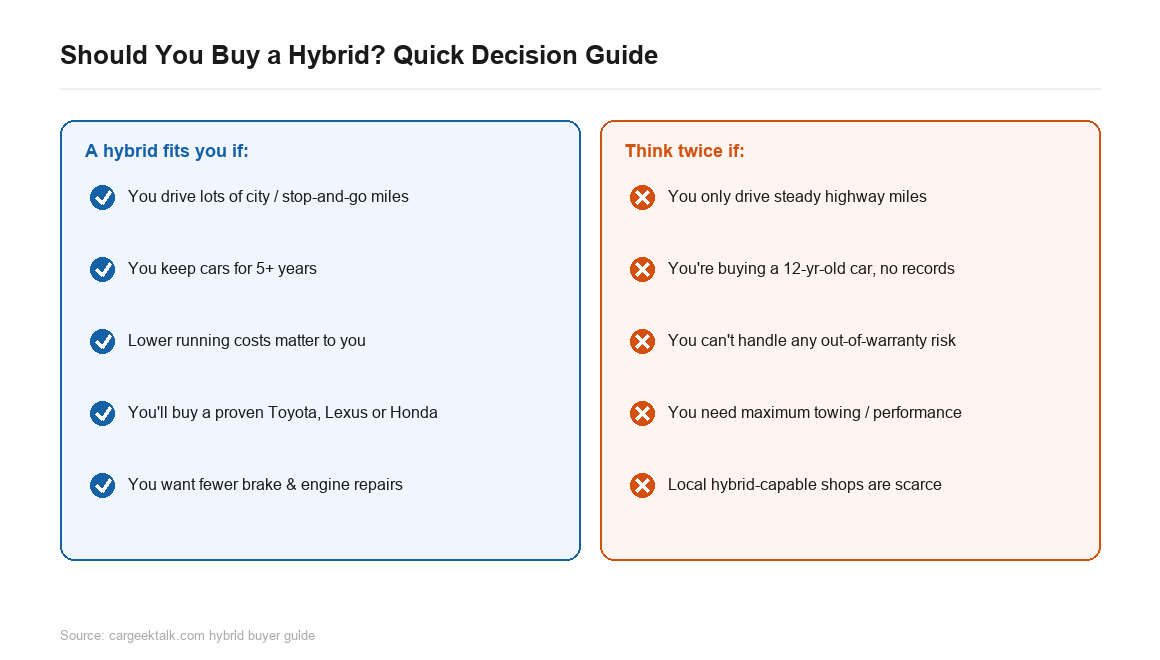
A quick decision guide for whether a hybrid fits your driving life.
For most people, the answer is yes. If you do a lot of city miles, want lower running costs, and plan to keep the car a while, a hybrid pays off and rarely gives more grief than a gas car. The data simply doesn’t support the “fragile and expensive” reputation anymore.
When might a hybrid not make sense? If you only drive highway miles at steady speeds, the fuel advantage shrinks. If you’re terrified of any out-of-warranty risk and buy a 12-year-old example with no records, sure, you could get burned — but that’s true of any old car.
The myth of the problem-prone hybrid was built on early-2000s tech and stubborn assumptions. Two decades of real-world mileage have quietly proven otherwise. Buy a proven model, keep up the basic maintenance, and you’ll likely forget there’s anything special under the hood at all. Want to keep exploring? Browse our full Electric and Hybrid Cars section.

Lower emissions are a bonus — but the running-cost savings are what win most buyers over.

Owner satisfaction surveys consistently rate hybrid reliability highly.
Frequently Asked Questions
Do hybrid cars have more problems than gas cars?
No. Reliability surveys consistently show top hybrids matching or beating gas cars. The electric motor reduces engine and brake wear, so many hybrids actually rack up fewer repairs over their lifetime.
How long do hybrid batteries really last?
Most last 150,000 to 200,000 miles, and many go further. Federal law requires at least an 8-year/100,000-mile warranty, with 10 years/150,000 miles in CARB states and on newer Toyotas.
How much does it cost to replace a hybrid battery?
A reconditioned pack runs $1,500–$2,500 installed for most Toyotas. A brand-new dealer pack ranges from $2,500 to $4,500. Replacing individual cells can cost under $1,000.
Are hybrids expensive to maintain?
Not really. Routine maintenance mirrors a gas car, and brake pads last far longer thanks to regenerative braking. Most owners spend about the same or slightly less over five years.
Which hybrid brands are the most reliable?
Toyota and Lexus lead by a clear margin, with Honda’s newer two-motor hybrids close behind. The Prius, Camry Hybrid, and RAV4 Hybrid are among the most reliable cars on the road.