

Which Car For Me: 9 Honest Factors That Matter

Picture this: you’ve got $28,000 saved, a two-year-old kid, a 40-minute commute, and a partner who wants to take road trips. So which car for me makes sense here — a hybrid SUV, a used minivan, or a cheap-to-run sedan? That single question trips up more buyers than any other, and the wrong answer can cost you thousands over five years. I’ve owned eight cars across sedans, trucks, and one regrettable European coupe, so let me walk you through how to actually decide instead of guessing.
The American market hands you something like 300 new models and millions of used listings. Overwhelming. But the decision gets simple once you stop shopping by emotion and start matching the car to how you really live.
Contents
- Start With Budget — But Not Just the Sticker Price
- Match the Car to Your Actual Lifestyle
- Fuel Efficiency and the Hidden Cost of Gas
- Safety Features Worth Paying For
- Technology, Resale Value, and Brand Reputation
- Which Car For Me: Comparing the Main Body Styles
- Maintenance and Ownership Costs Over Time
- Test Drives, Inspections, and Personal Preference
- Putting It All Together
- Frequently Asked Questions
Start With Budget — But Not Just the Sticker Price
Everyone leads with budget. Good instinct. Bad execution.
Most people fixate on the monthly payment and ignore everything else. That’s how you end up “affording” a $45,000 truck that bleeds you dry on fuel, insurance, and brake jobs. The real number you care about is the total cost of ownership — purchase price, financing, insurance, fuel, maintenance, and depreciation rolled together.
Here’s a rough framework I use. Keep your total car costs under 15% of your take-home pay. If you bring home $4,500 a month, that’s about $675 covering the payment, insurance, and gas. Suddenly, that $45k truck looks a lot less affordable, doesn’t it?
On a tight budget, reliable used cars from Toyota, Honda, or Mazda are hard to beat. A 2018 Honda Civic with 60,000 miles runs around $17,000 and will likely cross 200,000 miles with basic care. For buyers with room to stretch, brands like Lexus and Acura give you a near-luxury feel without the eye-watering repair bills of a German marque. If you’re buying used, do yourself a favor and read our guide on how to buy a reliable used car without regret before you sign anything.
My take: set two budgets. One for the purchase, one for the monthly running cost. If both work, you’re golden.
Match the Car to Your Actual Lifestyle

Your daily routine — not the brochure — should decide the body style.
This is where the question “which car for me” really gets answered. Not by horsepower charts. By your Tuesday morning.
Be honest about how you use a car. Solo commuter grinding through city traffic? A compact like a Mazda3 or Corolla sips fuel and parks anywhere. Weekend adventurer hauling bikes or hitting gravel roads? A Subaru Outback or a small crossover earns its keep. Growing family with car seats and strollers? A three-row SUV or a minivan — and yes, minivans are still the smartest family vehicle nobody wants to admit buying.
Think about the edge cases too. How often do you carry more than two passengers? When did you last need to tow anything? A lot of people buy big SUVs for the two times a year they road-trip, then waste fuel hauling empty seats for the other 363 days.
Quick lifestyle gut-check:
- Mostly solo, short trips? Compact car or hybrid hatch.
- Long highway commutes — you’ll want comfort and fuel range over sporty handling.
- Kids and gear? Three rows or a minivan, no shame in it.
- Do you actually go off-pavement, or just like the idea? Be honest.
- Cold-climate driver? All-wheel drive matters; a Subaru or AWD crossover saves headaches.
Fuel Efficiency and the Hidden Cost of Gas
Fuel is the cost people underestimate the most. At today’s prices, the gap between a 25-mpg crossover and a 45-mpg hybrid is real money.
Run the math. Drive 15,000 miles a year. The crossover burns 600 gallons; the hybrid burns about 333. At $3.50 a gallon, that’s roughly $935 saved every single year. Over five years? Nearly $4,700 back in your pocket. That’s a vacation, or a chunk of the price difference erased.
Electric vehicles push the savings further if your driving fits. Charge at home overnight, and you’re paying the equivalent of around $1.20 per “gallon” of electricity in most states. But — and this matters — an EV only makes sense if you have reliable charging access and you’re not regularly driving 300+ miles in a day. You can compare real-world mileage and yearly fuel cost for any model on the EPA’s fuel economy comparison tool, which I’d call essential homework before buying.
Want to squeeze more miles out of whatever you drive? Our piece on how to make your car more fuel efficient has practical tips that work on any vehicle.
Safety Features Worth Paying For
Modern safety tech has come a long way, and not all of it is marketing fluff.
The features that genuinely reduce crashes? Automatic emergency braking, blind-spot monitoring, and lane-keep assist. The IIHS has data showing that automatic emergency braking with pedestrian detection cuts certain crash types meaningfully. Before you fall for a model, check its crash test results directly on the IIHS vehicle ratings page — a Top Safety Pick+ rating is worth chasing.
For families, this isn’t optional. Solo drivers still benefit, especially on long highway runs where adaptive cruise control turns a tiring commute into something almost relaxing. I drove a base-trim car for years without blind-spot monitoring, then got a car with it. Now I genuinely don’t want to go back.
Technology, Resale Value, and Brand Reputation
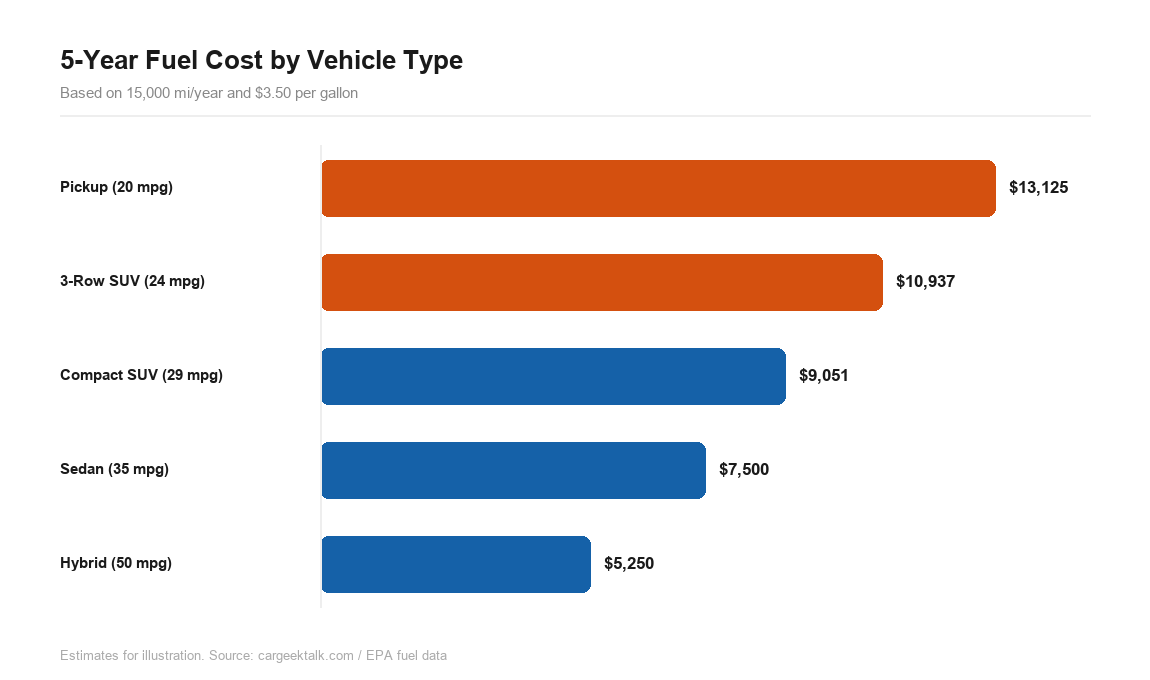
Five-year fuel cost by vehicle type at 15,000 miles a year and $3.50/gallon.
Tech and Infotainment
Here’s an unpopular opinion: most cars now have more screen than you need. Apple CarPlay and Android Auto are the only features I’d insist on, because they let you ignore the clunky factory software entirely. Wireless CarPlay is the genuine upgrade. Everything else — gesture controls, 14-speaker audio, ambient lighting — is nice, not necessary.
Resale Value
Resale value quietly determines whether your car was a smart buy. Two cars can cost the same new and differ by $8,000 in value after five years. Toyota and Honda historically hold value best; certain luxury sedans and EVs depreciate as a stone dropped in a lake.
If you upgrade every few years, resale matters enormously. If you drive cars into the ground, it matters less. Either way, check a vehicle’s history and ownership records — a clean report from CARFAX vehicle history reports protects you from buying someone else’s flood-damaged mistake.
Brand Reputation
Reputation isn’t snobbery — it’s a shortcut for predicting repair costs and reliability. A well-regarded brand usually means fewer surprises and easier resale. The flip side: some prestige brands cost a fortune to maintain. Curious how the numbers stack up? Our breakdown of average car repair costs by brand shows exactly which badges punish your wallet.
Which Car For Me: Comparing the Main Body Styles
Sometimes you just need the options side by side. Here’s how the major categories stack up on the things that actually matter.
| Body Style | Best For | Avg. MPG | 5-Yr Resale | Running Cost |
|---|---|---|---|---|
| Compact Sedan | Commuters, first cars | 32–40 | Good | Low |
| Hybrid | High-mileage drivers | 45–55 | Strong | Very Low |
| Compact SUV | Small families, mixed use | 26–32 | Strong | Medium |
| 3-Row SUV / Minivan | Big families, hauling | 20–27 | Medium | Higher |
| EV | Home chargers, city drivers | 100+ MPGe | Varies | Low fuel, high depreciation |
| Pickup Truck | Towing, trades, hauling | 18–24 | Strong | High |
Maintenance and Ownership Costs Over Time

A cheaper sticker price can hide a more expensive ownership story.
The purchase price is one payment. Maintenance is forever.
Some cars are cheap to buy and cheap to keep. Others lure you with a low price, then demand $1,200 brake jobs and $400 oil services. German luxury cars are notorious for this — a used BMW 5 Series might cost $22,000, but budget another $2,500+ a year once the warranty lapses. A comparable Lexus ES will cost half that to maintain and bore you in the best possible way.
According to AAA’s annual driving cost research, the average new vehicle costs over $12,000 a year to own when you fold in depreciation, fuel, insurance, and maintenance. You can read their full breakdown in the AAA new car ownership cost study. Sobering numbers, and exactly why ownership cost belongs near the top of your list, not the bottom.
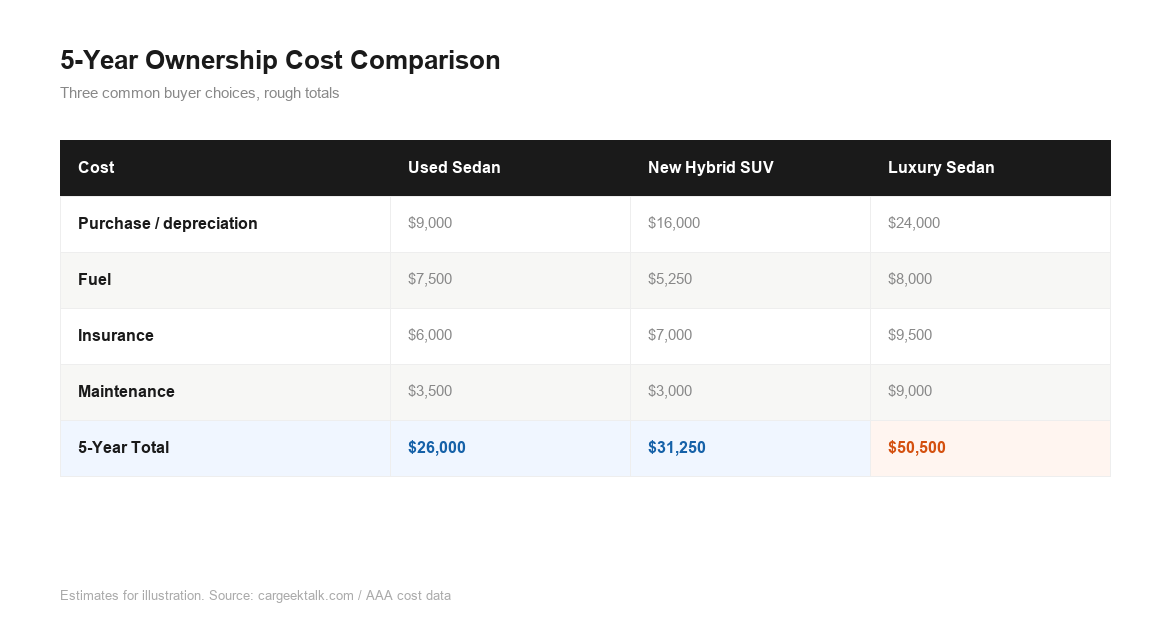
Five-year ownership cost comparison across three common buyer choices.
Test Drives, Inspections, and Personal Preference

No spec sheet replaces sitting in the seat and driving the thing.
Research narrows the field. The test drive decides it.
Drive every shortlisted car back to back on the same day if you can. Pay attention to seat comfort, visibility, how the controls fall to hand, and road noise at highway speed. A car that looks perfect on paper can feel wrong the moment you sit in it. Happened to me with a Mazda I was sure I’d love — the seating position just never clicked.
Buying used? Get a pre-purchase inspection, no exceptions. Our guide on how to inspect used cars walks you through what to check before you hand over a deposit.
And don’t dismiss personal preference. Color, interior feel, the badge — it’s your money, and you’ll look at this thing in the driveway every day. Just make sure preference is the tiebreaker, not the deciding factor.
Putting It All Together
So you’ve weighed these nine key factors: budget, lifestyle, fuel, safety, tech, resale, reputation, and running costs. Now stack-rank them for YOUR situation. A new parent ranks safety and space first. A solo commuter on a budget ranks fuel and reliability. There’s no universal right answer — there’s only the right answer for you.
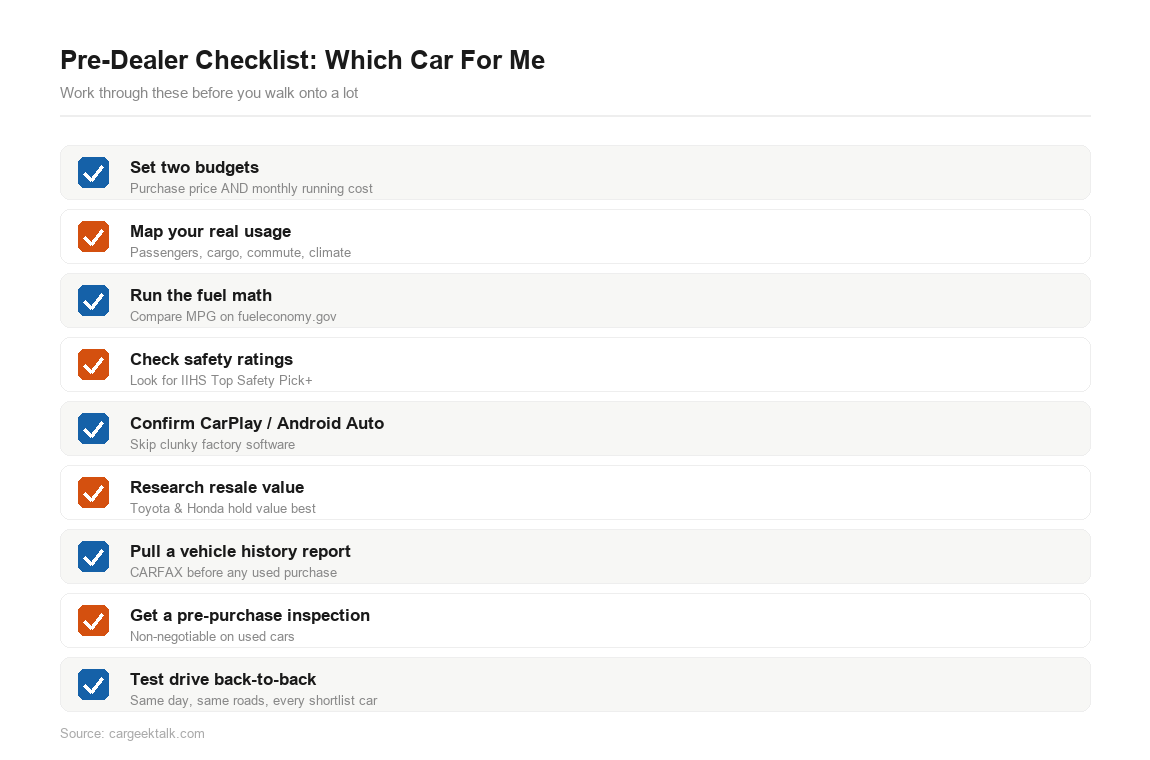
Work through this checklist before you set foot on a dealer lot.
Take your time, do the math, drive everything, and trust the numbers over the salesperson. Get those right and you’ll buy a car you’re still happy with five years from now — instead of one you’re already trying to sell.
Frequently Asked Questions
How do I decide which car is right for me on a budget?
Start with total cost of ownership, not just the sticker price. Keep your combined payment, insurance, and fuel under about 15% of your take-home pay. Reliable used cars from Toyota, Honda, or Mazda give you the most value per dollar on a tight budget.
Is a hybrid worth it when choosing which car for me?
If you drive 12,000+ miles a year, almost certainly yes. A 45-mpg hybrid can save around $900 a year versus a 25-mpg crossover, which adds up to roughly $4,700 over five years. Low-mileage drivers see a smaller payback.
SUV or sedan — which should I pick?
Choose based on how you actually use the car. Sedans cost less to buy and run and handle better; SUVs offer more cargo space, higher seating, and easier child-seat access. If you rarely carry more than two people, a sedan or hybrid usually makes more sense.
How important is resale value when buying a car?
Very important if you trade cars every few years — the difference can be $8,000 over five years between two similarly priced cars. Toyota and Honda hold their value best, while many luxury sedans and EVs depreciate quickly.
Should I buy new or used?
Used cars two to four years old offer the best value because someone else absorbed the steepest depreciation. Always get a pre-purchase inspection and a vehicle history report. New makes sense if you want the latest safety tech and a full warranty.