
Why Does My Car Overheat? The Brutal Truth
You glance down at the temperature gauge, and something’s wrong. The needle is climbing. Then comes that unmistakable sweetish smell from the vents, and suddenly you’re asking the one question nobody wants to be asking on the side of a highway: Why does my car overheat? The short answer is that your engine is either producing more heat than the cooling system can handle, losing its ability to shed that heat, or both at the same time. The longer — and more important — answer is that the cause determines whether you’re looking at a $90 thermostat or a $2,500 head gasket job.
In my experience, most drivers make one of two mistakes: they either panic and assume the worst, or they top off the coolant and hope the problem goes away. Neither response is useful without understanding what the cooling system is actually telling you. The symptoms matter — and they’re more specific than most people realize.
Contents
- Why Does My Car Overheat — The Basic Physics
- 9 Reasons Why Your Car Overheats (From Cheap to Catastrophic)
- What Your Symptoms Actually Mean
- Why Does My Car Overheat Even After I Added Coolant?
- Car Overheat Repair Costs: What to Budget
- What to Do When Your Car Overheats Right Now
- Vehicles More Prone to Overheating (And Why)
- How to Prevent the Next Overheat
- The Real Answer to “Why Does My Car Overheat”
- Frequently Asked Questions
Why Does My Car Overheat — The Basic Physics
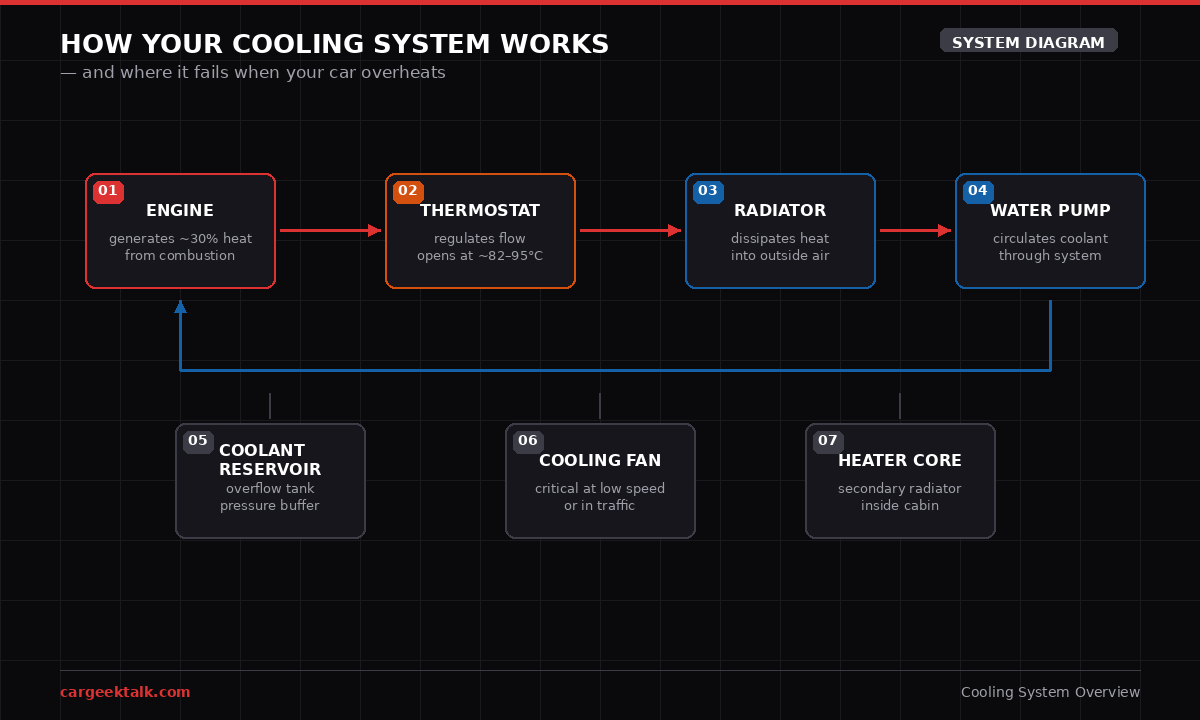
A modern gasoline engine converts only about 25–30% of its fuel energy into motion. The rest becomes heat — and a lot of it. The cooling system’s job is to absorb that heat from the engine block and cylinder head, circulate it through the radiator where air strips it away, and keep coolant temperatures in the 88–104°C range where the engine operates efficiently.
That system depends on five things working in sync: coolant level, thermostat operation, water pump flow, radiator capacity, and fan airflow. Remove any one of those, and temperatures spike. What makes diagnosing why my car overheats tricky is that the same symptom — a rising temperature gauge — can come from completely different parts of the chain.
The pattern of overheating is your first real clue. A car that overheats sitting in traffic but runs fine on the highway almost always has an airflow or fan problem. A car that overheats at highway speed but stays cool at idle typically has a coolant or circulation issue. Pay attention to when and where it happens — that’s diagnostic information before you even open the hood.
9 Reasons Why Your Car Overheats (From Cheap to Catastrophic)
1. Low Coolant Level
The most common answer to why does my car overheat is also the most overlooked: there simply isn’t enough coolant in the system. Low coolant means the fluid can’t absorb and carry heat efficiently — hot spots develop around the combustion chambers, and temperatures climb fast.
The critical thing to understand is that coolant doesn’t just evaporate. If your level keeps dropping, the system has a leak somewhere: a cracked hose, a weeping radiator, a failing water pump seal, a leaking heater core, or — worst case — a compromised head gasket letting coolant into the combustion chamber. A top-off might stop the warning light today, but if the coolant level keeps dropping, you need to find the source before it gets expensive.
2. Stuck or Failing Thermostat
The thermostat is a temperature-controlled valve. When the engine is cold, it stays closed so the engine warms up quickly. Once the coolant hits roughly 82–95°C, depending on the vehicle, it opens and allows flow through the radiator. If it sticks in the closed position, hot coolant stays trapped inside the engine. Temperatures spike, often suddenly and dramatically.
A thermostat typically costs $15–$50 for the part. Labor adds another $60–$150, depending on access. Total job: under $220 in most cases. Ignore it, and you’re risking warped aluminum cylinder heads — a repair that starts at $800 and goes up from there. This is one of the highest-ROI repairs in automotive maintenance.
3. Cooling Fan Failure
At highway speed, air rams through the radiator naturally. At idle or in slow traffic, that airflow disappears — and the electric or mechanical fan has to take over. If the fan isn’t working, the radiator can’t transfer heat when you need it most.
The failure point isn’t always the fan motor itself. It can be the relay, a blown fuse, the fan temperature sensor (which tells the fan when to kick on), or corroded wiring. What most buyers miss is that a car can have a fully functioning fan that still overheats in traffic because the radiator fins are so clogged or bent that airflow is inadequate, regardless of fan speed. Both issues cause the same symptom: fine on the highway, hot at idle.
4. Water Pump Failure
The water pump is the heart of the cooling system — literally a centrifugal pump driven by either the serpentine belt or timing belt, circulating coolant continuously through the engine and radiator. When it fails, circulation slows or stops entirely, and the engine overheats quickly.
Water pumps fail in two ways. They leak — usually from the weep hole when the shaft seal goes — or the impeller (the internal spinning vane) wears or breaks, so the pump spins but moves little or no coolant. The second type is particularly nasty because there’s no visible leak to tip you off. According to the NHTSA recall, water pump failures linked to timing belt-driven designs have triggered recalls on multiple platforms because there’s zero warning before complete failure.
If your timing belt is due and your water pump is driven by it, replace both at the same time. The labor overlap makes it one of the most cost-efficient decisions in car ownership.
5. Clogged or Damaged Radiator
The radiator dissipates heat by running coolant through a network of thin tubes surrounded by fins. If those passages clog internally (from old coolant, scale, or corrosion) or the external fins are bent and blocking airflow, the radiator’s heat transfer capacity drops significantly — even though it looks fine from the outside.
Old coolant is a major contributor. Coolant that’s never been changed loses its corrosion inhibitors, and rust or scale builds up inside the passages. This is one reason coolant service intervals exist: it’s not just the fluid that’s degrading, it’s the protection it provides to the entire metal cooling system.
6. Leaking or Burst Radiator Hose
Radiator hoses are under real pressure — typically 15–18 psi — and they run at temperatures that degrade rubber over time. A hose that looks fine on the outside can be soft, mushy, or cracked on the inside. When it goes, it often goes suddenly: you lose coolant fast, and the engine overheats within minutes.
Inspect hoses by feel as much as by sight. They should be firm but slightly pliable. If they feel rock-hard (heat-hardened) or collapse easily when squeezed (internally degraded), they’re overdue. On any car over 100,000 miles with original hoses, replacing them during a coolant service costs relatively little and eliminates a significant roadside risk.
7. Pressure Cap Failure
This one surprises people. The radiator cap or coolant reservoir cap isn’t just a lid — it’s a pressure valve that maintains system pressure at 15–18 psi. Higher pressure raises the boiling point of coolant, which is exactly what you want. If the cap fails and can’t hold pressure, the coolant boils at a lower temperature, and you get localized steam pockets and heat spikes even though the coolant level is technically fine.
A pressure cap costs $10–$20 and can be tested with a simple pressure gauge tool at most shops. It’s one of the first things worth checking if overheating is intermittent and otherwise unexplained.
8. Air in the Cooling System
Coolant systems need to be bled properly — air pockets are a surprisingly common cause of overheating after repairs. Air compresses; coolant doesn’t. An air pocket trapped near a temperature sensor gives a false reading. One trapped near the cylinder head means that area gets no cooling at all, even though the rest of the system works fine.
If your car overheated recently and was then “fixed,” but the problem keeps coming back, air in the system is worth checking — especially if the heater is blowing lukewarm air when it should be hot. That’s a classic sign coolant isn’t circulating fully through the heater core.
9. Blown Head Gasket
This is the one people fear, and for good reason. The head gasket seals the combustion chamber from the coolant and oil passages in the engine block and cylinder head. When it fails, combustion gases can enter the cooling system (causing pressure spikes, coolant loss, and bubbles in the reservoir) or coolant can enter the combustion chamber (causing white smoke from the exhaust) or the oil passages (causing that infamous milky, coffee-colored oil).
What makes head gaskets particularly brutal is the causality loop: overheating causes head gasket failures, and head gasket failures cause overheating. A car that overheats once might be fine. A car that overheats repeatedly is developing hot-spot damage in the aluminum cylinder head that will eventually compromise the gasket — often quietly, until the symptoms become obvious and expensive.
What Your Symptoms Actually Mean
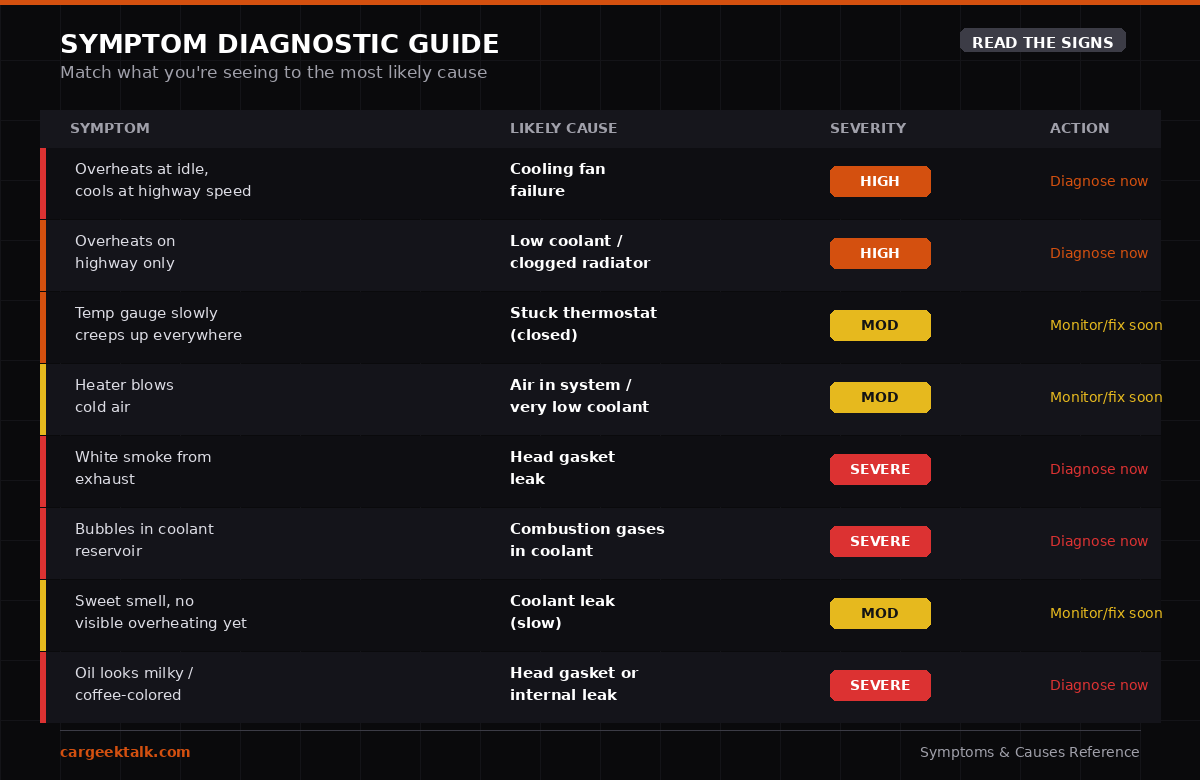
Two cars can both answer “yes” to why does my car overheat and need completely different repairs. The details tell the story.
| Symptom You’re Seeing | Likely Cause | Urgency |
|---|---|---|
| Hot at idle, fine on highway | Cooling fan or relay failure | Fix immediately |
| Hot at highway speed | Low coolant, clogged radiator, weak pump | Fix immediately |
| Heater blowing cold air | Very low coolant or air in the system | Diagnose today |
| Steam from under the hood | Coolant boil-over or burst hose | Stop driving NOW |
| Bubbles in the reservoir | Head gasket leak or trapped air | Stop driving NOW |
| White smoke from the exhaust | Coolant entering the combustion chamber | Tow it — head gasket |
| Sweet smell inside the cabin | Heater core or hose leak | Diagnose this week |
| Milky or coffee-colored oil | Coolant in oil — internal gasket leak | Stop driving NOW |
If you’re seeing more than one of those symptoms simultaneously — especially coolant loss plus white exhaust smoke plus a rising gauge — the likelihood of a deeper engine issue is high. At that point, the most expensive thing you can do is keep driving.
Why Does My Car Overheat Even After I Added Coolant?
This is one of the most common and frustrating situations. You add coolant, the gauge drops, you drive away — and a day later the same thing happens. Adding coolant addresses the symptom but not the cause. Here’s why it keeps coming back:
- The leak is still there. Whether it’s a hose, radiator, water pump, or head gasket, if fluid can leave the system, the level will drop again.
- The thermostat is stuck. Coolant circulates correctly only up to the thermostat. With the correct amount of fluid in a broken circulation loop, you still overheat.
- The fan isn’t running. More coolant doesn’t compensate for a radiator that can’t shed heat because there’s no airflow in traffic.
- Combustion gases are pressurizing the system. A compromised head gasket pushes exhaust gases into the coolant passages, which forces fluid out of the reservoir. You can add coolant indefinitely, and the level will keep dropping until you fix the gasket.
The right move after a top-off is to find and fix the source — not to see how long the top-off lasts.
Car Overheat Repair Costs: What to Budget
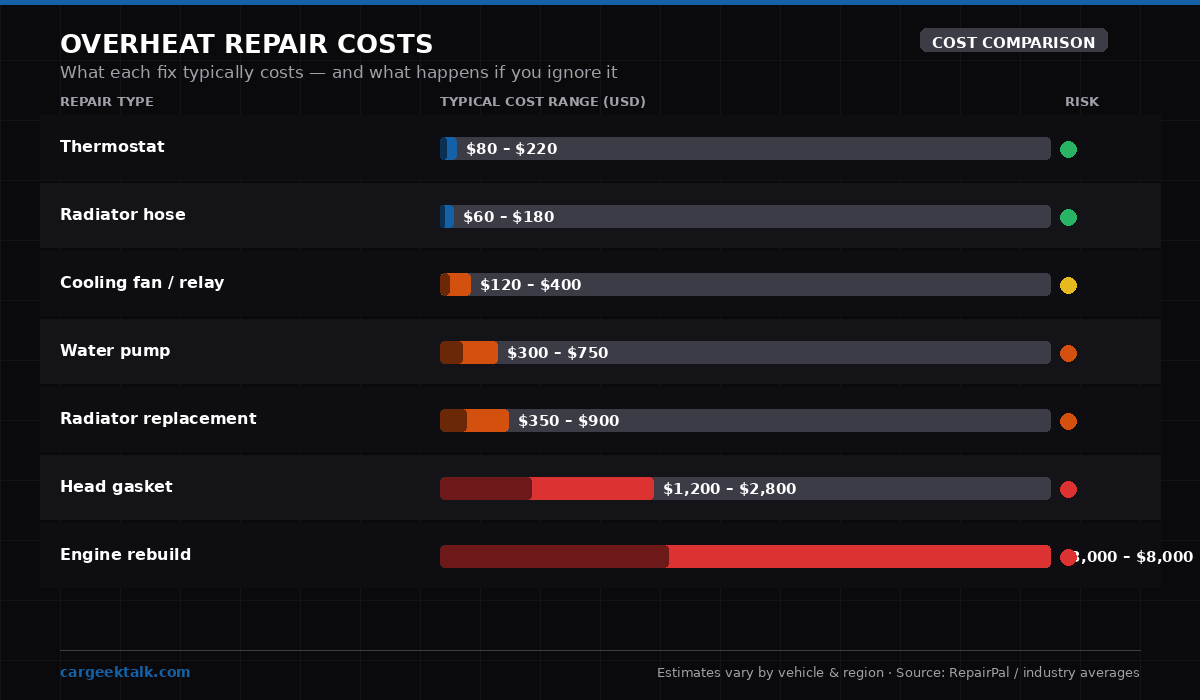
Cost estimates vary by vehicle, region, and shop, but these ranges give you a realistic frame for conversations with mechanics.
| Repair | Typical Cost (Parts + Labor) | Risk If Ignored |
|---|---|---|
| Pressure cap replacement | $15–$40 | Low — but causes intermittent overheating |
| Thermostat replacement | $80–$220 | Moderate — warped head if ignored |
| Radiator hose replacement | $60–$180 | Moderate — sudden total coolant loss |
| Cooling fan / relay | $120–$400 | High — constant overheating in traffic |
| Water pump | $300–$750 | High — rapid overheating, no warning |
| Radiator replacement | $350–$900 | High — progressive heat transfer loss |
| Head gasket replacement | $1,200–$2,800 | Severe — engine contamination, rebuild risk |
| Engine rebuild / replacement | $3,000–$8,000+ | End result of ignoring overheating |
The math on early diagnosis is brutal and obvious. A $150 thermostat fix becomes a $2,500 head gasket job. That job ignored becomes an engine that costs more than the car is worth. Most overheating stories that end badly aren’t about bad luck — they’re about delaying the inevitable. You can find more context on brand-specific repair costs in our average car repair costs by brand guide.
What to Do When Your Car Overheats Right Now
The moment the gauge climbs into the danger zone, every decision matters.
- Turn off the AC immediately. The AC compressor adds load to the engine and reduces radiator cooling capacity. Cutting it buys you time.
- Turn the cabin heater to max heat, max fan. The heater core is a small secondary radiator — running it at full blast can draw a surprising amount of heat away from the engine. It’s uncomfortable, but it works.
- Get out of traffic. If you’re in stop-and-go, find a way to exit or pull to the shoulder. Moving air through the radiator helps enormously.
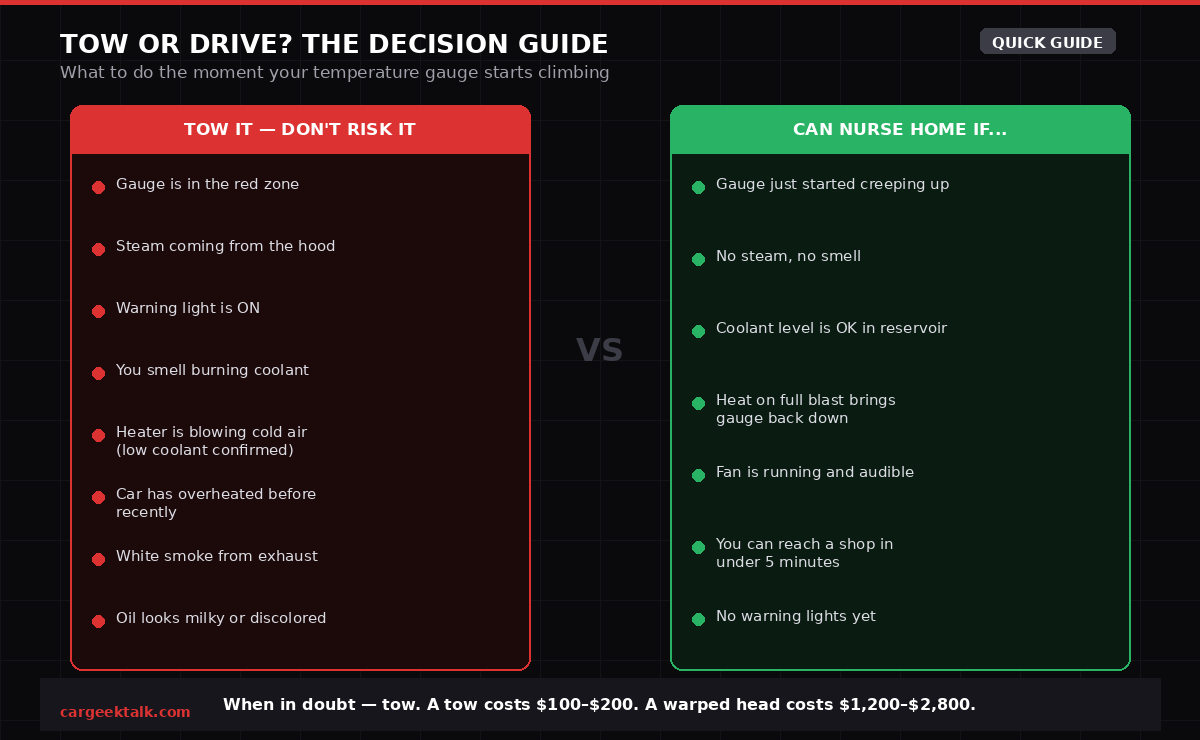
- If the gauge hits the red — stop. Turn off the engine. Don’t open the radiator cap. Don’t add cold water to a hot engine.
- Wait 30–45 minutes before touching anything. A pressurized hot cooling system opened prematurely can spray boiling coolant.
- After cooling, check the reservoir level. If it’s bone dry, don’t drive it anywhere. Call for a tow.
The tow bill — typically $100–$200 — is almost always cheaper than testing how far you can limp a car that’s already in the red. AAA roadside data consistently shows that overheating-related engine damage from continued driving is one of the most preventable and costly outcomes in vehicle ownership.
Vehicles More Prone to Overheating (And Why)
Some platforms are more forgiving than others. Turbocharged engines run higher exhaust and coolant temperatures by design — anything compromising the cooling system pushes them over the edge faster. The 2012–2016 Ford Focus and 2013–2016 Escape with the 1.6L EcoBoost had documented overheating issues tied to coolant loss through the head gasket, ultimately addressed through a recall. The 2008–2013 BMW N54 and N55 six-cylinders are notorious for cooling system component failures — water pumps, thermostats, and expansion tanks all have known service lives well under 100,000 miles.
Older vehicles with original hoses, original radiators, and coolant that’s never been changed are also walking a line. The components are worn, the coolant’s corrosion inhibitors are depleted, and there’s little margin when one part starts to slip. If you’re inspecting a used car, the cooling system condition — hose feel, coolant color, reservoir contamination, any sign of prior overheating — tells you more about the car’s real maintenance history than the service records.
How to Prevent the Next Overheat
Cooling system maintenance isn’t exciting, but the cost of neglecting it is. These habits eliminate most overheating scenarios before they happen:
- Flush and replace coolant on schedule. Most manufacturers specify every 3–5 years or 50,000–100,000 miles. Old coolant is acidic, depleted of inhibitors, and actively corroding your system from the inside.
- Check hose condition annually. Squeeze them, feel for softness or hardness. Look for cracks, seeping residue around clamps, or swelling near hose ends.
- Watch the temp gauge as a habit. A gauge that runs slightly higher than it used to is telling you something before it becomes a problem.
- Don’t ignore small leaks. A weeping hose or a dripping water pump seal is a time bomb. Fix it when it’s small.
- Combine water pump and timing belt service. If your engine has a timing belt-driven water pump (many Hondas, Toyotas, Subarus, VWs), replace both together. The pump is 20–30% of the total job cost when done alongside the belt.
- Keep the radiator fins clean. A pressure rinse from the engine side annually — pushing debris out the front rather than deeper in — maintains airflow capacity.
If you want more detail on the underlying cost picture for your specific make, our breakdown of repair costs by brand puts cooling system work in context alongside everything else that wears out.
The Real Answer to “Why Does My Car Overheat”
Heat kills engines quietly, then loudly. A car that overheats once and gets ignored is a car that’s learning to fail permanently. The question of why my car overheats deserves a real answer — not a top-off and a hope. The truth is, the cooling system is telling you something specific. Your job is to read the pattern, match it to the likely cause, and act before the $150 problem becomes a $2,500 one.
Diagnosis costs money. Guessing costs more. A cooling system pressure test at most shops runs $50–$80 and will find leaks the naked eye misses. A combustion leak test — using a chemical dye that reacts to exhaust gases in coolant — will confirm or rule out a head gasket issue in under an hour. These are money well spent before authorizing any major cooling system repair.
Frequently Asked Questions
Why does my car overheat only in traffic and not on the highway?
This pattern almost always points to a cooling fan problem. At highway speed, air moves through the radiator naturally and keeps coolant temperatures down. In slow traffic or at idle, the car depends on the electric fan to pull air through the radiator. If the fan motor, relay, fuse, or temperature sensor has failed, the radiator can’t shed heat and the engine overheats. The fix ranges from a $15 relay to a $300–$400 fan assembly, depending on what failed.
Can I drive my car if it’s overheating?
If the temperature gauge is entering the red zone or a warning light has come on, you should stop as soon as it’s safe to do so and turn off the engine. Continuing to drive an overheating car risks warping the aluminum cylinder head, blowing the head gasket, or seizing the engine entirely — any of which turns a manageable repair into a potentially total loss. If the gauge is only slightly elevated and there’s no steam, no warning light, and no smell, you may be able to nurse the car to a nearby shop — but towing is always the safer choice.
Why does my car overheat after I added coolant?
Adding coolant fixes the symptom temporarily but not the cause. If the cooling system leaks, the level will drop again. If the thermostat is stuck, the correct amount of coolant still won’t circulate properly. If the head gasket is compromised, combustion gases will continue to pressurize the system and push coolant out of the reservoir. Adding fluid is a temporary measure that buys you time to find and fix the actual problem — not a repair in itself.
How much does it cost to fix a car that overheats?
It depends entirely on the cause. Simple fixes like a thermostat ($80–$220), pressure cap ($15–$40), or cooling fan relay ($30–$80) are inexpensive. A water pump runs $300–$750 with labor. A full head gasket replacement typically costs $1,200–$2,800. If the engine has been driven hot for an extended period and sustained serious damage, an engine rebuild or replacement can run $3,000–$8,000 or more. This is why early diagnosis is so important — the cost gap between catching it early and ignoring it is enormous.
What are the first signs my car is about to overheat?
Early warning signs include the temperature gauge running slightly higher than its normal position, the heater suddenly blowing cooler air than it used to, a faint sweet smell inside the cabin (indicating a small coolant leak), or the coolant level in the reservoir dropping over time without any visible puddles. Any of these signals is a problem worth investigating before the gauge climbs into the danger zone.
Will a bad water pump always leak?
Not always. Water pumps typically fail in one of two ways: the shaft seal fails and the pump leaks from the weep hole (visible), or the internal impeller wears out or breaks, so the pump spins but doesn’t circulate coolant properly (no visible leak). The second type is particularly difficult to catch because there’s no puddle, no dripping — just an engine that overheats and a pump that appears to be working. A coolant flow test or removal and inspection is the only way to confirm a bad impeller.
Can low oil cause a car to overheat?
Yes, indirectly. Engine oil isn’t just a lubricant — it carries heat away from internal components that coolant can’t reach, including the pistons, valve stems, and upper cylinder walls. When oil is very low or severely degraded, the engine runs hotter internally, which adds load to the cooling system. In extreme cases, low oil can contribute to overheating on its own. More commonly, low oil and overheating appear together because both indicate the same thing: a car that hasn’t been properly maintained.
Helpful independent resources: RepairPal · NHTSA · your vehicle's owner's manual